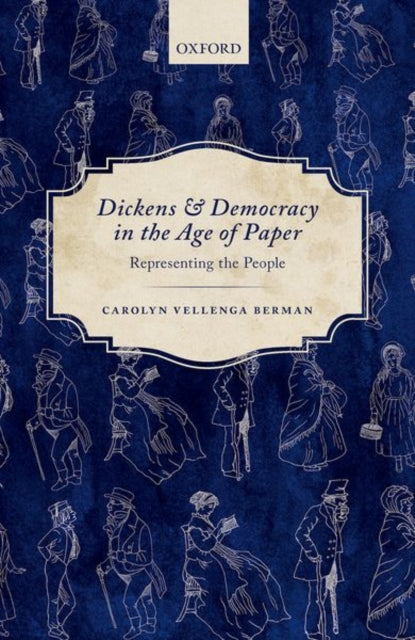
Carolyn VellengaBerman
Dickens and Democracy in the Age of Paper: Representing the People
Dickens and Democracy in the Age of Paper: Representing the People
💎 Earn 650 Points (£6.50) on this item.
We can order this item for you. Delivery usually takes about 4 to 6 weeks.
This item is not held in our immediate stock. We will order it for you after checkout.
Estimated delivery: About 4 to 6 weeks
- Condition: Brand new
- UK Delivery times: Usually arrives within 2 - 3 working days
- UK Shipping: Fee starts at £3.89. Subject to product weight & dimension
Bulk ordering. Want 15 or more copies? Get a personalised quote and bigger discounts. Learn more about bulk orders.
Couldn't load pickup availability
- More about Dickens and Democracy in the Age of Paper: Representing the People
This book explores how Charles Dickens' fiction competes with Parliament's publications to represent the People during a pivotal period in the history of representative democracy. It argues that Dickens' novels mock parliamentary form, canvass the history of parliamentary representation, and depict the relationship between the People and the state.
Format: Hardback
Length: 368 pages
Publication date: 17 February 2022
Publisher: Oxford University Press
This book delves into the intricate relationship between Charles Dickens' fiction and publications originating from Parliament, exploring a pivotal period in the history of representative democracy. During this time, the British government faced immense political pressure to expand the franchise beyond a limited group of male landowners. The book argues that Dickens and Parliament engaged in a fierce competition to accurately represent the People. It suggests that fiction and parliamentary literature coexisted in the same bookshops, engaging in a dynamic interplay. By closely reading Dickens' novels alongside blue books, which were practice texts for shorthand manuals, and his journalism, the book reveals how his fiction critiqued parliamentary forms, explored the history of parliamentary representation, and portrayed the complex relationship between the People and the state, as well as commerce. Through this comprehensive analysis, the book offers a fresh perspective on the history of the Victorian novel by examining its rivalry with Parliament in the expanding world of print publication.
Introduction:
In the mid-19th century, Britain experienced a significant shift in political and social dynamics. The Industrial Revolution had transformed the country, leading to urbanization, industrialization, and the rise of a new middle class. At the same time, the British government faced mounting pressure to expand the franchise beyond a narrow band of male landowners. This demand for greater democratic representation echoed the broader social and political movements of the time, such as the Chartist movement and the campaign for women's suffrage.
Charles Dickens and Parliamentary Publications:
Charles Dickens was a prominent figure in the Victorian era, known for his literary prowess and his ability to capture the essence of British society. His novels, such as "A Christmas Carol," "David Copperfield," and "Great Expectations," were widely read and celebrated for their portrayal of the lives of ordinary people and their struggles against social and economic inequality. Dickens was also a keen observer of parliamentary politics and a vocal critic of the government's policies.
The Rivalry between Fiction and Parliament:
The book argues that Dickens and Parliament were engaged in a competitive effort to represent the People at a crucial moment in the history of representative democracy. While Dickens' fiction offered a powerful critique of parliamentary forms and practices, parliamentary publications provided a more official and authoritative account of parliamentary proceedings. The two forms of literature interacted at a host of levels, jostling one another in the same bookshops and shaping public perception of politics and government.
Interactions between Fiction and Parliamentary Literature:
The book explores how Dickens' fiction and parliamentary literature interacted at various levels. It shows how his novels critiqued parliamentary forms, such as the use of committees and the conduct of debates. For example, in "Pickwick Papers," Dickens satirized the use of committees as a means of delaying legislation and the tendency of politicians to prioritize their interests over the needs of the People.
At the same time, parliamentary publications provided a more detailed account of parliamentary proceedings and the debates that took place. Blue books, for instance, were practice texts for shorthand manuals, and they were used by politicians and journalists to record the speeches and actions of parliamentarians. These books were often published in conjunction with parliamentary debates and provided a valuable resource for those interested in understanding the workings of the government.
Dickens' Journalism:
In addition to his fiction, Dickens was a prolific journalist and a vocal critic of the government's policies. His articles and essays were published in various newspapers and magazines, and they provided a platform for him to express his views on political and social issues. The book argues that Dickens' journalism was closely linked to his fiction and that his observations and criticisms of parliamentary politics were often reflected in his novels.
Conclusion:
In conclusion, this book offers a fresh perspective on the history of the Victorian novel by examining its rivalry with Parliament in the expanding world of print publication. It demonstrates how Dickens and Parliament engaged in a competitive effort to represent the People and how fiction and parliamentary literature interacted at various levels. By reading Dickens' novels in tandem with parliamentary publications, the book reveals how his fiction mocked parliamentary form, canvassed the history of parliamentary representation, and depicted the complex relationship between the People and the state, as well as commerce. This analysis provides valuable insights into the role of literature in shaping public perception of politics and government and into the complex dynamics of power and representation in the Victorian era.
Weight: 668g
Dimension: 240 x 160 x 25 (mm)
ISBN-13: 9780192845405
UK and International shipping information
UK and International shipping information
We deliver throughout the United Kingdom and to 128 countries and territories worldwide, including the United States, Australia, Canada, Germany, Spain and France.