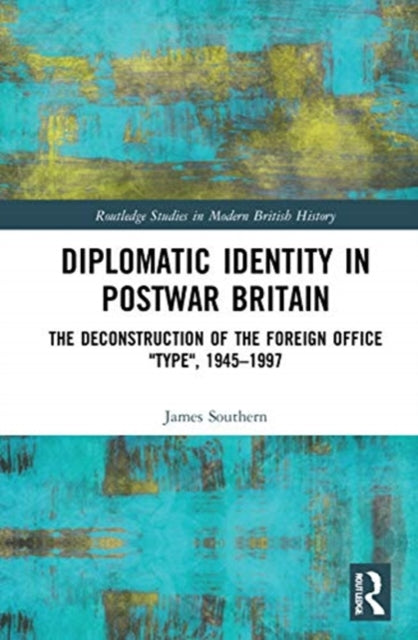
JamesSouthern
Diplomatic Identity in Postwar Britain: The Deconstruction of the Foreign Office "Type", 1945-1997
Diplomatic Identity in Postwar Britain: The Deconstruction of the Foreign Office "Type", 1945-1997
💎 Earn 811 Points (£8.11) on this item.
We can order this item for you. Delivery usually takes about 4 to 6 weeks.
This item is not held in our immediate stock. We will order it for you after checkout.
Estimated delivery: About 4 to 6 weeks
YOU SAVE £9.63
- Condition: Brand new
- UK Delivery times: Usually arrives within 2 - 3 working days
- UK Shipping: Fee starts at £2.39. Subject to product weight & dimension
Bulk ordering. Want 15 or more copies? Get a personalised quote and bigger discounts. Learn more about bulk orders.
Couldn't load pickup availability
- More about Diplomatic Identity in Postwar Britain: The Deconstruction of the Foreign Office "Type", 1945-1997
This book explores how the Foreign Office adapted to the rise of identity politics in Britain during the Cold War and the end of the British Empire by recruiting candidates from different backgrounds and considering the impact of cultural changes on diplomatic archetypes. It challenges the idea of fixed talent, merit, equality, and representation and argues that these concepts were subject to political and cultural renegotiation and revision.
\n Format: Hardback
\n Length: 236 pages
\n Publication date: 10 May 2021
\n Publisher: Taylor & Francis Ltd
\n
This book delves into the intricate ways in which the Foreign Office adapted to the emergence of identity politics in Britain during the Cold War and the twilight of the British Empire. Following the Second World War, significant cultural shifts in British society prompted a reevaluation of traditional diplomatic archetypes, as the exclusive recruitment of white, heterosexual, upper- or middle-class men gradually became less socially acceptable and less politically advantageous. As the tripartite school system and mass university education gained prominence, the Foreign Office faced the challenge of attracting qualified candidates who had not received their education in the esteemed public schools and Oxbridge. Moreover, the passage of the 1948 Nationality Act opened the door for nonwhites to join the Foreign Office. However, the rise of the gay rights movement and the postwar women's liberation movements presented the Foreign Office with distinct and complex dilemmas in their recruitment efforts.
Diplomatic Identity in Postwar Britain challenges the notion of talent, merit, equality, and representation as fixed and uncontested concepts. Instead, it argues that these ideas were subject to political and cultural renegotiation and revision throughout the period under examination. The book explores the ways in which the Foreign Office navigated these challenges and attempted to redefine its recruitment policies to reflect the changing social and political landscape of postwar Britain.
One of the key themes of the book is the impact of cultural changes on diplomatic practices. As British society became more diverse and inclusive, the Foreign Office had to adapt its policies to accommodate a broader range of candidates. This led to the recruitment of individuals from different backgrounds, including women, nonwhites, and members of the LGBTQ+ community. However, the book also highlights the complexities and challenges associated with these efforts, such as resistance from traditionalist factions within the Foreign Office and the need to balance diversity with the need for expertise and experience.
Another important aspect of the book is the role of gender in diplomatic identity. The rise of women's liberation movements and the increasing participation of women in the workforce challenged traditional gender roles and stereotypes in the Foreign Office. The book explores the ways in which the Foreign Office responded to these changes, both by promoting women to senior positions and by addressing issues such as gender-based discrimination and harassment.
Furthermore, the book examines the impact of identity politics on British foreign policy during the Cold War and the end of the British Empire. The Foreign Office had to navigate a complex web of international relations, including the Cold War rivalry between the United States and the Soviet Union, the decolonization of Africa and Asia, and the emergence of new political movements and ideologies. The book explores how the Foreign Office responded to these challenges, both by adapting its policies to align with the interests of emerging nations and by engaging with political movements and ideologies that challenged the established order.
In conclusion, Diplomatic Identity in Postwar Britain is a valuable contribution to the study of diplomacy and international relations. By exploring the complex ways in which the Foreign Office adapted to the rise of identity politics in Britain, the book provides a fresh perspective on the history of diplomacy and sheds light on the ongoing challenges and opportunities facing the field today.
\n Weight: 496g\n
Dimension: 158 x 236 x 20 (mm)\n
ISBN-13: 9780367458478\n \n
UK and International shipping information
UK and International shipping information
UK Delivery and returns information:
- Delivery within 2 - 3 days when ordering in the UK.
- Shipping fee for UK customers from £2.39. Fully tracked shipping service available.
- Returns policy: Return within 30 days of receipt for full refund.
International deliveries:
Shulph Ink now ships to Australia, Belgium, Canada, France, Germany, Ireland, Italy, India, Luxembourg Saudi Arabia, Singapore, Spain, Netherlands, New Zealand, United Arab Emirates, United States of America.
- Delivery times: within 5 - 10 days for international orders.
- Shipping fee: charges vary for overseas orders. Only tracked services are available for most international orders. Some countries have untracked shipping options.
- Customs charges: If ordering to addresses outside the United Kingdom, you may or may not incur additional customs and duties fees during local delivery.