Eduard Altarriba
Discovering Architecture
Discovering Architecture
💎 Earn 45 Points (£0.45) on this item.
YOU SAVE £3.80
- Condition: Brand new
- UK Delivery times: Usually arrives within 2 - 3 working days
- UK Shipping: Fee starts at £2.39. Subject to product weight & dimension
Bulk ordering. Want 15 or more copies? Get a personalised quote and bigger discounts. Learn more about bulk orders.
Couldn't load pickup availability
- More about Discovering Architecture
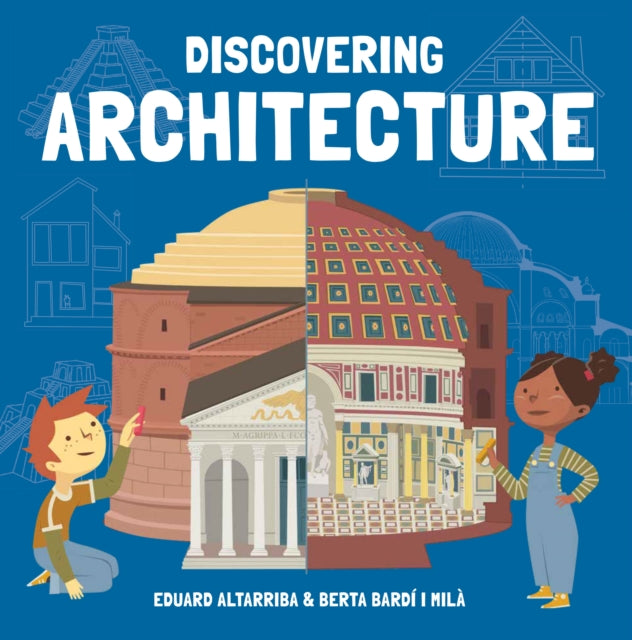
This illustrated guide to architecture around the world explores iconic buildings and the people who created them, from ancient mud huts to modern towers. It also covers the development of different building materials and techniques.
\n Format: Hardback
\n Length: 48 pages
\n Publication date: 07 April 2019
\n Publisher: Button Books
\n
Who built the first houses?
The first houses were built by early human societies, which emerged around 2 million years ago. These early houses were simple structures made of natural materials such as mud, straw, and wood. Over time, these structures evolved into more complex forms, including the construction of mud bricks, stone walls, and timber frames.
What is the difference between an arch and an architrave?
An arch is a curved structure that supports weight from above, while an architrave is a flat, decorative element that sits on top of an arch. Arches are commonly used in architectural design to create decorative features, while architraves are used to add visual interest and detail to buildings.
How does a dome stay up?
A dome is a large, spherical structure that is supported by a network of arches, columns, and beams. The weight of the dome is distributed evenly across the structure, which allows it to remain upright without any external support. The design of a dome is based on the principles of geometry and physics, and it has been used in architectural design for centuries.
Who invented concrete?
Concrete is a type of construction material that was invented in the late 19th century by the Scottish engineer Joseph Aspdin. Concrete is made by mixing cement, sand, and water, and it is a strong and durable material that is used in a wide range of construction applications, including buildings, bridges, and roads.
Can you build a house from paper?
While it is not possible to build a house from paper alone, paper has been used as a building material in some experimental and innovative designs. For example, paper-crete is a type of construction material that is made by mixing paper fibers with cement and water, and it has been used to build low-cost housing in developing countries.
If you want to know more about the buildings around you, this entertaining illustrated guide is a perfect introduction to architecture around the world.
From the mud huts of ancient history to today's towering edifices, you can explore iconic buildings and find out more about the people who created them. You'll also discover the development of different building materials, from mud and straw to paper, steel, and reinforced concrete.
AGES: 5 to 11
AUTHORS:
Eduard Altarriba is a graphic designer and illustrator. He runs Alababalà, a Barcelona-based independent studio producing games, exhibitions, animation, apps, and workbooks for children that are practical and fun. Other books he has worked on include My First Book of Quantum Physics, also published by Button Books.
Berta Bardí i Milà is a Lecturer at the School of Architecture, Polytechnic University of Catalonia (UPC), Barcelona. She has a PhD in Architectural Design. Berta specialises in modern architecture, and the methodology of teaching architecture. This is her first book for Button Books.
\n Weight: 482g\n
Dimension: 255 x 250 x 11 (mm)\n
ISBN-13: 9781787080287\n \n
UK and International shipping information
UK and International shipping information
UK Delivery and returns information:
- Delivery within 2 - 3 days when ordering in the UK.
- Shipping fee for UK customers from £2.39. Fully tracked shipping service available.
- Returns policy: Return within 30 days of receipt for full refund.
International deliveries:
Shulph Ink now ships to Australia, Belgium, Canada, France, Germany, Ireland, Italy, India, Luxembourg Saudi Arabia, Singapore, Spain, Netherlands, New Zealand, United Arab Emirates, United States of America.
- Delivery times: within 5 - 10 days for international orders.
- Shipping fee: charges vary for overseas orders. Only tracked services are available for most international orders. Some countries have untracked shipping options.
- Customs charges: If ordering to addresses outside the United Kingdom, you may or may not incur additional customs and duties fees during local delivery.