Shulph Ink
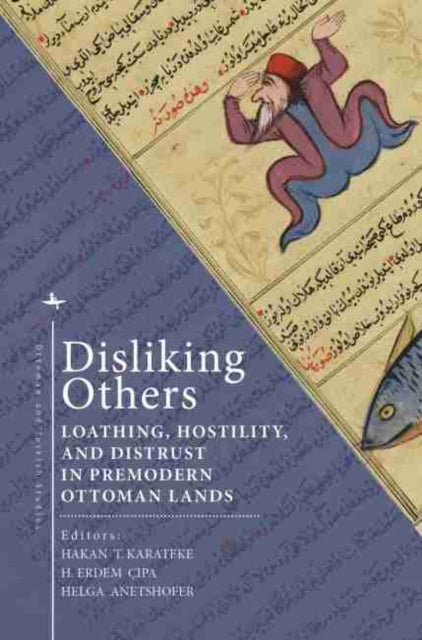
Disliking Others: Loathing, Hostility, and Distrust in Premodern Ottoman Lands
Disliking Others: Loathing, Hostility, and Distrust in Premodern Ottoman Lands
💎 Earn 492 Points (£4.92) on this item.
- Condition: Brand new
- UK Delivery times: Usually arrives within 2 - 3 working days
- UK Shipping: Fee starts at £2.39. Subject to product weight & dimension
Bulk ordering. Want 15 or more copies? Get a personalised quote and bigger discounts. Learn more about bulk orders.
Couldn't load pickup availability
- More about Disliking Others: Loathing, Hostility, and Distrust in Premodern Ottoman Lands
Recent historical studies challenge the notion of "Pax Ottomanica" and explore the tensions, blemishes, and fractures in the everyday practice of coexistence in the Ottoman Empire. The volume aims to investigate the axes of tension, blemishes, and fractures in a dynamic, multi-religious, multi-confessional, and multi-ethnic empire where difference was the norm rather than the exception.
\n Format: Hardback
\n Length: 400 pages
\n Publication date: 30 August 2018
\n Publisher: Academic Studies Press
\n
Recent historical studies on the Ottoman Empire have assumed without question that the subjects of the Ottoman polity thrived under a so-called "Pax Ottomanica." This edited volume challenges the pervasive narrative of Ottoman tolerance that has long dominated discussions. The articles carefully contextualize the many issues that, to modern ears, sound like ethnic slurs, racial stereotyping, religious discrimination, misogyny, and elitism. The volume's goal is not to establish that Ottoman society was a persecutory one or that dislike or distrust was its defining characteristic. Rather, it seeks to investigate the axes of tension, blemishes, and fractures in the everyday practice of coexistence in a dynamic, multi-religious, multi-confessional, and multi-ethnic empire where difference was the norm rather than the exception.
Introduction:
The Ottoman Empire, a vast and complex empire that spanned multiple continents and cultures, has long been a subject of fascination for historians and scholars. While the empire is known for its impressive architectural achievements, its political and social systems have also been the subject of much debate and analysis. In recent years, there has been a growing interest in examining the Ottoman Empire's relationship with its diverse subjects, particularly in light of the concept of "Pax Ottomanica."
The "Pax Ottomanica" Narrative:
The "Pax Ottomanica" narrative is a pervasive one in historical studies of the empire. It suggests that the Ottoman Empire was a tolerant and inclusive society that welcomed and respected the diversity of its subjects. This narrative has been reinforced by the portrayal of the empire in popular culture, where the Ottomans are often depicted as benevolent rulers who promoted religious and cultural tolerance.
Challenging the "Pax Ottomanica" Narrative:
However, recent historical studies have begun to challenge the "Pax Ottomanica" narrative. These studies have revealed that the empire was not as tolerant and inclusive as it is often portrayed. Instead, the empire was characterized by a complex web of tensions and conflicts that were often rooted in religious, ethnic, and cultural differences.
Ethnic Slurs, Racial Stereotyping, and Religious Discrimination:
One of the most significant challenges to the "Pax Ottomanica" narrative is the issue of ethnic slurs, racial stereotyping, and religious discrimination. The empire was characterized by a hierarchical social structure that placed Muslims at the top and non-Muslims at the bottom. This hierarchy was reflected in the use of ethnic slurs and racial stereotypes, which were used to demean and marginalize non-Muslims.
Misogyny and Elitism:
Another challenge to the "Pax Ottomanica" narrative is the issue of misogyny and elitism. Women in the empire were often subjected to discrimination and oppression, with their rights and freedoms limited by the patriarchal system. Elites, particularly the military and administrative elite, were also characterized by a sense of entitlement and privilege, which led to a lack of accountability and corruption.
Conclusion:
In conclusion, recent historical studies have challenged the pervasive narrative of Ottoman tolerance and inclusivity. While the empire was characterized by a complex web of tensions and conflicts, it was not as tolerant and inclusive as it is often portrayed. The use of ethnic slurs, racial stereotyping, religious discrimination, misogyny, and elitism were all features of the empire's social and political systems. It is important to recognize the complexities of the Ottoman Empire's history and to approach it with a critical and nuanced perspective.
\n Weight: 698g\n
Dimension: 215 x 241 x 27 (mm)\n
ISBN-13: 9781618118806\n \n
This item can be found in:
UK and International shipping information
UK and International shipping information
UK Delivery and returns information:
- Delivery within 2 - 3 days when ordering in the UK.
- Shipping fee for UK customers from £2.39. Fully tracked shipping service available.
- Returns policy: Return within 30 days of receipt for full refund.
International deliveries:
Shulph Ink now ships to Australia, Belgium, Canada, France, Germany, Ireland, Italy, India, Luxembourg Saudi Arabia, Singapore, Spain, Netherlands, New Zealand, United Arab Emirates, United States of America.
- Delivery times: within 5 - 10 days for international orders.
- Shipping fee: charges vary for overseas orders. Only tracked services are available for most international orders. Some countries have untracked shipping options.
- Customs charges: If ordering to addresses outside the United Kingdom, you may or may not incur additional customs and duties fees during local delivery.