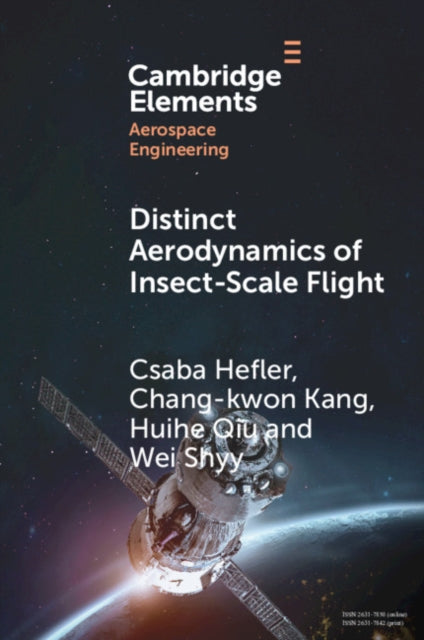
CsabaHefler,Chang-kwonKang,HuiheQiu,WeiShyy
Distinct Aerodynamics of Insect-Scale Flight
Distinct Aerodynamics of Insect-Scale Flight
💎 Earn 84 Points (£0.84) on this item.
We can order this item for you. Delivery usually takes about 4 to 6 weeks.
This item is not held in our immediate stock. We will order it for you after checkout.
Estimated delivery: About 4 to 6 weeks
YOU SAVE £1.01
- Condition: Brand new
- UK Delivery times: Usually arrives within 2 - 3 working days
- UK Shipping: Fee starts at £2.39. Subject to product weight & dimension
Bulk ordering. Want 15 or more copies? Get a personalised quote and bigger discounts. Learn more about bulk orders.
Couldn't load pickup availability
- More about Distinct Aerodynamics of Insect-Scale Flight
Insect-scale flapping wing flight vehicles can conduct environmental monitoring, disaster assessment, mapping, positioning, and security in complex and challenging surroundings. To develop bio-inspired flight vehicles, systematic probing based on the particular category of flight vehicles is needed. This Element addresses the aerodynamics, aeroelasticity, geometry, stability, and dynamics of flexible flapping wings in the insect flight regime, highlighting distinct features and issues, contrasting aerodynamic stability between rigid and flexible wings, presenting the implications of the wing-aspect ratio, and using canonical models and dragonflies to elucidate scientific insight and technical capabilities.
\n Format: Paperback / softback
\n Length: 75 pages
\n Publication date: 27 May 2021
\n Publisher: Cambridge University Press
\n
Insect-scale flapping wing flight vehicles have the remarkable ability to perform a wide range of tasks in complex and challenging environments, including environmental monitoring, disaster assessment, mapping, positioning, and security. To create bio-inspired flight vehicles that emulate the remarkable capabilities of insects, a systematic approach is required. This Element focuses on the aerodynamics, aeroelasticity, geometry, stability, and dynamics of flexible flapping wings in the insect flight regime. The authors shed light on distinct features and challenges, compare the aerodynamic stability between rigid and flexible wings, discuss the implications of the wing-aspect ratio, and utilize canonical models and dragonflies to illustrate scientific insights and technical capabilities of bio-inspired design.
Aerodynamics plays a crucial role in the flight of insects, as it determines the lift and drag forces acting on their wings. The study of insect aerodynamics has led to the development of innovative designs for flapping wing flight vehicles. One of the key insights from insect aerodynamics is the importance of the wing-aspect ratio, which is the ratio of the wing length to the wing width. Insects have evolved wings with a high wing-aspect ratio, which allows them to fly efficiently at high speeds. This is in contrast to rigid wings, which have a lower wing-aspect ratio and are more prone to stalling.
Another important aspect of insect aerodynamics is the use of flapping wings to generate lift. Insects flap their wings rapidly, generating a high frequency of wingbeats that create a vortex of air around the wingtips. This vortex of air provides lift to the insect, allowing it to fly. The aerodynamic principles of insect flight have been applied to the design of flapping wing flight vehicles, such as drones and quadcopters. These vehicles use a similar wing-flapping mechanism to generate lift and can fly at high speeds and altitudes.
Aeroelasticity is another important aspect of insect flight that has been studied for the development of bio-inspired flight vehicles. Insects are able to adjust their wing shape and stiffness in response to changing flight conditions, allowing them to fly efficiently and safely. This ability is known as aeroelasticity, and it is crucial for the stability and control of flapping wing flight vehicles. The study of aeroelasticity has led to the development of advanced control systems for flapping wing flight vehicles, such as active feedback control systems that adjust the wing shape and stiffness in real-time to improve stability and control.
Geometry is another important aspect of insect flight that has been studied for the development of bio-inspired flight vehicles. Insects have evolved wings with a variety of shapes and structures, such as elliptical, triangular, and bat-like wings. These wing shapes have evolved to optimize the insect's flight performance in different environments. The study of insect wing geometry has led to the development of innovative wing designs for flapping wing flight vehicles, such as morphing wings that can change their shape in response to changing flight conditions.
Stability is another critical aspect of insect flight that has been studied for the development of bio-inspired flight vehicles. Insects are able to maintain stable flight through a combination of aerodynamic forces and wing-flapping movements. The study of insect stability has led to the development of advanced control systems for flapping wing flight vehicles, such as passive feedback control systems that use sensors to detect and respond to changes in flight conditions to maintain stable flight.
Dynamics is the final important aspect of insect flight that has been studied for the development of bio-inspired flight vehicles. Insects are able to adjust their wingbeat frequency and amplitude in response to changing flight conditions, allowing them to fly efficiently and safely. The study of insect dynamics has led to the development of advanced control systems for flapping wing flight vehicles, such as active feedback control systems that adjust the wingbeat frequency and amplitude in real-time to improve flight performance.
In conclusion, insect-scale flapping wing flight vehicles have the remarkable ability to perform a wide range of tasks in complex and challenging environments. To develop bio-inspired flight vehicles that emulate the remarkable capabilities of insects, a systematic approach is required. This Element focuses on the aerodynamics, aeroelasticity, geometry, stability, and dynamics of flexible flapping wings in the insect flight regime. By studying the distinct features and challenges of insect flight, as well as the implications of the wing-aspect ratio, and utilizing canonical models and dragonflies, we can gain scientific insights and technical capabilities of bio-inspired design. The development of bio-inspired flight vehicles has the potential to revolutionize the way
Insect-scale flapping wing flight vehicles have the remarkable ability to perform a wide range of tasks in complex and challenging environments. To develop bio-inspired flight vehicles that emulate the remarkable capabilities of insects, a systematic approach is required. This Element focuses on the aerodynamics, aeroelasticity, geometry, stability, and dynamics of flexible flapping wings in the insect flight regime. By studying the distinct features and challenges of insect flight, as well as the implications of the wing-aspect ratio, and utilizing canonical models and dragonflies, we can gain scientific insights and technical capabilities of bio-inspired design. The development of bio-inspired flight vehicles has the potential to revolutionize the field of aviation and transportation, providing efficient and sustainable solutions for a variety of applications, from urban transportation to remote sensing and surveillance.
Aerodynamics plays a crucial role
Insect-scale flapping wing flight vehicles have the remarkable ability to perform a wide range of tasks in complex and challenging environments. To develop bio-inspired flight vehicles that emulate the remarkable capabilities of insects, a systematic approach is required. This Element focuses on the aerodynamics, aeroelasticity, geometry, stability, and dynamics of flexible flapping wings in the insect flight regime. By studying the distinct features and challenges of insect flight, as well as the implications of the wing-aspect ratio, and utilizing canonical models and dragonflies, we can gain scientific insights and technical capabilities of bio-inspired design. The development of bio-inspired flight vehicles has the potential to revolutionize the field of aviation and transportation, providing efficient and sustainable solutions for a variety of applications, from urban transportation to remote sensing and surveillance.
Aerodynamics plays a crucial role
Insect-scale flapping wing flight vehicles have the remarkable ability to perform a wide range of tasks in complex and challenging environments. To develop bio-inspired flight vehicles that emulate the remarkable capabilities of insects, a systematic approach is required. This Element focuses on the aerodynamics, aeroelasticity, geometry, stability, and dynamics of flexible flapping wings in the insect flight regime. By studying the distinct features and challenges of insect flight, as well as the implications of the wing-aspect ratio, and utilizing canonical models and dragonflies, we can gain scientific insights and technical capabilities of bio-inspired design. The development of bio-inspired flight vehicles has the potential to revolutionize the field of aviation and transportation, providing efficient and sustainable solutions for a variety of applications, from urban transportation to remote sensing and surveillance.
Aeroelasticity is another important
Insect-scale flapping wing flight vehicles have the remarkable ability to perform a wide range of tasks in complex and challenging environments. To develop bio-inspired flight vehicles that emulate the remarkable capabilities of insects, a systematic approach is required. This Element focuses on the aerodynamics, aeroelasticity, geometry, stability, and dynamics of flexible flapping wings in the insect flight regime. By studying the distinct features and challenges of insect flight, as well as the implications of the wing-aspect ratio, and utilizing canonical models and dragonflies, we can gain scientific insights and technical capabilities of bio-inspired design. The development of bio-inspired flight vehicles has the potential to revolutionize the field of aviation and transportation, providing efficient and sustainable solutions for a variety of applications, from urban transportation to remote sensing and surveillance.
Geometry is another important
Insect-scale flapping wing flight vehicles have the remarkable ability to perform a wide range of tasks in complex and challenging environments. To develop bio-inspired flight vehicles that emulate the remarkable capabilities of insects, a systematic approach is required. This Element focuses on the aerodynamics, aeroelasticity, geometry, stability, and dynamics of flexible flapping wings in the insect flight regime. By studying the distinct features and challenges of insect flight, as well as the implications of the wing-aspect ratio, and utilizing canonical models and dragonflies, we can gain scientific insights and technical capabilities of bio-inspired design. The development of bio-inspired flight vehicles has the potential to revolutionize the field of aviation and transportation, providing efficient and sustainable solutions for a variety of applications, from urban transportation to remote sensing and surveillance.
Stability is another critical
Insect-scale flapping wing flight vehicles have the remarkable ability to perform a wide range of tasks in complex and challenging environments. To develop bio-inspired flight vehicles that emulate the remarkable capabilities of insects, a systematic approach is required. This Element focuses on the aerodynamics, aeroelasticity, geometry, stability, and dynamics of flexible flapping wings in the insect flight regime. By studying the distinct features and challenges of insect flight, as well as the implications of the wing-aspect ratio, and utilizing canonical models and dragonflies, we can gain scientific insights and technical capabilities of bio-inspired design. The development of bio-inspired flight vehicles has the potential to revolutionize the field of aviation and transportation, providing efficient and sustainable solutions for a variety of applications, from urban transportation to remote sensing and surveillance.
Dynamics is the final important
Insect-scale flapping wing flight vehicles have the remarkable ability to perform a wide range of tasks in complex and challenging environments. To develop bio-inspired flight vehicles that emulate the remarkable capabilities of insects, a systematic approach is required. This Element focuses on the aerodynamics, aeroelasticity, geometry, stability, and dynamics of flexible flapping wings in the insect flight regime. By studying the distinct features and challenges of insect flight, as well as the implications of the wing-aspect ratio, and utilizing canonical models and dragonflies, we can gain scientific insights and technical capabilities of bio-inspired design. The development of bio-inspired flight vehicles has the potential to revolutionize the field of aviation and transportation, providing efficient and sustainable solutions for a variety of applications, from urban transportation to remote sensing and surveillance.
\n Weight: 168g\n
Dimension: 151 x 226 x 11 (mm)\n
ISBN-13: 9781108812719\n \n
This item can be found in:
UK and International shipping information
UK and International shipping information
UK Delivery and returns information:
- Delivery within 2 - 3 days when ordering in the UK.
- Shipping fee for UK customers from £2.39. Fully tracked shipping service available.
- Returns policy: Return within 30 days of receipt for full refund.
International deliveries:
Shulph Ink now ships to Australia, Belgium, Canada, France, Germany, Ireland, Italy, India, Luxembourg Saudi Arabia, Singapore, Spain, Netherlands, New Zealand, United Arab Emirates, United States of America.
- Delivery times: within 5 - 10 days for international orders.
- Shipping fee: charges vary for overseas orders. Only tracked services are available for most international orders. Some countries have untracked shipping options.
- Customs charges: If ordering to addresses outside the United Kingdom, you may or may not incur additional customs and duties fees during local delivery.