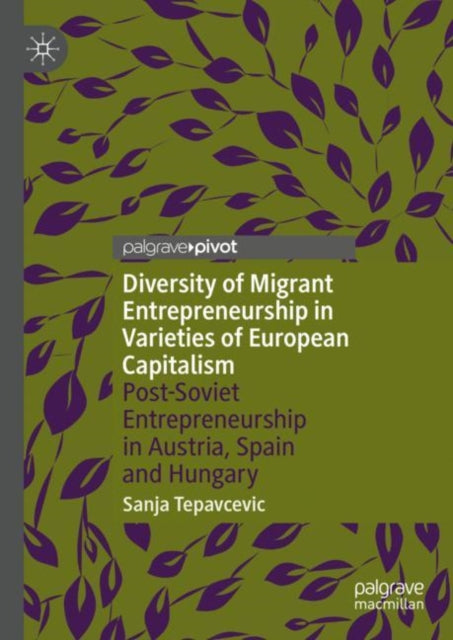
Sanja Tepavcevic
Diversity of Migrant Entrepreneurship in Varieties of European Capitalism: Post-Soviet Entrepreneurship in Austria, Spain and Hungary
Diversity of Migrant Entrepreneurship in Varieties of European Capitalism: Post-Soviet Entrepreneurship in Austria, Spain and Hungary
💎 Earn 165 Points (£1.65) on this item.
We can order this item for you. Delivery usually takes about 4 to 6 weeks.
This item is not held in our immediate stock. We will order it for you after checkout.
Estimated delivery: About 4 to 6 weeks
YOU SAVE £6.96
- Condition: Brand new
- UK Delivery times: Usually arrives within 2 - 3 working days
- UK Shipping: Fee starts at £2.39. Subject to product weight & dimension
Bulk ordering. Want 15 or more copies? Get a personalised quote and bigger discounts. Learn more about bulk orders.
Couldn't load pickup availability
- More about Diversity of Migrant Entrepreneurship in Varieties of European Capitalism: Post-Soviet Entrepreneurship in Austria, Spain and Hungary
The book examines the role of entrepreneurship in the economic and social integration of post-Soviet immigrants in the European Union, exploring the influence of national institutions on these processes. It traces the development of economic models and immigration policies in Austria, Spain, and Hungary and their impact on post-Soviet immigration and entrepreneurship.
Format: Hardback
Length: 157 pages
Publication date: 06 September 2023
Publisher: Springer International Publishing AG
Entrepreneurship plays a crucial role in the economic and social integration of post-Soviet immigrants in the European Union. This book explores the ways in which national institutions influence these processes, tracing the development of economic models and immigration policies in Austria, Spain, and Hungary and their impact on post-Soviet immigration and entrepreneurship in these countries. By adopting an interdisciplinary approach, the book provides valuable insights for students, researchers, and practitioners interested in the economics of migration, labor economics, and the political economy.
The book begins by examining the historical background of post-Soviet immigration to the European Union, including the political and economic conditions that led to the migration of millions of people from the former Soviet Union to the EU. It then explores the various economic models and immigration policies that have been implemented in Austria, Spain, and Hungary, and their impact on post-Soviet immigration and entrepreneurship.
One of the key findings of the book is that national institutions play a significant role in shaping post-Soviet immigration and entrepreneurship. For example, Austria's economic model is characterized by a strong emphasis on entrepreneurship and innovation, which has attracted many post-Soviet immigrants to the country. Spain's immigration policies have been more restrictive, but have also led to the development of a vibrant immigrant community and a growing economy. Hungary's immigration policies have been more open, but have also faced challenges related to integration and assimilation.
The book also examines the impact of post-Soviet immigration on the labor market in Austria, Spain, and Hungary. It finds that post-Soviet immigrants have contributed to the growth of the labor force in these countries, particularly in the service sector. However, they have also faced challenges related to discrimination and social exclusion.
In addition to its academic analysis, the book also provides practical insights for policymakers and practitioners. It suggests that policymakers should focus on creating a welcoming and inclusive environment for post-Soviet immigrants, and should provide them with access to education, training, and employment opportunities. It also suggests that practitioners should be aware of the cultural and linguistic barriers that post-Soviet immigrants may face and should work to address them.
Overall, this book is a valuable contribution to the study of post-Soviet immigration and entrepreneurship in the European Union. It provides an interdisciplinary approach to the study of institutions relevant to students, researchers, and practitioners interested in the economics of migration, labor economics, and the political economy. By examining the development of economic models and immigration policies in Austria, Spain, and Hungary, the book provides valuable insights into the ways in which national institutions influence these processes and the impact that they have on post-Soviet immigrants and the broader society.
Weight: 369g
Dimension: 210 x 148 (mm)
ISBN-13: 9783031310966
Edition number: 1st ed. 2023
This item can be found in:
UK and International shipping information
UK and International shipping information
UK Delivery and returns information:
- Delivery within 2 - 3 days when ordering in the UK.
- Shipping fee for UK customers from £2.39. Fully tracked shipping service available.
- Returns policy: Return within 30 days of receipt for full refund.
International deliveries:
Shulph Ink now ships to Australia, Belgium, Canada, France, Germany, Ireland, Italy, India, Luxembourg Saudi Arabia, Singapore, Spain, Netherlands, New Zealand, United Arab Emirates, United States of America.
- Delivery times: within 5 - 10 days for international orders.
- Shipping fee: charges vary for overseas orders. Only tracked services are available for most international orders. Some countries have untracked shipping options.
- Customs charges: If ordering to addresses outside the United Kingdom, you may or may not incur additional customs and duties fees during local delivery.