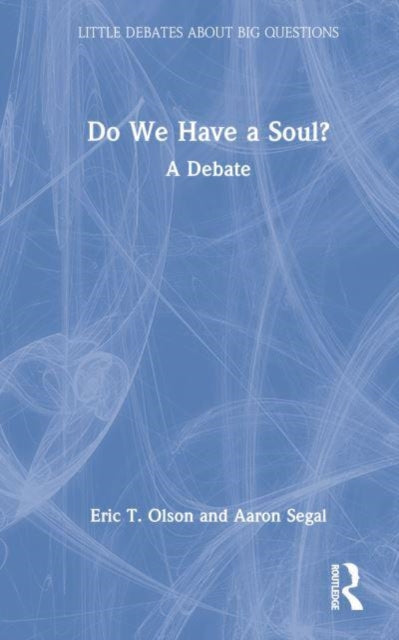
Eric T. Olson,Aaron Segal
Do We Have a Soul?: A Debate
Do We Have a Soul?: A Debate
💎 Earn 689 Points (£6.89) on this item.
We can order this item for you. Delivery usually takes about 4 to 6 weeks.
This item is not held in our immediate stock. We will order it for you after checkout.
Estimated delivery: About 4 to 6 weeks
YOU SAVE £8.18
- Condition: Brand new
- UK Delivery times: Usually arrives within 2 - 3 working days
- UK Shipping: Fee starts at £2.39. Subject to product weight & dimension
Bulk ordering. Want 15 or more copies? Get a personalised quote and bigger discounts. Learn more about bulk orders.
Couldn't load pickup availability
- More about Do We Have a Soul?: A Debate
The debate between substance dualism and materialism examines whether we are made of matter or have a soul. Eric T. Olson argues that our mental lives are physical activities in our brains, while Aaron Segal objects that this view is incompatible with two important facts about ourselves: that there is only one of us and that we exist and remain conscious for more than an instant. The book features clear statements of each argument, responses to counter-arguments, in-text definitions, a glossary of key terms, and section summaries.
Format: Hardback
Length: 240 pages
Publication date: 04 August 2023
Publisher: Taylor & Francis Ltd
The debate between substance dualism and materialism is a complex and fascinating topic that has been the subject of much discussion among philosophers for centuries. At its core, the debate revolves around the question of whether our mental lives are solely the result of physical processes in the brain, or if they are also influenced by a nonphysical entity, such as a soul.
One of the key proponents of substance dualism is Eric T. Olson, a professor of philosophy at the University of Minnesota. In his book "The Physical Mind," Olson argues that our mental lives are physical activities in the brain, rather than nonphysical activities in the soul. He bases this argument on the fact that general anesthesia, which causes complete unconsciousness, can completely erase our mental lives. Olson believes that this suggests that our mental lives are dependent on the physical state of our brains, rather than on the existence of a nonphysical soul.
On the other hand, Aaron Segal, a professor of philosophy at the University of California, Berkeley, argues that substance dualism is incompatible with two important facts about ourselves. The first fact is that there is only one of us, rather than trillions of almost identical beings now thinking our thoughts. The second fact is that we exist and remain conscious for more than an instant. Segal believes that these facts require us to be immaterial things, rather than physical objects.
Segal argues that our mental lives are not physical activities in the brain, but rather nonphysical activities in the soul. He bases this argument on the fact that we have subjective experiences, such as thoughts, feelings, and perceptions, that cannot be explained solely by physical processes in the brain. Segal believes that these experiences are the result of the interaction between the physical body and the nonphysical soul.
One of the main objections to Segal's argument is that it is incompatible with the fact that there is only one of us. Olson argues that if there were trillions of almost identical beings, each with their own nonphysical soul, then there would be trillions of different mental lives. However, this is not the case, as we all have the same mental lives, regardless of whether we are identical or not.
Another objection to Segal's argument is that it is incompatible with the fact that we exist and remain conscious for more than an instant. Olson argues that if our mental lives were nonphysical, then they would not be able to exist for more than an instant, as they would not be able to survive the physical destruction of the brain. However, we do exist and remain conscious for more than an instant, which suggests that our mental lives are physical.
The debate between substance dualism and materialism is a complex and multifaceted issue that extends well beyond dualism and materialism. It raises important questions about the nature of consciousness, the relationship between the mind and the body, and the ultimate fate of our mental lives. While there is no easy and uncontroversial answer to these questions, the debate continues to be an important area of research and discussion among philosophers.
In conclusion, the debate between substance dualism and materialism is a fascinating and important topic that continues to be the subject of much discussion among philosophers. While there is no easy and uncontroversial answer to these questions, the debate continues to be an important area of research and discussion among philosophers. By exploring the arguments and objections of both proponents and opponents, we can gain a deeper understanding of the nature of consciousness and the ultimate fate of our mental lives.
Dimension: 216 x 138 (mm)
ISBN-13: 9780367470265
UK and International shipping information
UK and International shipping information
UK Delivery and returns information:
- Delivery within 2 - 3 days when ordering in the UK.
- Shipping fee for UK customers from £2.39. Fully tracked shipping service available.
- Returns policy: Return within 30 days of receipt for full refund.
International deliveries:
Shulph Ink now ships to Australia, Belgium, Canada, France, Germany, Ireland, Italy, India, Luxembourg Saudi Arabia, Singapore, Spain, Netherlands, New Zealand, United Arab Emirates, United States of America.
- Delivery times: within 5 - 10 days for international orders.
- Shipping fee: charges vary for overseas orders. Only tracked services are available for most international orders. Some countries have untracked shipping options.
- Customs charges: If ordering to addresses outside the United Kingdom, you may or may not incur additional customs and duties fees during local delivery.