Ladybird
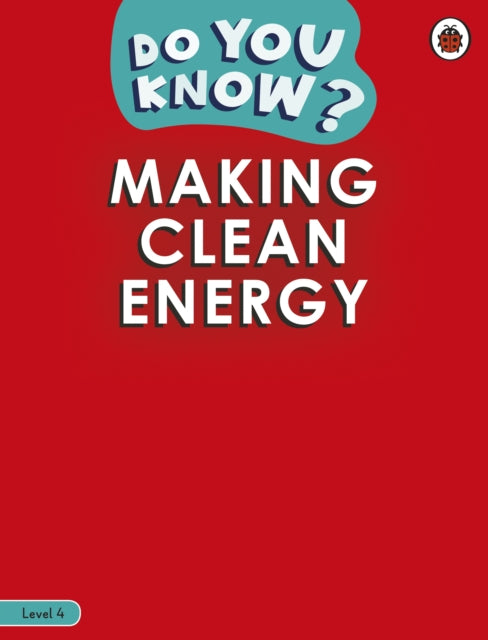
Do You Know? Level 4 - Making Clean Energy
Do You Know? Level 4 - Making Clean Energy
YOU SAVE £1.58
- Condition: Brand new
- UK Delivery times: Usually arrives within 2 - 3 working days
- UK Shipping: Fee starts at £3.89. Subject to product weight & dimension
Bulk ordering. Want 15 or more copies? Get a personalised quote and bigger discounts. Learn more about bulk orders.
Couldn't load pickup availability
- More about Do You Know? Level 4 - Making Clean Energy
Do You Know? is a series of levelled non-fiction books for young learners, covering STEM topics from nocturnal animals to climate change. Level 4 Reader, Making Clean Energy, supports YLE Flyers exams and includes longer text with complex sentence structures and vocabulary.
Format: Paperback / softback
Length: 32 pages
Publication date: 21 October 2021
Publisher: Penguin Random House Children's UK
Energy is a fundamental concept that encompasses the various forms and sources of power that drive our world. It is the essence of motion and activity, and it is essential for the survival and well-being of all living organisms.
Energy can take many different forms, including kinetic energy, potential energy, thermal energy, electrical energy, and chemical energy. Kinetic energy is the energy of motion, while potential energy is stored energy that can be released through work or movement. Thermal energy is the energy of heat, while electrical energy is the energy produced by the movement of charged particles. Chemical energy is the energy stored in chemical bonds and can be released through reactions.
Energy is obtained from a variety of sources, including fossil fuels, renewable energy sources, and nuclear energy. Fossil fuels, such as coal, oil, and natural gas, are formed from the remains of plants and animals that lived millions of years ago. When these fuels are burned, they release energy that can be used to power machines and generate electricity. However, the burning of fossil fuels also releases harmful greenhouse gases, such as carbon dioxide, which contribute to climate change.
Renewable energy sources, such as solar, wind, hydro, and geothermal energy, are obtained from natural resources that are replenished over time. Solar energy is obtained from the sun, while wind energy is obtained from the wind. Hydro energy is obtained from the movement of water, while geothermal energy is obtained from the heat of the earth. Renewable energy sources are much cleaner than fossil fuels and do not release harmful greenhouse gases.
Nuclear energy is obtained from the nucleus of an atom, which is composed of protons and neutrons. When these atoms are split, they release a large amount of energy. Nuclear energy is a clean source of energy, but it also poses risks, such as the potential for accidents and the disposal of radioactive waste.
In order to reduce our dependence on fossil fuels and mitigate the effects of climate change, we need to transition to a more sustainable energy system. This can be achieved through a combination of policies and technologies, such as energy efficiency, renewable energy development, and carbon capture and storage. Energy efficiency measures can help reduce the amount of energy we use, while renewable energy development can help increase the amount of clean energy we produce. Carbon capture and storage can help capture and store carbon dioxide emissions from power plants and other industrial sources.
In conclusion, energy is a fundamental concept that is essential for the survival and well-being of all living organisms. It can take many different forms, and it is obtained from a variety of sources, including fossil fuels, renewable energy sources, and nuclear energy. In order to reduce our dependence on fossil fuels and mitigate the effects of climate change, we need to transition to a more sustainable energy system. This can be achieved through a combination of policies and technologies, such as energy efficiency, renewable energy development, and carbon capture and storage.
Weight: 152g
Dimension: 195 x 254 x 5 (mm)
ISBN-13: 9780241503447
UK and International shipping information
UK and International shipping information
We deliver throughout the United Kingdom and to 128 countries and territories worldwide, including the United States, Australia, Canada, Germany, Spain and France.