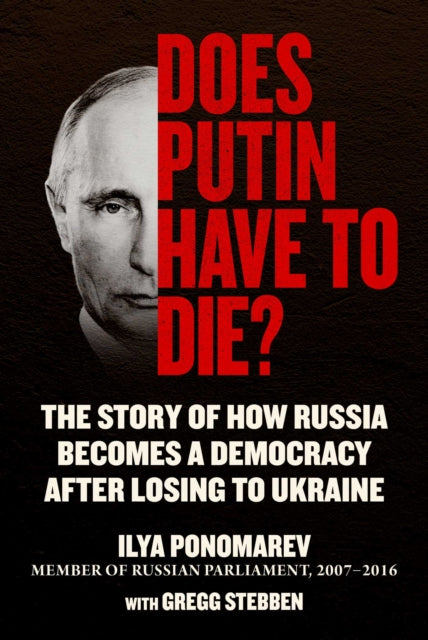
Ilya Ponomarev,Gregg Stebben
Does Putin Have to Die?: The Story of How Russia Becomes a Democracy after Losing to Ukraine
Does Putin Have to Die?: The Story of How Russia Becomes a Democracy after Losing to Ukraine
💎 Earn 77 Points (£0.77) on this item.
YOU SAVE £6.42
- Condition: Brand new
- UK Delivery times: Usually arrives within 2 - 3 working days
- UK Shipping: Fee starts at £2.39. Subject to product weight & dimension
Bulk ordering. Want 15 or more copies? Get a personalised quote and bigger discounts. Learn more about bulk orders.
Couldn't load pickup availability
- More about Does Putin Have to Die?: The Story of How Russia Becomes a Democracy after Losing to Ukraine
A Russian Parliament member turned dissident, Denis Voronenkov, was assassinated in March 2017 by Russian intelligence, prompting Ponomarev to join Ukraine's armed territorial defense forces to fight against Putin, Putinism, and Russian fascism. Ponomarev has written a book about his plan to turn Russia into a democracy.
Format: Hardback
Length: 288 pages
Publication date: 19 January 2023
Publisher: Skyhorse Publishing
The Story of How Russia Becomes a Democracy after Losing to Ukraine
Opposing Putin is a risky proposition; for instance, a fellow Russian Parliament member turned dissident, Denis Voronenkov, was on his way to see Ponomarev when he was shot and killed in March 2017 by Russian intelligence. Ponomarev has lived in Kyiv since 2016. As a result of Voronenkovs murder, he now receives personal protection by the Ukrainian Security Service. And as he said in a recent television interview, I keep a machine gun by the door. But if you ask Ponomarev why he joined Ukraines armed territorial defense forces, he will reply: Im not fighting against Russia, Im fighting against Putin and Putinism and Russian fascism. In this book, Ponomarev offers his plan for how the Russian people can purge their country of Putin, Putinism, and dictatorship, and turn it into a democracy.
The Russian people have been living under the authoritarian rule of President Vladimir Putin for nearly two decades. During this time, the country has experienced a decline in democratic norms, human rights abuses, and economic instability. However, there is a growing movement within Russia that seeks to overthrow Putin and establish a democratic government.
One of the key figures in this movement is Alexei Navalny, a prominent opposition politician and anti-corruption activist. Navalny has been arrested multiple times and has faced severe persecution from the Russian government. Despite these challenges, he has continued to campaign for democratic reforms and has become a symbol of resistance against Putinism.
Another important player in the movement is Maria Aleksandrovna Shalayeva, a former journalist and human rights activist who was arrested in 2017 and sentenced to 10 years in prison on charges of fraud and embezzlement. Shalayeva has become a prominent figure in the international community, advocating for the release of political prisoners and the restoration of democracy in Russia.
Despite these challenges, there is a growing sense of hope among the Russian people that they can overcome the authoritarian rule of Putin and establish a democratic government. This hope is fueled by a number of factors, including the growing opposition to Putinism, the increasing economic instability in Russia, and the international communitys support for democratic reforms.
One of the key challenges facing the Russian people is the need to build a strong and united opposition movement. This movement must be able to mobilize millions of people and organize protests and demonstrations that challenge the legitimacy of the Russian government. Additionally, the opposition movement must be able to develop a clear and compelling vision for a democratic Russia that addresses the countrys economic, social, and political challenges.
Another challenge is the need to address the underlying political and economic issues that have contributed to the decline of democracy in Russia. This includes addressing corruption, improving the rule and transparency of the government, and promoting economic development and social justice.
Despite these challenges, there is a growing sense of optimism among the Russian people that they can overcome the authoritarian rule of Putin and establish a democratic government. This optimism is fueled by a number of factors, including the growing opposition to Putinism, the increasing economic instability in Russia, and the international communitys support for democratic reforms.
In conclusion, the story of how Russia becomes a democracy after losing to Ukraine is a complex and multifaceted one that requires a sustained and coordinated effort from the Russian people, the international community, and the Russian government. While there are many challenges and obstacles to overcome, there is a growing sense of hope and optimism that a democratic Russia is possible. It is up to the Russian people and their leaders to seize this opportunity and work towards building a better future for their country.
Weight: 470g
Dimension: 162 x 239 x 29 (mm)
ISBN-13: 9781510775909
UK and International shipping information
UK and International shipping information
UK Delivery and returns information:
- Delivery within 2 - 3 days when ordering in the UK.
- Shipping fee for UK customers from £2.39. Fully tracked shipping service available.
- Returns policy: Return within 30 days of receipt for full refund.
International deliveries:
Shulph Ink now ships to Australia, Belgium, Canada, France, Germany, Ireland, Italy, India, Luxembourg Saudi Arabia, Singapore, Spain, Netherlands, New Zealand, United Arab Emirates, United States of America.
- Delivery times: within 5 - 10 days for international orders.
- Shipping fee: charges vary for overseas orders. Only tracked services are available for most international orders. Some countries have untracked shipping options.
- Customs charges: If ordering to addresses outside the United Kingdom, you may or may not incur additional customs and duties fees during local delivery.