Henrike Knappe
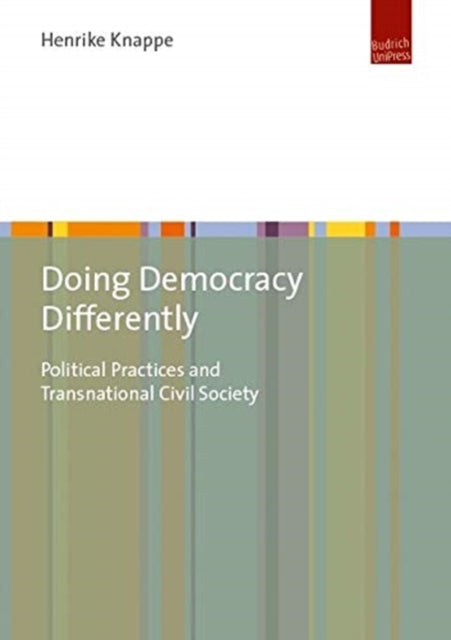
Doing Democracy Differently - Political Practices and Transnational Civil Society
Doing Democracy Differently - Political Practices and Transnational Civil Society
💎 Earn 214 Points (£2.14) on this item.
YOU SAVE £13.05
- Condition: Brand new
- UK Delivery times: Usually arrives within 2 - 3 working days
- UK Shipping: Fee starts at £2.39. Subject to product weight & dimension
Bulk ordering. Want 15 or more copies? Get a personalised quote and bigger discounts. Learn more about bulk orders.
Couldn't load pickup availability
- More about Doing Democracy Differently - Political Practices and Transnational Civil Society
Transnational civil society networks are important democratizing actors in global politics, but studying democracy in these networks is challenging. Practice theory provides a framework to understand democracy as routinized performances in contexts of fluid boundaries, temporal relations, and diffuse constituencies.
Format: Paperback / softback
Length: 220 pages
Publication date: 08 December 2021
Publisher: Verlag Barbara Budrich
Transnational civil society networks have emerged as vital democratizing forces in global politics, yet the exploration of democracy within these networks remains conceptually and methodologically complex. Practice theory offers a valuable framework for studying democracy as routinized performances, even in contexts characterized by fluid boundaries, temporal dynamics, and a dispersed constituency. In this essay, the author endeavors to delve into the mechanisms that facilitate the emergence of new democratic practices in the interplay between political actors and their structural environments.
Transnational civil society networks (TCSNs) have gained significant importance in democratizing global politics. These networks, composed of individuals, organizations, and institutions across national borders, have played a crucial role in promoting social, political, and economic change on a global scale. However, the study of democracy within TCSNs remains challenging due to the complex nature of these networks and the diverse contexts in which they operate.
One approach to understanding democracy in TCSNs is through the lens of practice theory. Practice theory emphasizes the role of routine and repetition in shaping social practices and institutions. It posits that even in contexts with fluid boundaries, temporal relations, and a dispersed constituency, democratic practices can be observed as routinized performances. This perspective allows scholars to examine how new forms of democratic practice emerge in the interaction between political actors and their structural environments.
One key aspect of practice theory is the concept of "reflexivity." Reflexivity refers to the ability of individuals and organizations to recognize and respond to the social and political contexts in which they operate. In the context of TCSNs, reflexivity involves the ability of network members to understand the power dynamics, norms, and values that shape their interactions and to adapt their practices accordingly. This can include the development of new strategies, the formation of alliances, and the negotiation of different identities and interests.
Another important aspect of practice theory is the concept of "legitimacy." Legitimacy refers to the perceived legitimacy of a particular practice or institution. In the context of TCSNs, legitimacy is often conferred through the perceived ability of the network to effectively promote democratic values and principles. This can include the development of effective advocacy campaigns, the provision of humanitarian aid, and the promotion of human rights.
To illustrate the application of practice theory to the study of democracy in TCSNs, consider the case of the Global Civil Society Forum (GCSF). The GCSF is a network of civil society organizations that promotes democracy, human rights, and social justice around the world. The GCSF has played a significant role in promoting democratic reforms in countries such as Egypt, Tunisia, and Myanmar, and has also been involved in responding to crises such as the Syrian refugee crisis and the COVID-19 pandemic.
In examining the GCSF's role in promoting democracy, it is clear that the network operates through a combination of routine practices and reflexive adaptations. For example, the GCSF hosts annual conferences that bring together civil society organizations from around the world to discuss pressing social and political issues. These conferences serve as a platform for networking, knowledge sharing, and advocacy, and have helped to shape the GCSF's approach to promoting democracy.
At the same time, the GCSF has also been responsive to changing social and political contexts. For example, in response to the COVID-19 pandemic, the GCSF has launched a number of initiatives to support civil society organizations and promote public health. These initiatives have involved the use of digital technologies, the formation of alliances with government agencies, and the promotion of citizen engagement and participation.
In conclusion, transnational civil society networks have become increasingly important democratizing actors in global politics. The study of democracy within these networks remains conceptually and methodologically challenging, but practice theory provides a valuable framework for understanding democracy as routinized performances, even in contexts with fluid boundaries, temporal relations, and a dispersed constituency. By examining the role of reflexivity and legitimacy in the interaction between political actors and their structural environments, scholars can gain a deeper understanding of how new forms of democratic practice emerge and are sustained in TCSNs.
Weight: 334g
Dimension: 150 x 213 x 18 (mm)
ISBN-13: 9783863887209
This item can be found in:
UK and International shipping information
UK and International shipping information
UK Delivery and returns information:
- Delivery within 2 - 3 days when ordering in the UK.
- Shipping fee for UK customers from £2.39. Fully tracked shipping service available.
- Returns policy: Return within 30 days of receipt for full refund.
International deliveries:
Shulph Ink now ships to Australia, Belgium, Canada, France, Germany, Ireland, Italy, India, Luxembourg Saudi Arabia, Singapore, Spain, Netherlands, New Zealand, United Arab Emirates, United States of America.
- Delivery times: within 5 - 10 days for international orders.
- Shipping fee: charges vary for overseas orders. Only tracked services are available for most international orders. Some countries have untracked shipping options.
- Customs charges: If ordering to addresses outside the United Kingdom, you may or may not incur additional customs and duties fees during local delivery.