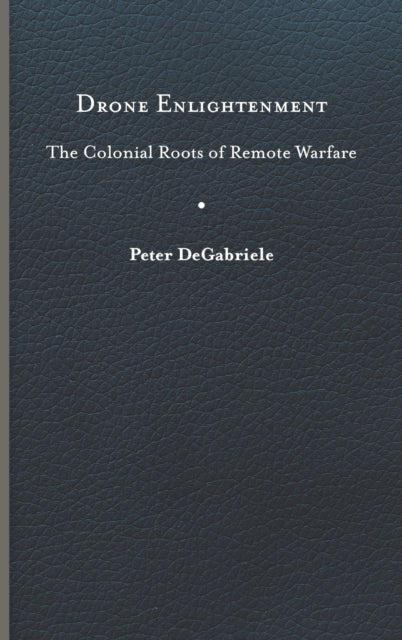
Peter DeGabriele
Drone Enlightenment: The Colonial Roots of Remote Warfare
Drone Enlightenment: The Colonial Roots of Remote Warfare
💎 Earn 411 Points (£4.11) on this item.
- Condition: Brand new
- UK Delivery times: Usually arrives within 2 - 3 working days
- UK Shipping: Fee starts at £2.39. Subject to product weight & dimension
Bulk ordering. Want 15 or more copies? Get a personalised quote and bigger discounts. Learn more about bulk orders.
Couldn't load pickup availability
- More about Drone Enlightenment: The Colonial Roots of Remote Warfare
Drone warfare raises questions about responsibility, war, and sovereignty. Drone Enlightenment argues that this kind of warfare has its roots in the Enlightenment's imagination of moral agency, occupation, race, and sovereignty, and reevaluates the Enlightenment itself.
Format: Hardback
Length: 174 pages
Publication date: 10 May 2023
Publisher: University of Virginia Press
Drone warfare presents a complex and multifaceted set of ethical, legal, and geopolitical concerns. It raises profound questions about accountability, warfare, and sovereignty. Who should be held responsible for drone strikes? Do drones constitute the conduct of wars within national territories and sovereign boundaries? What does the occupation of land or people look like without the presence of physical troops?
In examining the United States' use of killer drones during the War on Terror, Drone Enlightenment offers a thought-provoking analysis. The book argues that this form of warfare has its intellectual, ideological, and practical roots in the way the Enlightenment conceived of moral agency, occupation, race, and sovereignty. By viewing drone warfare as a product of the Enlightenment, and through innovative readings of key thinkers such as Hobbes, Locke, Grotius, Pufendorf, Barbeyrac, and Swift, the book also reevaluates the Enlightenment itself.
One of the central arguments of Drone Enlightenment is that the Enlightenment's emphasis on individual moral agency and the pursuit of self-interest led to a conception of warfare that prioritized technological efficiency and remote control over the physical presence of soldiers. This shift in mindset, according to the book, has had profound implications for the way we understand and engage in warfare.
For example, the use of killer drones allows for the targeted killing of individuals without the need for direct military intervention. This raises questions about the moral legitimacy of such actions and the extent to which they can be justified in the name of national security. Moreover, the use of drones has blurred the lines between combatants and non-combatants, making it difficult to determine who is responsible for civilian casualties and other unintended consequences.
Another key aspect of Drone Enlightenment is its exploration of the concept of occupation. The book argues that the Enlightenment's emphasis on the right to self-determination and the pursuit of individual liberty has led to a conception of occupation that is based on the presence of physical troops and the establishment of a military presence. However, the use of drones challenges this notion by allowing for the occupation of land or people without the need for boots on the ground.
This raises questions about the nature of sovereignty and the extent to which it can be exercised in the age of advanced technology. The book suggests that the use of drones has created a new form of sovereignty that is based on remote control and technological dominance rather than physical presence. This has implications for the way we understand international relations and the balance of power in the global arena.
Furthermore, Drone Enlightenment examines the ethical and legal implications of drone warfare. The book argues that the use of drones raises a range of ethical concerns, including the use of targeted killing, the violation of human rights, and the potential for unintended consequences. Moreover, the legal framework governing drone strikes is complex and uncertain, with different countries having different interpretations of international law and the use of force.
To address these challenges, Drone Enlightenment offers a range of innovative readings and interpretations of key thinkers. The book explores the works of Hobbes, Locke, Grotius, Pufendorf, Barbeyrac, and Swift to understand the philosophical foundations of moral agency, occupation, race, and sovereignty. By reexamining these thinkers in the context of drone warfare, the book provides a fresh perspective on the ethical and legal implications of this form of warfare.
In conclusion, Drone warfare raises far-reaching questions about responsibility, war, and sovereignty. By examining the United States' use of killer drones during the War on Terror, Drone Enlightenment offers a thought-provoking analysis that challenges our understanding of these complex issues. The book argues that the Enlightenment's emphasis on individual moral agency and the pursuit of self-interest has led to a conception of warfare that prioritizes technological efficiency and remote control over the physical presence of soldiers. This shift in mindset has had profound implications for the way we understand and engage in warfare, including the use of killer drones, the concept of occupation, and the nature of sovereignty. Through innovative readings of key thinkers, the book provides a fresh perspective on these issues and offers potential solutions to address the ethical and legal challenges posed by drone warfare.
Weight: 416g
Dimension: 159 x 237 x 19 (mm)
ISBN-13: 9780813949536
UK and International shipping information
UK and International shipping information
UK Delivery and returns information:
- Delivery within 2 - 3 days when ordering in the UK.
- Shipping fee for UK customers from £2.39. Fully tracked shipping service available.
- Returns policy: Return within 30 days of receipt for full refund.
International deliveries:
Shulph Ink now ships to Australia, Belgium, Canada, France, Germany, Ireland, Italy, India, Luxembourg Saudi Arabia, Singapore, Spain, Netherlands, New Zealand, United Arab Emirates, United States of America.
- Delivery times: within 5 - 10 days for international orders.
- Shipping fee: charges vary for overseas orders. Only tracked services are available for most international orders. Some countries have untracked shipping options.
- Customs charges: If ordering to addresses outside the United Kingdom, you may or may not incur additional customs and duties fees during local delivery.