GabrielSchwake
Dwelling on the Green Line: Privatize and Rule in Israel/Palestine
Dwelling on the Green Line: Privatize and Rule in Israel/Palestine
💎 Earn 387 Points (£3.87) on this item.
YOU SAVE £4.59
- Condition: Brand new
- UK Delivery times: Usually arrives within 2 - 3 working days
- UK Shipping: Fee starts at £2.39. Subject to product weight & dimension
Bulk ordering. Want 15 or more copies? Get a personalised quote and bigger discounts. Learn more about bulk orders.
Couldn't load pickup availability
- More about Dwelling on the Green Line: Privatize and Rule in Israel/Palestine
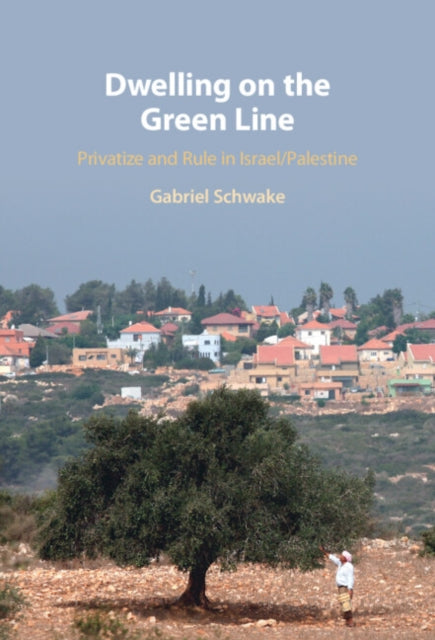
The state of Israel has been expanding its coastal area eastward into the occupied Palestinian territories since the late 1970s, granting favored groups of individuals, developers, and entrepreneurs the ability to influence the formation of built space. This production of space is a physical manifestation of the relationship between the political interest in controlling space and the ability to form it and is deeply entangled with geopolitical agendas. Gabriel Schwake demonstrates how this production of space can be seen as a cultural phenomenon and as one that is deeply entangled with geopolitical agendas.
Format: Hardback
Length: 240 pages
Publication date: 17 March 2022
Publisher: Cambridge University Press
Nestled within the confines of settlements along the Green-Line, the boundary dividing Israel and the occupied West Bank, lies a intricate tapestry of territoriality, privatization, and multifaceted class dynamics. Since the late 1970s, the state has embarked on a mission to expand the densely populated coastal region eastward into the occupied Palestinian territories, granting privileged groups of individuals, developers, and entrepreneurs the power to shape the built environment as a means to continually extend and settle national frontiers. As these settlements flourished, they emerged as tangible embodiments of the interplay between the political desire to control space and the capacity to forge it. By employing an architectural and urban history lens, Gabriel Schwake adeptly showcases how this spatial production can be perceived not only as a cultural phenomenon but also as intricately intertwined with geopolitical agendas.
The Green-Line, a physical and ideological boundary that divides Israel and the occupied West Bank, has witnessed a complex history of territoriality, privatization, and class dynamics. Since the late 1970s, the state has pursued a policy of expanding the heavily populated coastal area eastward into the occupied Palestinian territories, granting favored groups of individuals, developers, and entrepreneurs the ability to influence the formation of built space. As these settlements emerged, they became tangible manifestations of the interplay between the political desire to control space and the capacity to shape it.
From an architectural and urban history perspective, Gabriel Schwake's work demonstrates how this spatial production can be understood not only as a cultural phenomenon but also as deeply entangled with geopolitical agendas. The Green-Line serves as a physical barrier that divides communities, but it also reflects the broader political and economic dynamics of the region. The settlements that have grown along the Green-Line represent a range of interests, from those seeking to establish a permanent presence in the occupied territories to those seeking to leverage their proximity to Israel for economic gain.
The architectural designs of these settlements reflect the diverse range of interests and perspectives involved. Some settlements are characterized by modernist architecture, with clean lines and minimalistic designs that prioritize functionality and efficiency. Others, however, are more reminiscent of traditional Palestinian architecture, with intricate terraced gardens and decorative tilework that reflect the cultural heritage of the region.
The development of these settlements has had significant social and economic consequences. On the one hand, it has facilitated the expansion of Israeli settlements into the occupied territories, leading to the displacement of Palestinian communities and the fragmentation of the West Bank. On the other hand, it has created new opportunities for economic growth and development, particularly in the coastal region, which has attracted investment and tourism.
However, the development of these settlements has also been met with opposition and criticism from international communities, which view it as a violation of international law and human rights. The United Nations has condemned the construction of Israeli settlements in the occupied territories, and many countries have imposed economic sanctions on Israel in response to its settlement policies.
In conclusion, the history of territoriality, privatization, and class dynamics along the Green-Line is a complex and multifaceted story that reflects the broader political and economic dynamics of the region. The development of settlements along the Green-Line has served as a physical manifestation of the political interest to control space and the ability to shape it. While these settlements have brought economic benefits and opportunities, they have also led to displacement, fragmentation, and opposition from international communities. It is essential to address these issues and work towards a peaceful resolution that recognizes the rights and aspirations of all parties involved.
Weight: 566g
Dimension: 158 x 235 x 25 (mm)
ISBN-13: 9781316512890
Edition number: New ed
UK and International shipping information
UK and International shipping information
UK Delivery and returns information:
- Delivery within 2 - 3 days when ordering in the UK.
- Shipping fee for UK customers from £2.39. Fully tracked shipping service available.
- Returns policy: Return within 30 days of receipt for full refund.
International deliveries:
Shulph Ink now ships to Australia, Belgium, Canada, France, Germany, Ireland, Italy, India, Luxembourg Saudi Arabia, Singapore, Spain, Netherlands, New Zealand, United Arab Emirates, United States of America.
- Delivery times: within 5 - 10 days for international orders.
- Shipping fee: charges vary for overseas orders. Only tracked services are available for most international orders. Some countries have untracked shipping options.
- Customs charges: If ordering to addresses outside the United Kingdom, you may or may not incur additional customs and duties fees during local delivery.