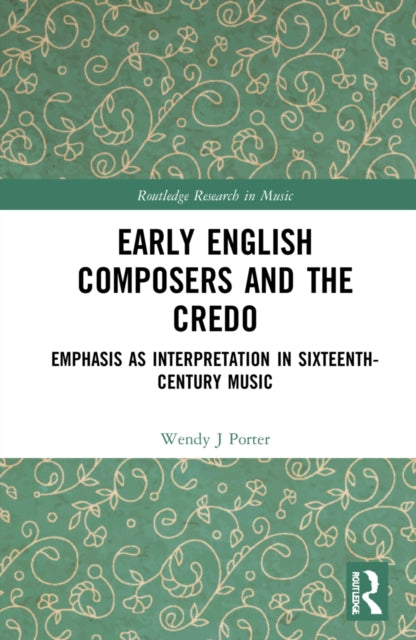
Wendy J. Porter
Early English Composers and the Credo: Emphasis as Interpretation in Sixteenth-Century Music
Early English Composers and the Credo: Emphasis as Interpretation in Sixteenth-Century Music
💎 Earn 811 Points (£8.11) on this item.
We can order this item for you. Delivery usually takes about 4 to 6 weeks.
This item is not held in our immediate stock. We will order it for you after checkout.
Estimated delivery: About 4 to 6 weeks
YOU SAVE £9.63
- Condition: Brand new
- UK Delivery times: Usually arrives within 2 - 3 working days
- UK Shipping: Fee starts at £2.39. Subject to product weight & dimension
Bulk ordering. Want 15 or more copies? Get a personalised quote and bigger discounts. Learn more about bulk orders.
Couldn't load pickup availability
- More about Early English Composers and the Credo: Emphasis as Interpretation in Sixteenth-Century Music
A new approach to early modern English liturgical music is presented, using musical-linguistic analysis to explore how composers used emphasis to create different interpretations of the religious text. This research is relevant to musicology, music theory, and religious history.
Format: Hardback
Length: 270 pages
Publication date: 24 March 2022
Publisher: Taylor & Francis Ltd
The study of early modern English music employs a cutting-edge musical-linguistic approach, delving into the intricate interplay between music and language. By analyzing the emphasis placed on specific words and phrases, researchers gain fresh insights into the liturgical music of composers, revealing how their settings shape diverse interpretations of religious texts. This field of study holds significant importance for musicology, music theory, and religious history, as it sheds light on the cultural and theological dimensions of music during this period.
Early modern English music, a rich tapestry of sound and expression, emerges from the vibrant cultural landscape of 16th and 17th century England. This period witnessed a remarkable fusion of traditional English folk melodies with the influences of continental European music, resulting in a unique and captivating musical tradition. One of the key approaches employed in the study of early modern English music is the musical-linguistic approach. This approach involves analyzing the intricate relationship between music and language, exploring how composers use musical elements such as rhythm, melody, harmony, and instrumentation to convey meaning and evoke emotions. By examining the emphasis placed on specific words and phrases in liturgical music, researchers gain valuable insights into the composers' intentions and the theological messages they sought to convey. For example, in the works of John Blow, a prominent composer of the late 16th century, the emphasis on certain words and phrases highlights the importance of the text in shaping the musical interpretation. Blow's compositions, such as "Ave Maria," are characterized by their dramatic and expressive qualities, which are closely linked to the emotional intensity of the religious text. Through the analysis of emphasis, researchers can uncover the underlying themes and messages that composers intended to communicate to their audiences. Moreover, the study of early modern English music offers valuable insights into the cultural and theological dimensions of the period. The liturgical music of this era was closely intertwined with the religious practices and beliefs of the time, reflecting the social and political context of the period. Composers were often commissioned to write music for specific religious ceremonies, such as weddings, funerals, and masses, and their compositions reflected the religious values and beliefs of their patrons. For instance, the works of Thomas Tallis, a renowned composer of the early 17th century, were often commissioned by the Anglican Church and were characterized by their rich harmonies and intricate counterpoint, reflecting the church's emphasis on the beauty and majesty of God. In addition to its musical and cultural significance, the study of early modern English music also has practical applications in the field of musicology and music theory. By examining the techniques and styles employed by composers, researchers can gain a deeper understanding of the evolution of musical composition and the development of musical notation. The study of early modern English music also provides valuable resources for music educators, performers, and scholars, as it offers a wealth of historical information and musical examples that can be studied and appreciated. In conclusion, the study of early modern English music employs a cutting-edge musical-linguistic approach, delving into the intricate interplay between music and language. By analyzing the emphasis placed on specific words and phrases in liturgical music, researchers gain fresh insights into the composers' intentions and the theological messages they sought to convey. This field of study holds significant importance for musicology, music theory, and religious history, as it sheds light on the cultural and theological dimensions of music during this period.
Dimension: 229 x 152 (mm)
ISBN-13: 9781032047584
UK and International shipping information
UK and International shipping information
UK Delivery and returns information:
- Delivery within 2 - 3 days when ordering in the UK.
- Shipping fee for UK customers from £2.39. Fully tracked shipping service available.
- Returns policy: Return within 30 days of receipt for full refund.
International deliveries:
Shulph Ink now ships to Australia, Belgium, Canada, France, Germany, Ireland, Italy, India, Luxembourg Saudi Arabia, Singapore, Spain, Netherlands, New Zealand, United Arab Emirates, United States of America.
- Delivery times: within 5 - 10 days for international orders.
- Shipping fee: charges vary for overseas orders. Only tracked services are available for most international orders. Some countries have untracked shipping options.
- Customs charges: If ordering to addresses outside the United Kingdom, you may or may not incur additional customs and duties fees during local delivery.