Susan Martineau
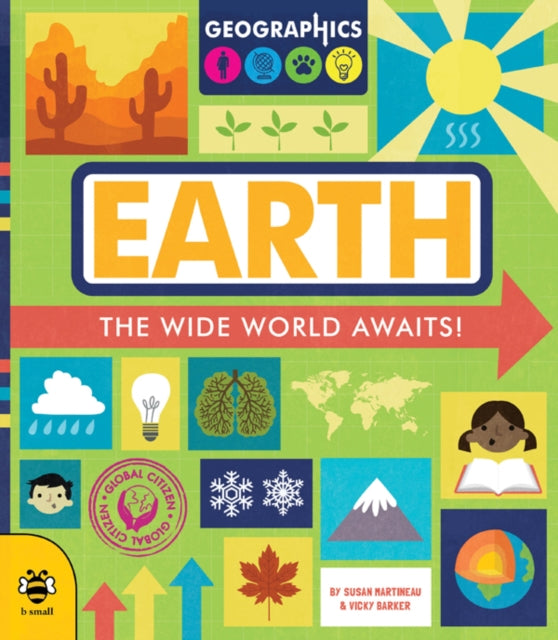
Earth
Earth
💎 Earn 26 Points (£0.26) on this item.
YOU SAVE £0.78
- Condition: Brand new
- UK Delivery times: Usually arrives within 2 - 3 working days
- UK Shipping: Fee starts at £2.39. Subject to product weight & dimension
Bulk ordering. Want 15 or more copies? Get a personalised quote and bigger discounts. Learn more about bulk orders.
Couldn't load pickup availability
- More about Earth
Explore the physical geography of Planet Earth with fascinating facts and figures that will stay with you for a lifetime.
\n Format: Paperback / softback
\n Length: 24 pages
\n Publication date: 01 February 2019
\n Publisher: b small publishing limited
\n
Planet Earth is a fascinating place with many different physical features. From the volcanoes that erupt and spew hot lava to the water cycle that keeps the planet alive, there is a lot to learn about our home. In this article, we will explore some of the most interesting physical geography of Planet Earth.
Volcanoes are one of the most impressive physical features of Planet Earth. These giant mountains are formed when hot molten rock from the Earth's mantle rises to the surface. The pressure and heat of the rock cause it to melt and form a molten liquid that can flow for miles before cooling and solidifying. Volcanoes can be found all over the world, but some of the most famous include Mount Everest in Nepal, Mount Fuji in Japan, and Mount Kilimanjaro in Tanzania.
Mount Everest is the highest mountain in the world, standing at an impressive 29,032 feet (8,848 meters) above sea level. It is located in the Himalayas, a mountain range that stretches across Asia and into Europe. Mount Everest is famous for its stunning views and challenging climbing routes, which have attracted thousands of adventurers over the years.
Mount Fuji is another famous volcano located in Japan. It is the tallest mountain in Japan and stands at an impressive 12,388 feet (3,776 meters) above sea level. Mount Fuji is famous for its symmetrical cone shape and is often used as a symbol of Japan.
Mount Kilimanjaro is a volcano located in Tanzania. It is the highest mountain in Africa and stands at an impressive 19,341 feet (5,895 meters) above sea level. Mount Kilimanjaro is famous for its three volcanic cones, which include Kibo, Mawenzi, and Shira, and for its stunning views of the African plains.
Another important physical feature of Planet Earth is the water cycle. This cycle involves the movement of water from the Earth's surface to the atmosphere and back to the Earth's surface. The water cycle is essential for life on Earth and is responsible for many of the planet's natural processes, such as precipitation, evaporation, and condensation.
The water cycle begins with the sun heating the Earth's surface, which causes water to evaporate from the oceans, lakes, and rivers. The evaporated water rises into the atmosphere and forms clouds. As the clouds cool, they become heavy with water droplets and fall back to the Earth's surface as precipitation.
The precipitation that falls on the Earth's surface can take many different forms, including rain, snow, sleet, and hail. Rain is the most common form of precipitation and is formed when water droplets in the clouds collide with raindrops. Snow is formed when the temperature is cold enough for the water droplets to freeze into ice crystals. Sleet is formed when the temperature is cold enough for the water droplets to freeze into ice crystals, but the wind blows before they can fall to the ground. Hail is formed when the temperature is cold enough for the water droplets to freeze into ice crystals, but the wind is strong enough to carry them away from the clouds before they can fall to the ground.
The water that falls to the Earth's surface can be used for many different purposes, including drinking, irrigation, and electricity generation. It can also be stored in reservoirs and used for hydroelectric power generation.
In addition to the water cycle, Planet Earth has many other physical features that are important for life on the planet. These include the Earth's magnetic field, which protects the planet from harmful solar radiation, and the Earth's atmosphere, which provides oxygen and other gases that are essential for life.
The Earth's magnetic field is generated by the movement of molten iron in the Earth's core. The magnetic field is divided into two parts: the magnetic north pole and the magnetic south pole. The magnetic north pole is located near the North Pole and the magnetic south pole is located near the South Pole.
The Earth's magnetic field is important for protecting the planet from harmful solar radiation. The sun emits a stream of charged particles called the solar wind, which can damage the Earth's atmosphere and surface. The Earth's magnetic field acts as a shield, trapping the solar wind and preventing it from reaching the Earth's surface.
The Earth's atmosphere is also important for life on the planet. The atmosphere provides oxygen and other gases that are essential for life. The atmosphere is made up of a mixture of gases, including nitrogen, oxygen, and carbon dioxide.
In addition to the water cycle and the Earth's magnetic field, Planet Earth has many other physical features that are important for life on the planet. These include the Earth's climate, which is affected by the amount of sunlight that the Earth receives, the amount of greenhouse gases that the Earth emits, and the amount of wind and ocean currents that the Earth experiences.
The Earth's climate is affected by the amount of sunlight that the Earth receives. The more sunlight that the Earth receives, the warmer the planet becomes. This is because sunlight is a form of energy that the Earth absorbs and converts into heat.
The amount of greenhouse gases that the Earth emits is also important for the Earth's climate. Greenhouse gases, such as carbon dioxide and methane, trap heat in the Earth's atmosphere and prevent it from escaping into space. This can lead to global warming, which is a phenomenon in which the Earth's temperature rises due to the increase in greenhouse gases.
The amount of wind and ocean currents that the Earth experiences is also important for the Earth's climate. Wind and ocean currents can transport heat and moisture around the planet, which can affect the temperature and precipitation patterns of different regions.
In conclusion, Planet Earth is a fascinating place with many different physical features. From the volcanoes that erupt and spew hot lava to the water cycle that keeps the planet alive, there is a lot to learn about our home. In this article, we have explored some of the most interesting physical geography of Planet Earth, including Mount Everest, Mount Fuji, Mount Kilimanjaro, the water cycle, the Earth's magnetic field, and the Earth's atmosphere. We have also discussed the importance of these physical features for life on the planet, including their role in protecting the planet from harmful solar radiation, providing oxygen and other gases that are essential for life, and affecting the Earth's climate. As we continue to explore and learn more about the world around us, we can better appreciate the beauty and complexity of our home planet.
\n Weight: 144g\n
Dimension: 217 x 249 x 6 (mm)\n
ISBN-13: 9781911509868\n \n
This item can be found in:
UK and International shipping information
UK and International shipping information
UK Delivery and returns information:
- Delivery within 2 - 3 days when ordering in the UK.
- Shipping fee for UK customers from £2.39. Fully tracked shipping service available.
- Returns policy: Return within 30 days of receipt for full refund.
International deliveries:
Shulph Ink now ships to Australia, Belgium, Canada, France, Germany, Ireland, Italy, India, Luxembourg Saudi Arabia, Singapore, Spain, Netherlands, New Zealand, United Arab Emirates, United States of America.
- Delivery times: within 5 - 10 days for international orders.
- Shipping fee: charges vary for overseas orders. Only tracked services are available for most international orders. Some countries have untracked shipping options.
- Customs charges: If ordering to addresses outside the United Kingdom, you may or may not incur additional customs and duties fees during local delivery.