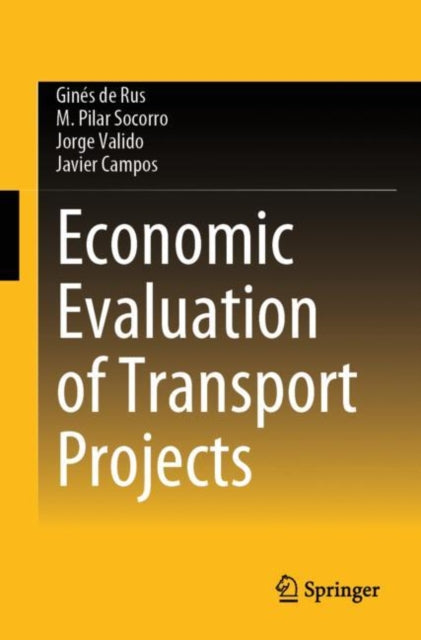
Gines de Rus,M. Pilar Socorro,Jorge Valido,Javier Campos
Economic Evaluation of Transport Projects
Economic Evaluation of Transport Projects
💎 Earn 247 Points (£2.47) on this item.
We can order this item for you. Delivery usually takes about 4 to 6 weeks.
This item is not held in our immediate stock. We will order it for you after checkout.
Estimated delivery: About 4 to 6 weeks
YOU SAVE £10.44
- Condition: Brand new
- UK Delivery times: Usually arrives within 2 - 3 working days
- UK Shipping: Fee starts at £2.39. Subject to product weight & dimension
Bulk ordering. Want 15 or more copies? Get a personalised quote and bigger discounts. Learn more about bulk orders.
Couldn't load pickup availability
- More about Economic Evaluation of Transport Projects
The book provides a guide to economic evaluation of transport policies and investment projects through cost-benefit analysis (CBA), covering CBA of transportation projects and policies and introducing fundamental concepts. It emphasizes practical applications with real-world examples, such as high-speed rail investment and air transport subsidization, and provides a basic model for evaluation with explicit assumptions and practical evaluation rules. It is an excellent resource for students, practitioners, and policymakers involved in transport economics and evaluation.
Format: Paperback / softback
Length: 116 pages
Publication date: 02 August 2023
Publisher: Springer International Publishing AG
Book Overview
This book is a comprehensive guide to the economic evaluation of transport policies and investment projects through cost-benefit analysis (CBA). It covers the CBA of transportation projects and policies, and introduces the fundamental concepts of CBA before considering their application in real-world settings. A distinct focus of the book is on the practical applications of CBA, with real-world examples of CBA such as high-speed rail investment and the subsidization of air transport illustrating the importance of using a rigorous analytical framework to evaluate transport projects and policies. The primary objective of this book is to present a basic model for the evaluation of transport projects and policies, with explicit assumptions and practical evaluation rules derived from it. The rules and measurement criteria derived from this model are applied to the examples mentioned above. Overall, this book is an excellent resource for students, practitioners, and policymakers involved in transport economics and evaluation, as it provides a comprehensive understanding of the principles and applications of CBA in the transport sector.
Introduction
Cost-benefit analysis (CBA) is a widely used tool for evaluating the economic impact of transport policies and investment projects. It involves comparing the costs of a project or policy with its benefits, to determine whether it is worthwhile to proceed with the project or policy. CBA can be used to evaluate a wide range of transport projects and policies, including high-speed rail investment, the subsidization of air transport, and the construction of new roads and highways. The primary objective of CBA is to ensure that the benefits of a project or policy outweigh the costs, so that the project or policy can be implemented successfully. However, CBA can be complex and challenging to implement, and there are many different approaches to CBA. This book provides a comprehensive overview of CBA, including its assumptions, principles, and applications. It also includes real-world examples of CBA, to illustrate the practical applications of CBA in the transport sector.
Assumptions and Principles
CBA is based on a set of assumptions and principles. These assumptions and principles include the following:
- The project or policy is feasible and will be implemented successfully.
- The costs and benefits of the project or policy are measurable and can be quantified.
- The costs and benefits of the project or policy are relevant to the decision-making process.
- The costs and benefits of the project or policy are distributed fairly among the stakeholders.
- The costs and benefits of the project or policy are discounted to account for the time value of money.
Applications of CBA
CBA can be used to evaluate a wide range of transport projects and policies. Some of the most common applications of CBA include the following:
- High-speed rail investment: High-speed rail investment is a major investment that can have significant economic benefits. CBA can be used to evaluate the costs and benefits of high-speed rail investment, to determine whether it is worthwhile to proceed with the project.
- Subsidization of air transport: Subsidization of air transport is a common policy that can have significant economic benefits. CBA can be used to evaluate the costs and benefits of air transport subsidies, to determine whether they are effective in promoting economic growth.
- Construction of new roads and highways: Construction of new roads and highways can have significant economic benefits. CBA can be used to evaluate the costs and benefits of new road and highway construction, to determine whether they are worthwhile to proceed with the project.
- Public transportation: Public transportation is a popular form of transportation that can have significant economic benefits. CBA can be used to evaluate the costs and benefits of public transportation, to determine whether it is worthwhile to invest in public transportation infrastructure.
- Transportation infrastructure: Transportation infrastructure is a critical component of the economy. CBA can be used to evaluate the costs and benefits of transportation infrastructure, to determine whether it is worthwhile to invest in transportation infrastructure.
Conclusion
In conclusion, this book is a comprehensive guide to the economic evaluation of transport policies and investment projects through cost-benefit analysis (CBA). It covers the CBA of transportation projects and policies, and introduces the fundamental concepts of CBA before considering their application in real-world settings. A distinct focus of the book is on the practical applications of CBA, with real-world examples of CBA such as high-speed rail investment and the subsidization of air transport illustrating the importance of using a rigorous analytical framework to evaluate transport projects and policies. The primary objective of this book is to present a basic model for the evaluation of transport projects and policies, with explicit assumptions and practical evaluation rules derived from it. The rules and measurement criteria derived from this model are applied to the examples mentioned above. Overall, this book is an excellent resource for students, practitioners, and policymakers involved in transport economics and evaluation, as it provides a comprehensive understanding of the principles and applications of CBA in the transport sector.
Weight: 203g
Dimension: 235 x 155 (mm)
ISBN-13: 9783031359583
Edition number: 1st ed. 2023
This item can be found in:
UK and International shipping information
UK and International shipping information
UK Delivery and returns information:
- Delivery within 2 - 3 days when ordering in the UK.
- Shipping fee for UK customers from £2.39. Fully tracked shipping service available.
- Returns policy: Return within 30 days of receipt for full refund.
International deliveries:
Shulph Ink now ships to Australia, Belgium, Canada, France, Germany, Ireland, Italy, India, Luxembourg Saudi Arabia, Singapore, Spain, Netherlands, New Zealand, United Arab Emirates, United States of America.
- Delivery times: within 5 - 10 days for international orders.
- Shipping fee: charges vary for overseas orders. Only tracked services are available for most international orders. Some countries have untracked shipping options.
- Customs charges: If ordering to addresses outside the United Kingdom, you may or may not incur additional customs and duties fees during local delivery.