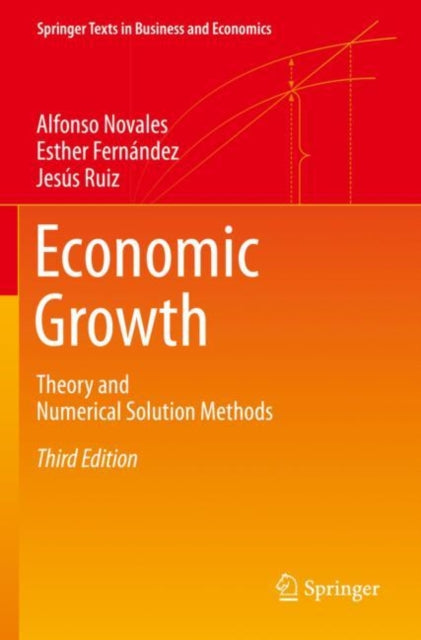
Alfonso Novales,Esther Fernandez,Jesus Ruiz
Economic Growth: Theory and Numerical Solution Methods
Economic Growth: Theory and Numerical Solution Methods
💎 Earn 371 Points (£3.71) on this item.
We can order this item for you. Delivery usually takes about 4 to 6 weeks.
This item is not held in our immediate stock. We will order it for you after checkout.
Estimated delivery: About 4 to 6 weeks
YOU SAVE £15.66
- Condition: Brand new
- UK Delivery times: Usually arrives within 2 - 3 working days
- UK Shipping: Fee starts at £2.39. Subject to product weight & dimension
Bulk ordering. Want 15 or more copies? Get a personalised quote and bigger discounts. Learn more about bulk orders.
Couldn't load pickup availability
- More about Economic Growth: Theory and Numerical Solution Methods
This book provides a comprehensive overview of deterministic and stochastic Growth Theory and computational methods for numerical solutions. It covers exogenous and endogenous growth, non-monetary and monetary models, and applies them to fiscal and monetary policy analysis. It includes analytical discussions, spreadsheets, and Matlab files to illustrate theoretical results and simulate economic policy interventions. The third edition includes typographical errors, new chapters on frequentist and Bayesian estimation, and improved notation.
Format: Paperback / softback
Length: 655 pages
Publication date: 05 December 2022
Publisher: Springer-Verlag Berlin and Heidelberg GmbH & Co. KG
This is the third revised and expanded edition of a book on deterministic and stochastic growth theory and the computational methods required to produce numerical solutions. Exogenous and endogenous growth, non-monetary and monetary models are thoroughly reviewed. Special attention is paid to the use of these models for fiscal and monetary policy analysis. Models under modern theories of the business cycle, new Keynesian macroeconomics, and dynamic stochastic general equilibrium models can be considered special cases of economic growth models, and they can be analyzed by the theoretical and numerical procedures provided in the textbook. Analytical discussions are presented in full detail. The book is self-contained and designed so that the student advances in the theoretical and computational issues in parallel. Spreadsheets are used to solve simple examples. Matlab files are provided on an accompanying website to illustrate theoretical results from all chapters as well as to simulate the effects of economic policy interventions. The logical structure of these program files is described in numerical exercise-type sections, where the output of these programs is also interpreted. The third edition corrects a few typographical errors, includes two new and original chapters on frequentist and Bayesian estimation, and improves some notation.
Introduction
This is the third revised and expanded edition of a book on deterministic and stochastic growth theory and the computational methods required to produce numerical solutions. Exogenous and endogenous growth, non-monetary and monetary models are thoroughly reviewed. Special attention is paid to the use of these models for fiscal and monetary policy analysis. Models under modern theories of the business cycle, new Keynesian macroeconomics, and dynamic stochastic general equilibrium models can be considered special cases of economic growth models, and they can be analyzed by the theoretical and numerical procedures provided in the textbook. Analytical discussions are presented in full detail. The book is self-contained and designed so that the student advances in the theoretical and computational issues in parallel. Spreadsheets are used to solve simple examples. Matlab files are provided on an accompanying website to illustrate theoretical results from all chapters as well as to simulate the effects of economic policy interventions. The logical structure of these program files is described in numerical exercise-type sections, where the output of these programs is also interpreted. The third edition corrects a few typographical errors, includes two new and original chapters on frequentist and Bayesian estimation, and improves some notation.
Exogenous and Endogenous Growth Models
Exogenous and endogenous growth models are fundamental tools for analyzing economic growth. These models assume that the level of economic activity is determined by a set of exogenous variables, such as investment, technology, and human capital, and endogenous variables, such as labor supply and demand. The key assumption of these models is that the economy is subject to certain constraints, such as the law of diminishing returns and the law of increasing returns.
Exogenous and endogenous growth models have been used extensively in the field of economics to analyze a wide range of economic phenomena, including economic growth, unemployment, inflation, and financial crises. These models have also been used to develop economic policy interventions, such as fiscal and monetary policies.
One of the key advantages of exogenous and endogenous growth models is that they allow for a more comprehensive analysis of economic growth. These models can incorporate a wide range of economic variables, including investment, technology, and human capital, and can also account for the interactions between these variables. This allows for a more accurate analysis of economic growth and can help policymakers develop more effective economic policy interventions.
However, exogenous and endogenous growth models also have some limitations. One of the main limitations of these models is that they assume that the economy is subject to certain constraints, such as the law of diminishing returns and the law of increasing returns. However, these constraints may not always hold in real-world situations, and this can lead to inaccurate predictions of economic growth.
Another limitation of exogenous and endogenous growth models is that they can be difficult to implement and interpret. These models require a significant amount of data and computational power to implement, and they can also be difficult to interpret and explain to policymakers and the general public.
Despite these limitations, exogenous and endogenous growth models remain a valuable tool for analyzing economic growth. These models allow for a more comprehensive analysis of economic growth and can help policymakers develop more effective economic policy interventions.
Non-Monetary and Monetary Models
Non-monetary and monetary models are two different approaches to analyzing economic growth. Non-monetary models focus on the non-monetary factors that influence economic growth, such as technological change, innovation, and human capital. Monetary models, on the other hand, focus on the monetary factors that influence economic growth, such as interest rates, inflation, and monetary policy.
Non-monetary models have been used extensively in the field of economics to analyze a wide range of economic phenomena, including economic growth, unemployment, inflation, and financial crises. These models have also been used to develop economic policy interventions, such as fiscal and monetary policies.
One of the key advantages of non-monetary models is that they allow for a more comprehensive analysis of economic growth. These models can incorporate a wide range of non-monetary variables, such as technological change, innovation, and human capital, and can also account for the interactions between these variables. This allows for a more accurate analysis of economic growth and can help policymakers develop more effective economic policy interventions.
However, non-monetary models also have some limitations. One of the main limitations of these models is that they assume that the economy is subject to certain constraints, such as the law of diminishing returns and the law of increasing returns. However, these constraints may not always hold in real-world situations, and this can lead to inaccurate predictions of economic growth.
Another limitation of non-monetary models is that they can be difficult to implement and interpret. These models require a significant amount of data and computational power to implement, and they can also be difficult to interpret and explain to policymakers and the general public.
Despite these limitations, non-monetary models remain a valuable tool for analyzing economic growth. These models allow for a more comprehensive analysis of economic growth and can help policymakers develop more effective economic policy interventions.
Fiscal and Monetary Policy Analysis
Fiscal and monetary policy analysis is a critical component of economic growth. Fiscal policy refers to the use of government spending and taxation to influence economic growth. Monetary policy refers to the use of central bank policies, such as interest rates and inflation targets, to influence economic growth.
Fiscal and monetary policy analysis is a complex and multifaceted process. It requires a deep understanding of economic theory and a thorough analysis of economic data. It also requires a strong understanding of the political and social context in which economic policy is developed and implemented.
Fiscal and monetary policy analysis is a critical component of economic growth. Fiscal policy refers to the use of government spending and taxation to influence economic growth. Monetary policy refers to the use of central bank policies, such as interest rates and inflation targets, to influence economic growth.
Fiscal policy can be used to stimulate economic growth by increasing government spending on infrastructure, education, and healthcare. This can increase demand for goods and services, which can stimulate economic growth. Fiscal policy can also be used to reduce unemployment by increasing government spending on job training and employment programs.
Monetary policy can be used to stimulate economic growth by reducing interest rates and increasing the money supply. This can encourage borrowing and spending, which can stimulate economic growth. Monetary policy can also be used to control inflation by reducing the money supply and raising interest rates.
Fiscal and monetary policy analysis is a complex and multifaceted process. It requires a deep understanding of economic theory and a thorough analysis of economic data. It also requires a strong understanding of the political and social context in which economic policy is developed and implemented.
Fiscal and monetary policy analysis is a critical component of economic growth. Fiscal policy can be used to stimulate economic growth by increasing government spending on infrastructure, education, and healthcare. Monetary policy can be used to stimulate economic growth by reducing interest rates and increasing the money supply.
Conclusion
In conclusion, this is the third revised and expanded edition of a book on deterministic and stochastic growth theory and the computational methods required to produce numerical solutions. Exogenous and endogenous growth models, non-monetary and monetary models, and fiscal and monetary policy analysis are all critical components of economic growth. These models allow for a more comprehensive analysis of economic growth and can help policymakers develop more effective economic policy interventions.
However, these models also have some limitations. These limitations include the assumption of certain constraints, such as the law of diminishing returns and the law of increasing returns, and the difficulty of implementing and interpreting these models. Despite these limitations, exogenous and endogenous growth models, non-monetary and monetary models, and fiscal and monetary policy analysis remain a valuable tool for analyzing economic growth.
This book is designed to provide students with a comprehensive understanding of economic growth theory and the computational methods required to produce numerical solutions. It is self-contained and designed so that the student advances in the theoretical and computational issues in parallel. Spreadsheets are used to solve simple examples, and Matlab files are provided on an accompanying website to illustrate theoretical results from all chapters as well as to simulate the effects of economic policy interventions.
The logical structure of these program files is described in numerical exercise-type sections, where the output of these programs is also interpreted. The third edition corrects a few typographical errors, includes two new and original chapters on frequentist and Bayesian estimation, and improves some notation.
In conclusion, this is the third revised and expanded edition of a book on deterministic and stochastic growth theory and the computational methods required to produce numerical solutions. Exogenous and endogenous growth models, non-monetary and monetary models, and fiscal and monetary policy analysis are all critical components of economic growth. These models allow for a more comprehensive analysis of economic growth and can help policymakers develop more effective economic policy interventions.
However, these models also have some limitations. These limitations include the assumption of certain constraints, such as the law of diminishing returns and the law of increasing returns, and the difficulty of implementing and interpreting these models. Despite these limitations, exogenous and endogenous growth models, non-monetary and monetary models, and fiscal and monetary policy analysis remain a valuable tool for analyzing economic growth.
Weight: 1021g
Dimension: 235 x 155 (mm)
ISBN-13: 9783662639849
Edition number: 3rd ed. 2022
This item can be found in:
UK and International shipping information
UK and International shipping information
UK Delivery and returns information:
- Delivery within 2 - 3 days when ordering in the UK.
- Shipping fee for UK customers from £2.39. Fully tracked shipping service available.
- Returns policy: Return within 30 days of receipt for full refund.
International deliveries:
Shulph Ink now ships to Australia, Belgium, Canada, France, Germany, Ireland, Italy, India, Luxembourg Saudi Arabia, Singapore, Spain, Netherlands, New Zealand, United Arab Emirates, United States of America.
- Delivery times: within 5 - 10 days for international orders.
- Shipping fee: charges vary for overseas orders. Only tracked services are available for most international orders. Some countries have untracked shipping options.
- Customs charges: If ordering to addresses outside the United Kingdom, you may or may not incur additional customs and duties fees during local delivery.