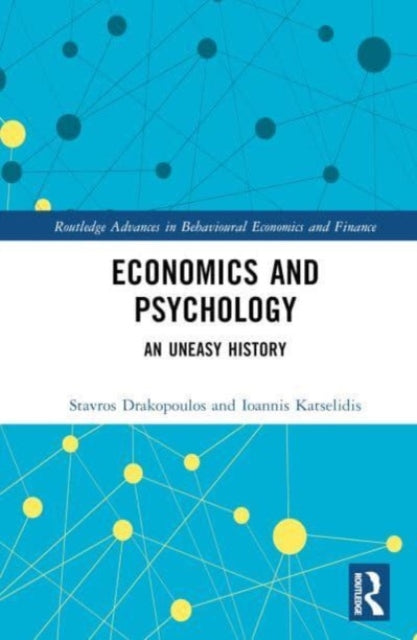
StavrosDrakopoulos,Ioannis Katselidis
Economics and Psychology: An Uneasy History
Economics and Psychology: An Uneasy History
💎 Earn 811 Points (£8.11) on this item.
We can order this item for you. Delivery usually takes about 4 to 6 weeks.
This item is not held in our immediate stock. We will order it for you after checkout.
Estimated delivery: About 4 to 6 weeks
YOU SAVE £9.63
- Condition: Brand new
- UK Delivery times: Usually arrives within 2 - 3 working days
- UK Shipping: Fee starts at £3.89. Subject to product weight & dimension
Bulk ordering. Want 15 or more copies? Get a personalised quote and bigger discounts. Learn more about bulk orders.
Couldn't load pickup availability
- More about Economics and Psychology: An Uneasy History
The relationship between economics and psychology has a long and complex history,with classical economists and pre-marginalist writers influencing early arguments supporting the interplay between the two disciplines. Following the marginalist revolution, early neoclassical economists attempted to expel psychological concepts from economic analysis, but non-mainstream traditions continued to acknowledge the significance of psychology. The revival of psychology in economics came with the emergence and development of new behavioural economics and the economics of subjective well-being. The current debate concerning the relationship between economics and psychology is explored.
Format: Hardback
Length: 124 pages
Publication date: 01 December 2023
Publisher: Taylor & Francis Ltd
The relationship between economics and psychology has been a subject of intense scrutiny in recent years, fueled by the rise of modern behavioral economics and the growing interest in subjective well-being research. This comprehensive book delves into the historical relationship between these two disciplines, tracing the evolution of thought from classical economists to pre-marginalists and the marginalist revolution. It explores how influential economists like Jevons and Edgeworth incorporated psychological concepts into their economic analysis, despite efforts by early neoclassical economists to expel them. The book also highlights the continued influence of non-mainstream traditions, such as old behavioral economics, in acknowledging the significance of psychology in economic analysis. The revival of psychology in economics, particularly with the emergence and development of new behavioral economics as a distinct branch, has been a significant trend in recent decades. This revival has been further aided by the economics of subjective well-being, which emphasizes the importance of individual well-being and happiness in economic decision-making. The book concludes by examining the current state of the debate concerning the relationship between economics and psychology, highlighting the ongoing challenges and opportunities for collaboration between these two fields.
The relationship between economics and psychology has been a subject of intense scrutiny in recent years, fueled by the rise of modern behavioral economics and the growing interest in subjective well-being research. This comprehensive book delves into the historical relationship between these two disciplines, tracing the evolution of thought from classical economists to pre-marginalists and the marginalist revolution. It explores how influential economists like Jevons and Edgeworth incorporated psychological concepts into their economic analysis, despite efforts by early neoclassical economists to expel them. The book also highlights the continued influence of non-mainstream traditions, such as old behavioral economics, in acknowledging the significance of psychology in economic analysis. The revival of psychology in economics, particularly with the emergence and development of new behavioral economics as a distinct branch, has been a significant trend in recent decades. This revival has been further aided by the economics of subjective well-being, which emphasizes the importance of individual well-being and happiness in economic decision-making. The book concludes by examining the current state of the debate concerning the relationship between economics and psychology, highlighting the ongoing challenges and opportunities for collaboration between these two fields.
Weight: 410g
Dimension: 234 x 156 (mm)
ISBN-13: 9781032132013
UK and International shipping information
UK and International shipping information
We deliver throughout the United Kingdom and to 128 countries and territories worldwide, including the United States, Australia, Canada, Germany, Spain and France.