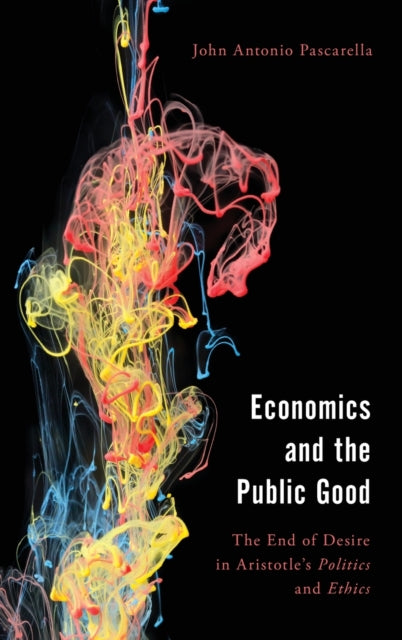
John Antonio Pascarella
Economics and the Public Good: The End of Desire in Aristotle's Politics and Ethics
Economics and the Public Good: The End of Desire in Aristotle's Politics and Ethics
💎 Earn 584 Points (£5.84) on this item.
We can order this item for you. Delivery usually takes about 4 to 6 weeks.
This item is not held in our immediate stock. We will order it for you after checkout.
Estimated delivery: About 4 to 6 weeks
- Condition: Brand new
- UK Delivery times: Usually arrives within 2 - 3 working days
- UK Shipping: Fee starts at £2.39. Subject to product weight & dimension
Bulk ordering. Want 15 or more copies? Get a personalised quote and bigger discounts. Learn more about bulk orders.
Couldn't load pickup availability
- More about Economics and the Public Good: The End of Desire in Aristotle's Politics and Ethics
Aristotle's political philosophy provides a perspective of economics and politics that offers readers the experience of the knowledge they need to desire and live within the limit of the good.
Format: Hardback
Length: 402 pages
Publication date: 07 March 2022
Publisher: Bloomsbury Publishing PLC
Economics and politics are two closely related fields that have a significant impact on our daily lives. Economics is the study of how individuals, groups, and societies allocate scarce resources to meet their needs and desires. It involves analyzing the production, distribution, and consumption of goods and services, as well as the factors that influence these processes. Politics, on the other hand, is the study of how power is exercised and distributed within a society. It involves analyzing the institutions, processes, and policies that govern society, as well as the relationships between individuals and groups.
One of the key questions that economics and politics address is the nature of economic growth. Economic growth is the increase in the production of goods and services over time, which can lead to increased prosperity and improved living standards. However, economic growth can also have negative consequences, such as environmental degradation, inequality, and social unrest. Economists study the factors that drive economic growth, such as technological innovation, investment, and human capital. They also develop policies to promote economic growth, such as tax cuts, government spending, and trade policies.
Another important question that economics and politics address is the distribution of wealth and income. Wealth and income are distributed unevenly across society, with some individuals and groups having much more than others. This can lead to social and economic inequality, which can have negative consequences for individuals and society as a whole. Economists study the factors that drive income inequality, such as discrimination, market failures, and government policies. They also develop policies to address income inequality, such as progressive taxation, social welfare programs, and labor market regulations.
Economics and politics also interact with each other in a variety of ways. For example, economic policies can have political consequences, such as changes in the distribution of power and the level of government spending. Political decisions can also have economic consequences, such as changes in the level of economic growth and the distribution of wealth and income.
One of the challenges that economists and politicians face is the issue of climate change. Climate change is a global problem that is caused by human activity, and it has significant consequences for the economy and society. Economists study the economic impacts of climate change, such as the costs of adapting to climate change and the costs of reducing greenhouse gas emissions. They also develop policies to address climate change, such as carbon taxes, renewable energy subsidies, and climate change adaptation programs.
Politicians also play a critical role in addressing climate change. They can enact policies to reduce greenhouse gas emissions, such as carbon taxes and renewable energy subsidies, and they can also promote climate change adaptation programs. However, politicians face a number of challenges in addressing climate change, such as opposition from industry groups and political polarization.
Another important question that economics and politics address is the issue of social justice. Social justice is the idea that all individuals should have equal access to the resources and opportunities that are necessary for a good life. Economists study the factors that drive social inequality, such as discrimination, market failures, and government policies. They also develop policies to address social inequality, such as affirmative action programs, social welfare programs, and labor market regulations.
Politicians also play a critical role in addressing social justice. They can enact policies to promote social justice, such as affirmative action programs and social welfare programs, and they can also promote policies that address the root causes of social inequality, such as discrimination and market failures. However, politicians face a number of challenges in addressing social justice, such as opposition from industry groups and political polarization.
In conclusion, economics and politics are two closely related fields that have a significant impact on our daily lives. Economics is the study of how individuals, groups, and societies allocate scarce resources to meet their needs and desires, while politics is the study of how power is exercised and distributed within a society. Economics and politics interact with each other in a variety of ways, and they face a number of challenges in addressing important issues such as economic growth, income inequality, climate change, and social justice. By studying the political philosophy of Aristotle, readers can gain a deeper understanding of the nature of economics and politics and how they can be used to promote a more just and sustainable society.
Weight: 767g
Dimension: 228 x 159 x 36 (mm)
ISBN-13: 9781786608437
This item can be found in:
UK and International shipping information
UK and International shipping information
UK Delivery and returns information:
- Delivery within 2 - 3 days when ordering in the UK.
- Shipping fee for UK customers from £2.39. Fully tracked shipping service available.
- Returns policy: Return within 30 days of receipt for full refund.
International deliveries:
Shulph Ink now ships to Australia, Belgium, Canada, France, Germany, Ireland, Italy, India, Luxembourg Saudi Arabia, Singapore, Spain, Netherlands, New Zealand, United Arab Emirates, United States of America.
- Delivery times: within 5 - 10 days for international orders.
- Shipping fee: charges vary for overseas orders. Only tracked services are available for most international orders. Some countries have untracked shipping options.
- Customs charges: If ordering to addresses outside the United Kingdom, you may or may not incur additional customs and duties fees during local delivery.