Tim Williams,Kat O'Connor
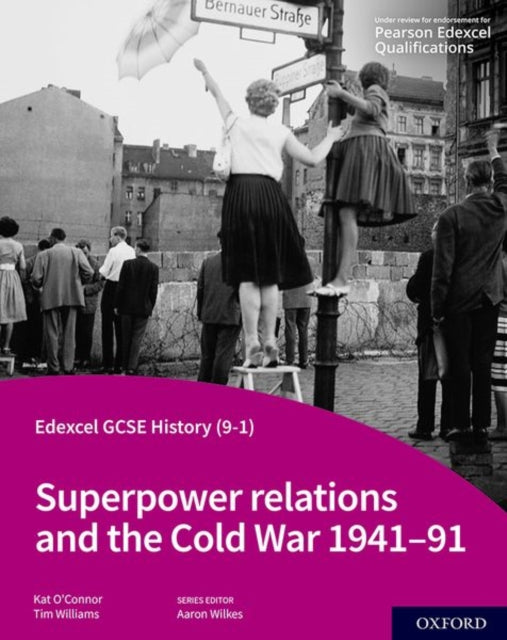
Edexcel GCSE History (9-1): Superpower relations and the Cold War 1941-91 Student Book
Edexcel GCSE History (9-1): Superpower relations and the Cold War 1941-91 Student Book
💎 Earn 98 Points (£0.98) on this item.
- Condition: Brand new
- UK Delivery times: Usually arrives within 2 - 3 working days
- UK Shipping: Fee starts at £3.89. Subject to product weight & dimension
Bulk ordering. Want 15 or more copies? Get a personalised quote and bigger discounts. Learn more about bulk orders.
Couldn't load pickup availability
- More about Edexcel GCSE History (9-1): Superpower relations and the Cold War 1941-91 Student Book
The Superpower Relations and the Cold War 1941-91 Student Book is part of Oxford's Edexcel GCSE History series, providing up-to-date exam practice and an accessible approach to help students get the best grades. It covers a 50-year period, the Cold War crisis, and the collapse of the Soviet Union, with exam-style questions, Nail it! features, Sources and Interpretations, and Later On and Earlier On features. It is endorsed by Edexcel and is perfect for use alongside Kerboodle for auto-marked quizzes, exam practice, film clips, and continuing exam support.
Format: Paperback / softback
Publication date: 17 March 2022
Publisher: Oxford University Press
The Cold War, a defining era of global politics, spanned from 1941 to 1991. It was a period characterized by intense rivalry and conflict between the United States and the Soviet Union, two superpowers that emerged after World War II. Superpower relations and the Cold War were intricately linked, with each nation seeking to assert its dominance and influence on the world stage.
The Cold War began shortly after the end of World War II, when the United States and the Soviet Union emerged as the world's two superpowers. The two nations had different ideologies and goals, with the United States advocating for democracy, capitalism, and individual freedom, while the Soviet Union promoted communism, socialism, and state control.
The Cold War was characterized by a series of proxy wars, economic sanctions, and military buildups. The two nations competed for dominance in the Middle East, Asia, and Africa, and they also engaged in a nuclear arms race, which saw both sides develop and stockpile nuclear weapons.
The Cold War also had a significant impact on global politics and international relations. It led to the formation of the United Nations, an international organization designed to promote peace, security, and cooperation among nations. The Cold War also contributed to the development of the arms control and disarmament treaty, which aimed to reduce the threat of nuclear war.
However, the Cold War also had a negative impact on the world. It led to the division of Europe into two camps, with the Soviet Union controlling Eastern Europe and the United States controlling Western Europe. It also contributed to the rise of authoritarianism and totalitarianism in many parts of the world, as nations sought to assert their dominance and control over their populations.
The Cold War came to an end in 1991 with the collapse of the Soviet Union. The fall of the Soviet Union was a result of a combination of factors, including economic collapse, political instability, and the rise of democratic movements in Eastern Europe. The end of the Cold War marked a new era of global politics, with the United States emerging as the sole superpower.
In conclusion, superpower relations and the Cold War were a defining era of global politics that spanned from 1941 to 1991. The two nations had different ideologies and goals, and they competed for dominance on the world stage through a series of proxy wars, economic sanctions, and military buildups. The Cold War had a significant impact on global politics and international relations, and it led to the formation of the United Nations and the arms control and disarmament treaty. However, it also had a negative impact on the world, leading to the division of Europe and the rise of authoritarianism and totalitarianism. The end of the Cold War in 1991 marked a new era of global politics, with the United States emerging as the sole superpower.
Weight: 344g
Dimension: 235 x 423 x 10 (mm)
ISBN-13: 9781382029858
Edition number: 1
UK and International shipping information
UK and International shipping information
We deliver throughout the United Kingdom and to 128 countries and territories worldwide, including the United States, Australia, Canada, Germany, Spain and France.