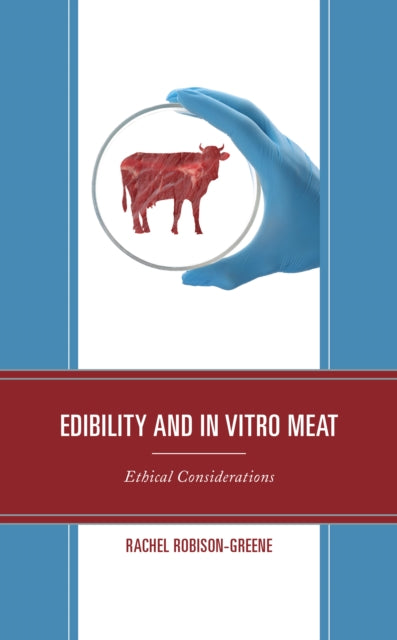
Rachel Robison-Greene
Edibility and In Vitro Meat: Ethical Considerations
Edibility and In Vitro Meat: Ethical Considerations
We can order this item for you. Delivery usually takes about 4 to 6 weeks.
This item is not held in our immediate stock. We will order it for you after checkout.
Estimated delivery: About 4 to 6 weeks
- Condition: Brand new
- UK Delivery times: Usually arrives within 2 - 3 working days
- UK Shipping: Fee starts at £3.89. Subject to product weight & dimension
Bulk ordering. Want 15 or more copies? Get a personalised quote and bigger discounts. Learn more about bulk orders.
Couldn't load pickup availability
- More about Edibility and In Vitro Meat: Ethical Considerations
In vitro meat production has the potential to reduce the severity of animal exploitation, environmental destruction, biodiversity loss, and challenges to human health, but it raises ethical questions that must be addressed. Rachel Robison-Greene argues that in vitro meat should be implemented and that we should re-think how we use the term "edible."
Format: Hardback
Length: 160 pages
Publication date: 14 November 2022
Publisher: Bloomsbury Publishing Plc
Consumers and policy makers face unprecedented choices regarding the way we eat in the years to come. If we continue on our current path of food production, we risk increasing levels of animal exploitation, environmental destruction, biodiversity loss, and challenges to human health. In vitro meat production, or the process of growing meat in a lab, has the potential to address these problems. This proposal would fundamentally change our food systems.
Edibility and In Vitro Meat: Ethical Considerations explores the ethical questions that are important to consider at every stage of this process. Rachel Robison-Greene considers arguments for and against the production of in vitro meat, as well as challenges for implementation. She argues that in vitro meat should be implemented and that we should re-think how we use the term "edible."
One of the main arguments against the production of in vitro meat is that it is unnatural. Some argue that meat should only be produced through traditional farming methods, which involve raising animals in a natural environment. However, in vitro meat production does not involve the use of animals, and therefore, it is not unnatural.
Another argument against the production of in vitro meat is that it is expensive. The process of growing meat in a lab is currently more expensive than traditional farming methods, and it is likely to remain so for some time. However, the cost of in vitro meat production is expected to decrease over time as the technology becomes more advanced.
Despite these arguments, there are several reasons why in vitro meat production should be implemented. One of the most important reasons is that it can reduce the severity of animal exploitation. Traditional farming methods involve the use of animals for food, and this can lead to a range of ethical issues, including animal cruelty, environmental degradation, and health problems. In vitro meat production, on the other hand, does not involve the use of animals, and therefore, it can reduce the number of animals that are killed for food.
In vitro meat production can also help to address environmental destruction. Traditional farming methods require a large amount of land, water, and energy, and this can lead to deforestation, soil erosion, and water pollution. In vitro meat production, on the other hand, requires a much smaller amount of land, water, and energy, and it can be produced in a controlled environment.
In vitro meat production can also help to address biodiversity loss. Traditional farming methods can lead to the loss of many species of animals and plants, and this can have a negative impact on the environment. In vitro meat production, on the other hand, can be produced from a variety of cell lines, and it can be designed to mimic the nutritional value of different types of meat.
However, there are also several challenges for the implementation of in vitro meat production. One of the most significant challenges is the need to ensure that the meat produced in a lab is safe for human consumption. In vitro meat production involves the use of cells, and it is possible that these cells could contain harmful bacteria or other pathogens.
Another challenge is the need to ensure that the meat produced in a lab is affordable for consumers. In vitro meat production is currently more expensive than traditional farming methods, and it is likely to remain so for some time. However, the cost of in vitro meat production is expected to decrease over time as the technology becomes more advanced.
In addition to these challenges, there are also ethical concerns about the use of in vitro meat. Some argue that in vitro meat is not truly edible, and that it is only a substitute for meat. Others argue that in vitro meat is a form of animal cruelty, and that it should not be allowed to be produced.
To address these ethical concerns, it is important to ensure that in vitro meat is produced in a safe and ethical manner. This includes ensuring that the cells used in the production of in vitro meat are healthy and that the meat produced is safe for human consumption. It also includes ensuring that the meat produced in a lab is affordable for consumers.
In conclusion, in vitro meat production has the potential to reduce the severity of animal exploitation, environmental destruction, biodiversity loss, and challenges to human health. However, there are also several challenges for the implementation of in vitro meat production, including the need to ensure that the meat produced in a lab is safe for human consumption and affordable for consumers. By addressing these challenges, we can ensure that in vitro meat is a viable and sustainable alternative to traditional farming methods.
Weight: 392g
Dimension: 160 x 235 x 19 (mm)
ISBN-13: 9781793614667
UK and International shipping information
UK and International shipping information
We deliver throughout the United Kingdom and to 128 countries and territories worldwide, including the United States, Australia, Canada, Germany, Spain and France.