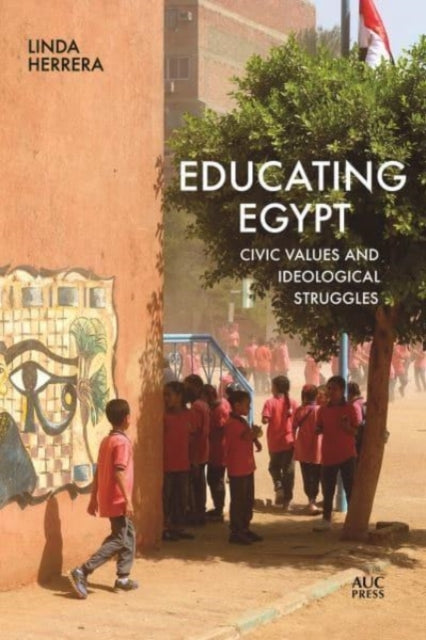
Linda Herrera
Educating Egypt: Civic Values and Ideological Struggles
Educating Egypt: Civic Values and Ideological Struggles
We can order this item for you. Delivery usually takes about 4 to 6 weeks.
This item is not held in our immediate stock. We will order it for you after checkout.
Estimated delivery: About 4 to 6 weeks
YOU SAVE £5.28
- Condition: Brand new
- UK Delivery times: Usually arrives within 2 - 3 working days
- UK Shipping: Fee starts at £3.89. Subject to product weight & dimension
Bulk ordering. Want 15 or more copies? Get a personalised quote and bigger discounts. Learn more about bulk orders.
Couldn't load pickup availability
- More about Educating Egypt: Civic Values and Ideological Struggles
The purpose of formal education in Egypt was to socialize children and youth into adopting certain attitudes and behaviors conducive to the regimes in power. However, control by the state over education was never entirely hegemonic. Educating Egypt explores the everyday practices,policy ideas,and ideological and political battles over education from the era of nation-building to the age of digital disruption, highlighting that schooling and education are ongoing battlegrounds of interests, ideas, and visions of the good society.
Format: Hardback
Length: 264 pages
Publication date: 20 February 2022
Publisher: American University in Cairo Press
From the 1952 revolution onward, a primary objective of formal education in Egypt was to socialize children and youth into adopting specific attitudes and behaviors that were conducive to the ruling regimes. The state's control over education was never absolute. National education faced increasing pressure due to a combination of the growing privatization of the education sector, the rise of political Islam, and rapidly evolving digital technologies.
Educating Egypt explores the multifaceted practices, policy ideas, and ideological and political battles surrounding education in Egypt from the era of nation-building in the twentieth century to the age of global change and digital disruption in the twenty-first century. Its central theme is that schooling and education, broadly defined, have consistently reflected broader debates about what constitutes the ideal citizen and the educated person. Drawing on three decades of ethnographic research within Egyptian schools and among Egyptian youth, Linda Herrera examines what transpires when education actors hold fundamentally different ideas about the purpose, provision, and meaning of education. Her research reveals that, rather than serving as a unifying social force, education is, in reality, an ongoing battleground of interests, ideas, and visions of the good society.
The 1952 revolution marked a significant turning point in Egypt's education system. Prior to this, education was primarily focused on religious and moral teachings, with little emphasis on secular knowledge. However, with the rise of Gamal Abdel Nasser and the establishment of the Free Officers Movement, a new vision for education emerged. The Free Officers aimed to modernize Egypt and create a new generation of educated and technologically skilled citizens who could contribute to the country's development.
To achieve this goal, the Free Officers implemented a series of educational reforms that aimed to expand access to education and improve the quality of education. They introduced a new curriculum that emphasized science, technology, engineering, and mathematics (STEM) subjects, as well as critical thinking and problem-solving skills. They also established new schools and universities, including the prestigious Cairo University, to provide more opportunities for education.
However, the Free Officers' vision of education was not without its challenges. One of the main criticisms was that it was heavily influenced by Western ideals and values, which were seen as antithetical to Egyptian culture and tradition. Some critics argued that the emphasis on STEM subjects and Western-style education was at the expense of traditional Egyptian arts and sciences, which were important for preserving the country's cultural heritage.
Another challenge was the growing privatization of the education sector. While the Free Officers aimed to expand access to education, they also allowed private companies and individuals to operate schools and universities. This led to a decline in the quality of education, as private operators were often more interested in profits than in providing quality education. Additionally, the privatization of education led to a concentration of wealth among a small elite, as access to education became increasingly expensive and exclusive.
Despite these challenges, the Free Officers' educational reforms were significant in shaping the modern education system in Egypt. They laid the foundation for a more secular and modern education system that emphasized critical thinking, problem-solving, and technological skills. They also established a new generation of educated and technologically skilled citizens who could contribute to the country's development.
However, the legacy of the Free Officers' education reforms is complex and multifaceted. While they were instrumental in modernizing Egypt's education system, they also faced criticism for their emphasis on Western ideals and values and for the growing privatization of the education sector. Today, Egypt's education system continues to evolve and adapt to the changing needs of society, with a growing emphasis on digital technologies and innovation.
In conclusion, Educating Egypt provides a comprehensive and nuanced exploration of the history, practices, and challenges of education in Egypt from the era of nation-building to the age of digital disruption. It highlights the complex and multifaceted nature of education as a social and political phenomenon, and it emphasizes the importance of understanding the diverse perspectives and interests that shape education policy and practice. By examining the everyday experiences of students, teachers, and policymakers, Educating Egypt offers a valuable insight into the ongoing struggle for educational reform and the pursuit of a more equitable and inclusive education system in Egypt.
ISBN-13: 9781649031693
UK and International shipping information
UK and International shipping information
We deliver throughout the United Kingdom and to 128 countries and territories worldwide, including the United States, Australia, Canada, Germany, Spain and France.