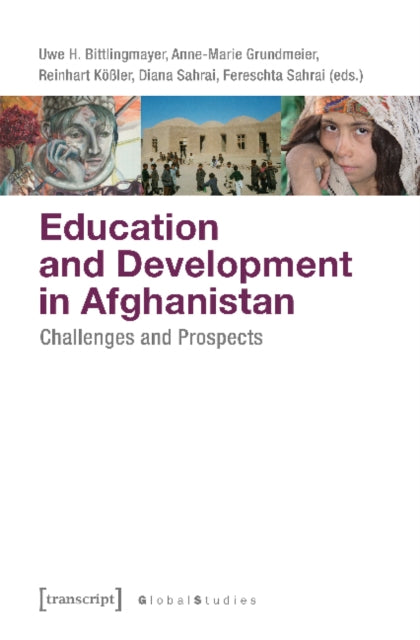
Anne-marie Grundmeier,Diana Sahrai,Fereschta Sahrai,Reinhart Koe ler,Uwe H. Bittlingmayer
Education and Development in Afghanistan - Challenges and Prospects
Education and Development in Afghanistan - Challenges and Prospects
💎 Earn 185 Points (£1.85) on this item.
We can order this item for you. Delivery usually takes about 4 to 6 weeks.
This item is not held in our immediate stock. We will order it for you after checkout.
Estimated delivery: About 4 to 6 weeks
YOU SAVE £7.83
- Condition: Brand new
- UK Delivery times: Usually arrives within 2 - 3 working days
- UK Shipping: Fee starts at £2.39. Subject to product weight & dimension
Bulk ordering. Want 15 or more copies? Get a personalised quote and bigger discounts. Learn more about bulk orders.
Couldn't load pickup availability
- More about Education and Development in Afghanistan - Challenges and Prospects
The current situation in Afghanistan is complex, with contradictory developments in security, economy, education, and peace. Despite initiatives, Afghanistan faces challenges in these areas. This volume explores the role of education in rebuilding a stable Afghan state and government, with contributions from sociologists, political and cultural scientists, development workers, educators, and artists from Germany and Afghanistan.
Format: Paperback / softback
Length: 400 pages
Publication date: 10 December 2021
Publisher: Transcript Verlag
After years of military interventions, the current situation in Afghanistan is highly ambivalent and partially contradictory, especially regarding the interplay of development, peace, security, education, and economy. Despite numerous initiatives, Afghanistan is still confronted with a poor security and economic condition. At the same time, enrollment numbers in schools and universities as well as the rate of academics reached a historical peak. This volume investigates the tension between these ambivalent developments. Sociologists, political and cultural scientists, along with development workers, educators, and artists from Germany and Afghanistan, discuss the idea that education is primary for rebuilding a stable Afghan state and government.
The current situation in Afghanistan is complex and multifaceted, with a range of positive and negative developments. On the one hand, there have been significant efforts to promote development, peace, security, education, and the economy in the country. For example, enrollment numbers in schools and universities have reached a historical peak, and the rate of academic achievement has also increased. This indicates that there is a growing interest in education among the Afghan population, and that the government is committed to improving the educational system.
On the other hand, the current situation in Afghanistan is also highly ambivalent and partially contradictory. Despite the positive developments in education, the country continues to face significant security and economic challenges. The security situation in Afghanistan is particularly concerning, with ongoing Taliban violence and instability posing a threat to the country's stability and development. The economy is also struggling, with high unemployment rates and limited access to basic services.
One of the key challenges facing Afghanistan is the tension between these ambivalent developments. On the one hand, education is seen as a critical tool for rebuilding a stable Afghan state and government. Education can help to promote social and economic development, reduce poverty, and improve the quality of life for the Afghan people. On the other hand, education can also be used as a tool for promoting political and social instability, particularly in the context of a country that has been affected by conflict for many years.
To address this tension, there have been numerous initiatives aimed at promoting education in Afghanistan. These initiatives have been led by the government, international organizations, and local communities. For example, the government has launched a number of programs aimed at improving access to education, particularly for girls and women. International organizations, such as the United Nations and the World Bank, have also provided funding and support for education initiatives in Afghanistan.
However, despite these efforts, there are still challenges that need to be addressed. One of the biggest challenges is the lack of infrastructure and resources in many parts of Afghanistan. This lack of infrastructure and resources makes it difficult for students to access education, particularly in rural areas. Additionally, there are also issues with the quality of education that is being provided. Many schools and universities lack the necessary resources and equipment to provide quality education to their students.
Another challenge is the issue of gender inequality in education. Despite the efforts of the government and international organizations to promote gender equality in education, there are still significant barriers to women's access to education. Women are often marginalized in Afghan society, and they face a range of barriers to accessing education, including cultural norms and traditions that prioritize male education.
To address these challenges, there is a need for a comprehensive and sustained effort to promote education in Afghanistan. This effort should involve the government, international organizations, local communities, and other stakeholders. The government should continue to invest in infrastructure and resources for education, particularly in rural areas. International organizations should provide funding and support for education initiatives, and they should also work to promote gender equality in education.
Local communities should also play a role in promoting education. Communities can provide support for schools and universities, and they can also work to promote gender equality in education. Additionally, communities can work to address cultural norms and traditions that prioritize male education and promote the importance of education for both boys and girls.
In conclusion, the current situation in Afghanistan is highly ambivalent and partially contradictory, especially regarding the interplay of development, peace, security, education, and the economy. Despite the positive developments in education, the country continues to face significant security and economic challenges. To address these challenges, there is a need for a comprehensive and sustained effort to promote education in Afghanistan. This effort should involve the government, international organizations, local communities, and other stakeholders. By working together, we can help to build a stable and prosperous Afghan state and government that is able to provide for the needs of its people.
Weight: 666g
Dimension: 226 x 147 x 15 (mm)
ISBN-13: 9783837636376
This item can be found in:
UK and International shipping information
UK and International shipping information
UK Delivery and returns information:
- Delivery within 2 - 3 days when ordering in the UK.
- Shipping fee for UK customers from £2.39. Fully tracked shipping service available.
- Returns policy: Return within 30 days of receipt for full refund.
International deliveries:
Shulph Ink now ships to Australia, Belgium, Canada, France, Germany, Ireland, Italy, India, Luxembourg Saudi Arabia, Singapore, Spain, Netherlands, New Zealand, United Arab Emirates, United States of America.
- Delivery times: within 5 - 10 days for international orders.
- Shipping fee: charges vary for overseas orders. Only tracked services are available for most international orders. Some countries have untracked shipping options.
- Customs charges: If ordering to addresses outside the United Kingdom, you may or may not incur additional customs and duties fees during local delivery.