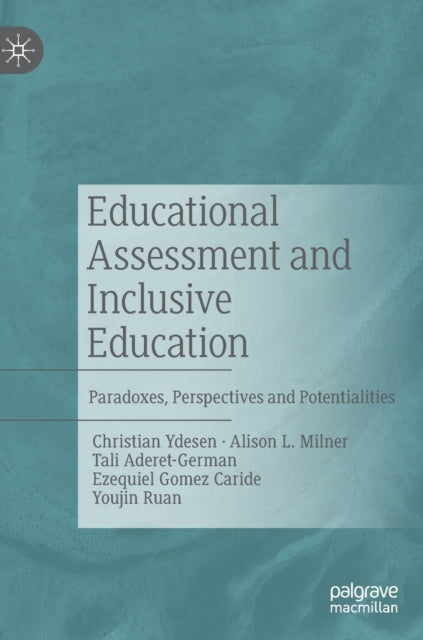
Christian Ydesen,Alison L. Milner,Tali Aderet-German,Ezequiel Gomez Caride,Youjin Ruan
Educational Assessment and Inclusive Education: Paradoxes, Perspectives and Potentialities
Educational Assessment and Inclusive Education: Paradoxes, Perspectives and Potentialities
💎 Earn 465 Points (£4.65) on this item.
YOU SAVE £16.83
- Condition: Brand new
- UK Delivery times: Usually arrives within 2 - 3 working days
- UK Shipping: Fee starts at £2.39. Subject to product weight & dimension
Bulk ordering. Want 15 or more copies? Get a personalised quote and bigger discounts. Learn more about bulk orders.
Couldn't load pickup availability
- More about Educational Assessment and Inclusive Education: Paradoxes, Perspectives and Potentialities
This book explores the interaction between assessment and inclusion agendas in education policies and practices across five countries, providing insights into the challenges and opportunities for stakeholders to mediate these two concerns.
Format: Hardback
Length: 357 pages
Publication date: 19 January 2023
Publisher: Springer International Publishing AG
This comprehensive book brings together a wealth of knowledge, experiences, and perspectives from policymakers and practitioners alike, focusing on the intricate interplay between the assessment and inclusion agenda. Through a rigorous analysis of comparative qualitative data from five diverse countries across four continents—Argentina, China, Denmark, England, and Israel—the book sheds light on the unique challenges and opportunities that arise when these two educational priorities converge.
The selection of these countries is driven by their distinct education policies, sociocultural contexts, and varying performance outcomes in standardized student assessments. By examining these specific contexts, the book offers valuable insights into the complexities and trade-offs involved in mediating these two educational concerns both in policy and practice.
One of the key findings of the book is the recognition of the inherent tensions and paradoxes that arise when attempting to balance assessment and inclusion. On the one hand, assessments are essential for measuring student learning and progress, providing valuable information for policymakers and educators to make informed decisions. On the other hand, assessments can inadvertently perpetuate biases and inequalities, particularly for marginalized students who may face additional barriers to achieving academic success.
The book explores these tensions through a series of case studies and vignettes, highlighting the experiences of policymakers, educators, and students in each country. These narratives provide a rich tapestry of perspectives, illustrating the challenges and successes that arise as stakeholders work to navigate the complex terrain of assessment and inclusion.
One of the key themes that emerges from the book is the importance of collaboration and partnership between policymakers, educators, and other stakeholders in developing and implementing effective assessment and inclusion policies. The book emphasizes the need for a holistic approach that considers the diverse needs of students and recognizes the role that assessment can play in promoting equity and inclusion.
Furthermore, the book highlights the importance of using data and evidence to inform decision-making and evaluate the impact of assessment and inclusion policies. By leveraging data to identify areas of strength and weakness, policymakers and educators can refine their approaches and ensure that they are making the most effective use of resources to support student learning and progress.
In conclusion, this book is a valuable resource for policymakers, educators, and other stakeholders interested in understanding the complex relationship between assessment and inclusion. Through a comparative analysis of data from five diverse countries, the book offers insights into the challenges and opportunities that arise as key stakeholders work to mediate these two educational concerns in both policy and practice. By promoting collaboration, partnership, and the use of data and evidence, the book aims to contribute to the development of more inclusive and equitable education systems worldwide.
Dimension: 210 x 148 (mm)
ISBN-13: 9783031190032
Edition number: 1st ed. 2022
This item can be found in:
UK and International shipping information
UK and International shipping information
UK Delivery and returns information:
- Delivery within 2 - 3 days when ordering in the UK.
- Shipping fee for UK customers from £2.39. Fully tracked shipping service available.
- Returns policy: Return within 30 days of receipt for full refund.
International deliveries:
Shulph Ink now ships to Australia, Belgium, Canada, France, Germany, Ireland, Italy, India, Luxembourg Saudi Arabia, Singapore, Spain, Netherlands, New Zealand, United Arab Emirates, United States of America.
- Delivery times: within 5 - 10 days for international orders.
- Shipping fee: charges vary for overseas orders. Only tracked services are available for most international orders. Some countries have untracked shipping options.
- Customs charges: If ordering to addresses outside the United Kingdom, you may or may not incur additional customs and duties fees during local delivery.