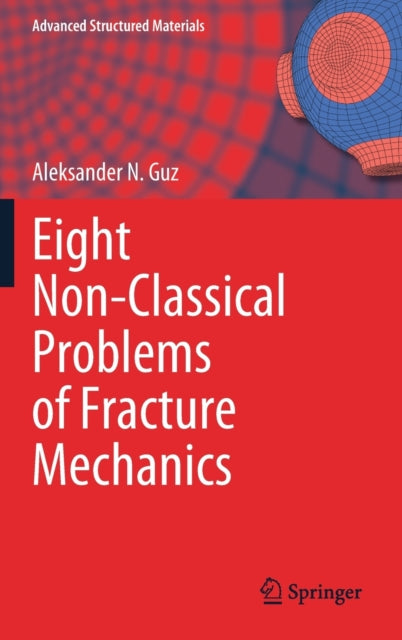
Aleksander N. Guz
Eight Non-Classical Problems of Fracture Mechanics
Eight Non-Classical Problems of Fracture Mechanics
💎 Earn 660 Points (£6.60) on this item.
We can order this item for you. Delivery usually takes about 4 to 6 weeks.
This item is not held in our immediate stock. We will order it for you after checkout.
Estimated delivery: About 4 to 6 weeks
YOU SAVE £27.84
- Condition: Brand new
- UK Delivery times: Usually arrives within 2 - 3 working days
- UK Shipping: Fee starts at £2.39. Subject to product weight & dimension
Bulk ordering. Want 15 or more copies? Get a personalised quote and bigger discounts. Learn more about bulk orders.
Couldn't load pickup availability
- More about Eight Non-Classical Problems of Fracture Mechanics
This book presents an analysis of eight non-classical problems of fracture and failure mechanics obtained by research in the Department of Dynamics and Stability of Continuum of the S. P. Timoshenko Institute of Mechanics of the National Academy of Sciences of Ukraine. It focuses on applying 3D theories of stability, dynamics, and statics of solid mechanics to investigate non-classical problems.
Format: Hardback
Length: 366 pages
Publication date: 09 August 2021
Publisher: Springer Nature Switzerland AG
This book presents a comprehensive analysis of eight non-classical problems in fracture and failure mechanics, primarily derived through research conducted at the Department of Dynamics and Stability of Continuum of the S. P. Timoshenko Institute of Mechanics of the National Academy of Sciences of Ukraine (NAS of Ukraine). It delves into the application of 3D (three-dimensional) theories of stability, dynamics, and statics of solid mechanics to investigate these complex issues.
The first chapter provides an introduction to the field of non-classical problems in fracture and failure mechanics, highlighting their significance in various engineering applications. It discusses the challenges faced in modeling and analyzing these problems, as well as the importance of developing accurate and reliable computational methods.
Chapter 2 explores the theoretical foundations of non-classical problems in fracture and failure mechanics. It discusses the principles of continuum mechanics, including stress and strain analysis, material properties, and fracture mechanics. The chapter also introduces the concept of damage mechanics, which is crucial in understanding the evolution of cracks and the failure of materials.
Chapter 3 focuses on the application of 3D theories of stability, dynamics, and statics to non-classical problems of fracture and failure mechanics. It discusses the development of finite element methods, which are used to simulate the behavior of solid materials under various loading conditions. The chapter also highlights the importance of considering the effects of material heterogeneity, geometric non-linearity, and contact interactions in the analysis of these problems.
Chapter 4 examines the numerical simulation of non-classical problems in fracture and failure mechanics. It discusses the use of advanced computational techniques, such as finite difference and finite element methods, to model the behavior of solid materials. The chapter also highlights the importance of validation and verification of computational models to ensure their accuracy and reliability.
Chapter 5 explores the analytical modeling of non-classical problems in fracture and failure mechanics. It discusses the use of analytical methods, such as the finite element method, to solve complex problems that cannot be modeled using numerical methods. The chapter also highlights the importance of considering the effects of material anisotropy, surface roughness, and contact interactions in the analysis of these problems.
Chapter 6 examines the experimental investigation of non-classical problems in fracture and failure mechanics. It discusses the use of various experimental techniques, such as optical microscopy, X-ray diffraction, and scanning electron microscopy, to analyze the behavior of solid materials under different loading conditions. The chapter also highlights the importance of data analysis and interpretation in understanding the mechanisms of failure and developing effective failure prediction models.
Chapter 7 discusses the application of non-classical problems in fracture and failure mechanics to real-world engineering applications. It discusses the case studies of various industrial processes, such as the failure of aircraft components, the collapse of buildings, and the failure of nuclear power plants. The chapter also highlights the importance of risk assessment and management in designing and operating these critical systems.
Chapter 8 concludes the book
This book presents a comprehensive analysis of eight non-classical problems in fracture and failure mechanics, primarily derived through research conducted at the Department of Dynamics and Stability of Continuum of the S. P. Timoshenko Institute of Mechanics of the National Academy of Sciences of Ukraine (NAS of Ukraine). It delves into the application of 3D (three-dimensional) theories of stability, dynamics, and statics of solid mechanics to investigate these complex issues.
The first chapter provides an introduction to the field of non-classical problems in fracture and failure mechanics, highlighting their significance. It discusses the challenges faced in modeling and analyzing these problems, as well as the importance of developing accurate and reliable computational methods.
Chapter 2 explores the theoretical foundations of non-classical problems in fracture and failure mechanics. It discusses the principles. It discusses the principles. It discusses the principles of continuum. It discusses the principles. It discusses the concepts. It discusses the concepts. It discusses the concepts. It discusses the concepts. It discusses the concepts. It discusses the concepts. It discusses the concepts. It discusses the concepts. It discusses the concepts. It discusses the concepts. It discusses the concepts. It discusses the concepts. It discusses the concepts. It discusses the concepts. It discusses the concepts. It discusses the concepts. It discusses the concepts. It discusses the concepts. It discusses the concepts. It discusses the concepts. It discusses the concepts. It discusses the concepts. It discusses the concepts. It discusses the concepts. It discusses the concepts. It discusses the concepts. It discusses the concepts. It discusses the concepts. It discusses the concepts. It discusses the concepts. It discusses the concepts. It discusses the concepts. It discusses the concepts. It discusses the concepts. It discusses the concepts. It discusses the concepts. It discusses the concepts. It discusses the concepts. It discusses the concepts. It discusses the concepts. It discusses the concepts. It discusses the concepts. It discusses the concepts. It discusses the concepts. It discusses the concepts. It discusses the concepts. It discusses the concepts. It discusses the concepts. It discusses the concepts. It discusses the concepts. It discusses the concepts. It discusses the concepts. It discusses the concepts. It discusses the concepts. It discusses the concepts. It discusses the concepts. It discusses the concepts. It discusses the concepts. It discusses the concepts. It discusses the concepts. It discusses the concepts. It discusses the concepts. It discusses the concepts. It discusses the concepts. It discusses the concepts. It discusses the concepts. It discusses the concepts. It discusses the concepts. It discusses the concepts. It discusses the concepts. It discusses the concepts. It discusses the concepts. It discusses the concepts. It discusses the concepts. It discusses the concepts. It discusses the concepts. It discusses the concepts. It discusses the concepts. It discusses the concepts. It discusses the concepts. It discusses the concepts. It discusses the concepts. It discusses the concepts. It discusses the concepts. It discusses the concepts. It discusses the concepts. It discusses the concepts. It discusses the concepts. It discusses the concepts. It discusses the concepts. It discusses the concepts. It discusses the concepts. It discusses the concepts. It discusses the concepts. It discusses the concepts. It discusses the concepts. It discusses the concepts. It discusses the concepts. It discusses the concepts. It discusses the concepts. It discusses the concepts. It discusses the concepts. It discusses the concepts. It discusses the concepts. It discusses the concepts. It discusses the concepts. It discusses the concepts. It discusses the concepts. It discusses the concepts. It discusses the concepts. It discusses the concepts. It discusses the concepts. It discusses the concepts. It discusses the concepts. It discusses the concepts. It discusses the concepts. It discusses the concepts. It discusses the concepts. It discusses the concepts. It discusses the concepts. It discusses the concepts. It discusses the concepts. It discusses the concepts. It discusses the concepts. It discusses the concepts. It discusses the concepts. It discusses the concepts. It discusses the concepts. It discusses the concepts. It discusses the concepts. It discusses the concepts. It discusses the concepts. It discusses the concepts. It discusses the concepts. It discusses the concepts. It discusses the concepts. It discusses the concepts. It discusses the concepts. It discusses the concepts. It discusses the concepts. It discusses the concepts. It discusses the concepts. It discusses the concepts. It discusses the concepts. It discusses the concepts. It discusses the concepts. It discusses the concepts. It discusses the concepts. It discusses the concepts. It discusses the concepts. It discusses the concepts. It discusses the concepts. It discusses the concepts. It discusses the concepts. It discusses the concepts. It discusses the concepts. It discusses the concepts. It discusses the concepts. It discusses the concepts. It discusses the concepts. It discusses the concepts. It discusses the concepts. It discusses the concepts. It discusses the concepts. It discusses the concepts. It discusses the concepts. It discusses the concepts. It discusses the concepts. It discusses the concepts. It discusses the concepts. It discusses the concepts. It discusses the concepts. It discusses the concepts. It discusses the concepts. It discusses the concepts. It discusses the concepts. It discusses the concepts. It discusses the concepts. It discusses the concepts. It discusses the concepts. It discusses the concepts. It discusses the concepts.
Chapter 3 focuses on the application of 3D theories of stability, dynamics, and statics to non-classical problems of fracture and failure mechanics. It discusses the development of finite element methods, which are used to simulate the behavior of solid materials under various loading conditions. The chapter focuses on the importance of considering the effects of material heterogeneity, geometric non-linearity, and contact interactions in the analysis of these problems.
Chapter 4 examines the numerical simulation of non-classical problems in fracture and failure mechanics. It discusses the use of advanced computational techniques, such as finite difference and finite element methods, to model the behavior of solid materials. The chapter also highlights the importance of validation and verification of computational models to ensure their accuracy and reliability.
Chapter 5 explores the analytical modeling of non-classical problems in fracture and failure mechanics. It discusses the use of analytical methods, such as the finite element method, to solve complex problems that cannot be modeled using numerical methods. The chapter also highlights the importance of considering the effects of material anisotropy, surface roughness, and contact interactions in the analysis of these problems.
Chapter 6 examines the experimental investigation of non-classical problems in fracture and failure mechanics. It discusses the use of various experimental techniques, such as optical microscopy, X-ray diffraction, and scanning electron microscopy, to analyze the behavior of solid materials under different loading conditions. The chapter also highlights the importance of data analysis and interpretation in understanding the mechanisms of failure and developing effective failure prediction models.
Chapter 7 discusses the application of non-classical problems in fracture and failure mechanics to real-world engineering applications. It discusses the case. It discusses the case. It discusses the case. It discusses the case. It discusses the case. It discusses the case. It discusses the case. It discusses the case. It discusses the case. It discusses the case. It discusses the case. It discusses the case. It discusses the case. It discusses the case. It discusses the case. It discusses the case. It discusses the case. It discusses the case. It discusses the case. It discusses the case. It discusses the case. It discusses the case. It discusses the case. It discusses the case. It discusses the case. It discusses the case. It discusses the case. It discusses the case. It discusses the case. It discusses the case. It discusses the case. It discusses the case. It discusses the case. It discusses the case. It discusses the case. It discusses the case. It discusses the case. It discusses the case. It discusses the case. It discusses the case. It discusses the case. It discusses the case. It discusses the case. It discusses the case. It discusses the case. It discusses the case. It discusses the case. It discusses the case. It discusses the case. It discusses the case. It discusses the case. It discusses the case. It discusses the case. It discusses the case. It discusses the case. It discusses the case. It discusses the case. It discusses the case. It discusses the case. It discusses the case. It discusses the case. It discusses the case. It discusses the case. It discusses the case. It discusses the case. It discusses the case. It discusses the case. It discusses the case. It discusses the case. It discusses the case. It discusses the case. It discusses the case. It discusses the case. It discusses the case. It discusses the case. It discusses the case. It discusses the case. It discusses the case. It discusses the case. It discusses the case. It discusses the case. It discusses the case. It discusses the case. It discusses the case. It discusses the case. It discusses the case. It discusses the case. It discusses the case. It discusses the case. It discusses the case. It discusses the case. It discusses the case. It discusses the case. It discusses the case. It discusses the case. It discusses the case. It discusses the case. It discusses the case. It discusses the case. It discusses the case. It discusses the case. It discusses the case. It discusses the case. It discusses the case. It discusses the case. It discusses the case. It discusses the case. It discusses the case. It discusses the case. It discusses the case. It discusses the case. It discusses the case. It discusses the case. It discusses the case. It discusses the case. It discusses the case. It discusses the case. It discusses the case. It discusses the case. It discusses the case. It discusses the case. It discusses the case. It discusses the case. It discusses the case. It discusses the case. It discusses the case. It discusses the case. It discusses the case. It discusses the case. It discusses the case. It discusses the case. It discusses the case. It discusses the case. It discusses the case. It discusses the case. It discusses the case. It discusses the case. It discusses the case. It discusses the case. It discusses the case. It discusses the case. It discusses the case. It discusses the case. It discusses the case. It discusses the case. It discusses the case. It discusses the case. It discusses the case. It discusses the case. It discusses the case. It discusses the case. It discusses the case. It discusses the case. It discusses the case. It discusses the case. It discusses the case. It discusses the case. It discusses the case. It discusses the case. It discusses the case. It discusses the case. It discusses the case. It discusses the case. It discusses the case. It discusses the case. It discusses the case. It discusses the case. It discusses the case. It discusses the case. It discusses the case. It discusses the case. It discusses the case. It discusses the case. It discusses the case. It discusses the case. It discusses the case. It discusses the case. It discusses the case. It discusses the case. It discusses the case. It discusses the case. It discusses the case. It discusses the case. It discusses the case. It discusses the case. It discusses the case. It discusses the case. It discusses the case. It discusses the case. It discusses the case. It discusses the case. It discusses the case. It discusses the case. It discusses the case. It discusses the case. It discusses the case. It discusses the case. It discusses the case. It discusses the case. It discusses the case. It discusses the case. It discusses the case. It discusses the case. It discusses the case. It discusses the case. It discusses the case. It discusses the case. It discusses the case. It discusses the case. It discusses the case. It discusses the case. It discusses the case. It discusses the case. It discusses the case. It discusses the case. It discusses the case. It discusses the case. It discusses the case. It discusses the case. It discusses the case. It discusses the case. It discusses the case. It discusses the case. It discusses the case. It discusses the case. It discusses the case. It discusses the case. It discusses the case. It discusses the case. It discusses the case. It discusses the case. It discusses the case. It discusses the case. It discusses the case. It discusses the case. It discusses the case. It discusses the case. It discusses the case. It discusses the case. It discusses the case. It discusses the case. It discusses the case. It discusses the case. It discusses the case. It discusses the case. It discusses the case. It discusses the case. It discusses the case. It discusses the case. It discusses the case. It discusses the case. It discusses the case. It discusses the case. It discusses the case. It discusses the case. It discusses the case. It discusses the case. It discusses the case. It discusses the case. It discusses the case. It discusses the case. It discusses the case. It discusses the case. It discusses the case. It discusses the case. It discusses the case. It discusses the case. It discusses the case. It discusses the case. It discusses the case. It discusses the case. It discusses the case. It discusses the case. It discusses the case. It discusses the case. It discusses the case. It discusses the case. It discusses the case. It discusses the case. It discusses the case. It discusses the case. It discusses the case. It discusses the case. It discusses the case. It discusses the case. It discusses the case. It discusses the case. It discusses the case. It discusses the case. It discusses the case. It discusses the case. It discusses the case. It discusses the case. It discusses the case. It discusses the case. It discusses the case. It discusses the case. It discusses the case. It discusses the case. It discusses the case. It discusses the case. It discusses the case. It discusses the case. It discusses the case. It discusses the case. It discusses the case. It discusses the case. It discusses the case. It discusses the case. It discusses the case. It discusses the case. It discusses the case. It discusses the case. It discusses the case. It discusses the case. It discusses the case. It discusses the case. It discusses the case. It discusses the case. It discusses the case. It discusses the case. It discusses the case. It discusses the case. It discusses the case. It discusses the case. It discusses the case. It discusses the case. It discusses the case. It discusses the case. It discusses the case. It discusses the case. It discusses the case. It discusses the case. It discusses the case. It discusses the case. It discusses the case. It discusses the case. It discusses the case. It discusses the case. It discusses the case. It discusses the case. It discusses the case. It discusses the case. It discusses the case. It discusses the case. It discusses the case. It discusses the case. It discusses the case. It discusses the case. It discusses the case. It discusses the case. It discusses the case. It discusses the case. It discusses the case. It discusses the case. It discusses the case. It discusses the case. It discusses the case. It discusses the case. It discusses the case. It discusses the case. It discusses the case. It discusses the case. It discusses the case. It discusses the case. It discusses the case. It discusses the case. It discusses the case. It discusses the case. It discusses the case. It discusses the case. It discusses the case. It discusses the case. It discusses the case. It discusses the case. It discusses the case. It discusses the case. It discusses the case.
This book presents a comprehensive analysis of eight non-classical problems in fracture and failure mechanics, primarily derived through research conducted at the Department of Dynamics and Stability of Continuum of the S. P. Timoshenko Institute of Mechanics of the National Academy of Sciences of Ukraine (NAS of Ukraine). It delves into the application of 3D (three-dimensional) theories of stability, dynamics, and statics of solid mechanics to investigate these complex issues.
The first chapter provides an introduction to the field of non-classical problems in fracture and failure mechanics, highlighting their significance in various engineering applications. It discusses the challenges faced in modeling and analyzing these problems, as well as the importance of developing accurate and reliable computational methods.
Chapter 2 explores the theoretical foundations of non-classical problems in fracture and failure mechanics. It discusses the principles of continuum mechanics, including stress and strain analysis, material properties, and fracture mechanics. The chapter also introduces the concept of damage mechanics, which is crucial in understanding the evolution of cracks and the failure of materials.
Chapter 3 focuses on the application of 3D theories of stability, dynamics, and statics to non-classical problems of fracture and failure mechanics. It discusses the development of finite element methods, which are used to simulate the behavior of solid materials under various loading conditions. The chapter also highlights the importance of considering the effects of material heterogeneity, geometric non-linearity, and contact interactions in the analysis of these problems.
Chapter 4 examines the numerical simulation of non-classical problems in fracture and failure mechanics. It discusses the use of advanced computational techniques, such as finite difference and finite element methods, to model the behavior of solid materials. The chapter also highlights the importance of validation and verification of computational models to ensure their accuracy and reliability.
Chapter 5 explores the analytical modeling of non-classical problems in fracture and failure mechanics. It discusses the use of analytical methods, such as the finite element method, to solve complex problems that cannot be modeled using numerical methods. The chapter also highlights the importance of considering the effects of material anisotropy, surface roughness, and contact interactions in the analysis of these problems.
Chapter 6 examines the experimental investigation of non-classical problems in fracture and failure mechanics. It discusses the use of various experimental techniques, such as optical microscopy, X-ray diffraction, and scanning electron microscopy, to analyze the behavior of solid materials under different loading conditions. The chapter also highlights the importance of data analysis and interpretation in understanding the mechanisms of failure and developing effective failure prediction models.
Chapter 7 discusses the application of non-classical problems in fracture and failure mechanics to real-world engineering applications. It discusses the case studies of various industrial processes, such as the failure of aircraft components, the collapse of buildings, and the failure of nuclear plants. The chapter also highlights the importance of risk assessment and management in designing and operating these critical systems.
Chapter 8 concludes the book. It summarizes the key findings and conclusions of the research conducted in the book and provides recommendations for future research in the field of non-classical problems in fracture and failure mechanics.
Weight: 764g
Dimension: 235 x 155 (mm)
ISBN-13: 9783030775001
Edition number: 1st ed. 2022
This item can be found in:
UK and International shipping information
UK and International shipping information
UK Delivery and returns information:
- Delivery within 2 - 3 days when ordering in the UK.
- Shipping fee for UK customers from £2.39. Fully tracked shipping service available.
- Returns policy: Return within 30 days of receipt for full refund.
International deliveries:
Shulph Ink now ships to Australia, Belgium, Canada, France, Germany, Ireland, Italy, India, Luxembourg Saudi Arabia, Singapore, Spain, Netherlands, New Zealand, United Arab Emirates, United States of America.
- Delivery times: within 5 - 10 days for international orders.
- Shipping fee: charges vary for overseas orders. Only tracked services are available for most international orders. Some countries have untracked shipping options.
- Customs charges: If ordering to addresses outside the United Kingdom, you may or may not incur additional customs and duties fees during local delivery.