ToddMcGowan
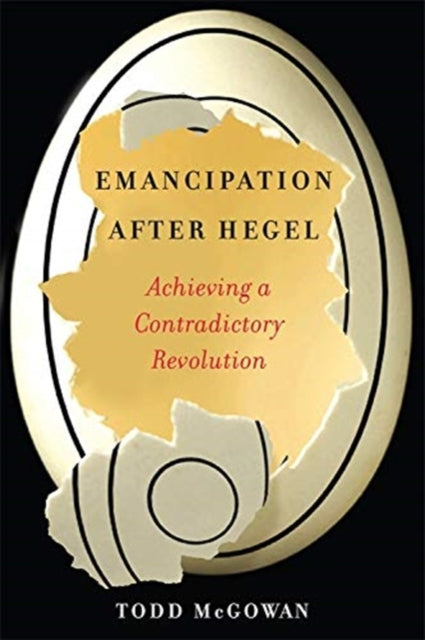
Emancipation After Hegel: Achieving a Contradictory Revolution
Emancipation After Hegel: Achieving a Contradictory Revolution
💎 Earn 100 Points (£1.00) on this item.
YOU SAVE £4.94
- Condition: Brand new
- UK Delivery times: Usually arrives within 2 - 3 working days
- UK Shipping: Fee starts at £2.39. Subject to product weight & dimension
Bulk ordering. Want 15 or more copies? Get a personalised quote and bigger discounts. Learn more about bulk orders.
Couldn't load pickup availability
- More about Emancipation After Hegel: Achieving a Contradictory Revolution
Hegel's thought is being rediscovered by contemporary thinkers as a resource for politics. In Emancipation After Hegel, Todd McGowan presents a radical Hegel who speaks to the world's challenges of right-wing populism, authoritarianism, neoliberalism, and economic inequalities. He argues that contradiction is essential and that we must sustain it rather than overcoming it or dismissing it. McGowan's book offers a way forward to a new politics of emancipation by reconciling us to the inevitability of contradiction and finding solidarity in not belonging.
\n Format: Paperback / softback
\n Length: 288 pages
\n Publication date: 01 June 2021
\n Publisher: Columbia University Press
\n
After the decline of Marxist Hegelianism that dominated the twentieth century, leading thinkers are rediscovering Hegel's thought as a resource for contemporary politics. What does a notoriously difficult nineteenth-century German philosopher have to offer the present? How should we understand Hegel, and what does understanding Hegel teach us about confronting our most urgent challenges?
In this book, Todd McGowan offers us a Hegel for the twenty-first century. Simultaneously an introduction to Hegel and a fundamental reimagining of Hegel's project, Emancipation After Hegel presents a radical Hegel who speaks to a world overwhelmed by right-wing populism, authoritarianism, neoliberalism, and economic inequalities. McGowan argues that the revolutionary core of Hegel's thought is contradiction. He reveals that contradiction is inexorable and that we must attempt to sustain it rather than overcoming it or dismissing it as a logical failure. McGowan contends that Hegel's notion of contradiction, when applied to contemporary problems, challenges any assertion of unitary identity as every identity is in tension with itself and dependent on others. An accessible and compelling reinterpretation of an often-misunderstood thinker, this book shows us a way forward to a new politics of emancipation as we reconcile ourselves to the inevitability of contradiction and find solidarity in not belonging.
The resurgence of Hegel's thought is a fascinating development in contemporary philosophy. After being marginalized for much of the twentieth century, Hegel's ideas are once again being explored by scholars and thinkers from various disciplines. This renewed interest is driven by a recognition of the relevance of Hegel's philosophical framework to address the complex challenges facing our world today.
One of the key reasons for Hegel's renewed appeal is his belief in the power of contradiction. Hegel saw contradiction as an essential aspect of the human experience and as a driving force behind social and political change. He believed that every idea, every institution, and every individual is in constant tension with itself and with other entities, and that this tension can lead to the emergence of new and innovative solutions.
In the context of contemporary politics, Hegel's notion of contradiction is particularly relevant. The world is facing a series of urgent challenges, including climate change, economic inequality, and political polarization. These challenges are complex and multifaceted, and they require a nuanced and multifaceted response. Hegel's philosophy provides a framework for understanding these challenges and for developing strategies for addressing them.
One of the key insights of Hegel's philosophy is that every individual and every institution is both a part of and separate from the larger social and political system. This means that we cannot understand these challenges in isolation from each other. We need to recognize the interconnectedness of all things and work towards creating a more harmonious and sustainable world.
Another important aspect of Hegel's philosophy is his emphasis on the importance of history. He believed that history is not just a record of past events but a living force that shapes the present and the future. Hegel saw the development of society as a continuous process of growth and transformation, and he believed that we can learn from the past and use it to guide our actions in the present and the future.
In the context of contemporary politics, Hegel's emphasis on history is particularly relevant. We need to understand the historical roots.
\n Weight: 412g\n
Dimension: 153 x 228 x 22 (mm)\n
ISBN-13: 9780231192712\n \n
This item can be found in:
UK and International shipping information
UK and International shipping information
UK Delivery and returns information:
- Delivery within 2 - 3 days when ordering in the UK.
- Shipping fee for UK customers from £2.39. Fully tracked shipping service available.
- Returns policy: Return within 30 days of receipt for full refund.
International deliveries:
Shulph Ink now ships to Australia, Belgium, Canada, France, Germany, Ireland, Italy, India, Luxembourg Saudi Arabia, Singapore, Spain, Netherlands, New Zealand, United Arab Emirates, United States of America.
- Delivery times: within 5 - 10 days for international orders.
- Shipping fee: charges vary for overseas orders. Only tracked services are available for most international orders. Some countries have untracked shipping options.
- Customs charges: If ordering to addresses outside the United Kingdom, you may or may not incur additional customs and duties fees during local delivery.