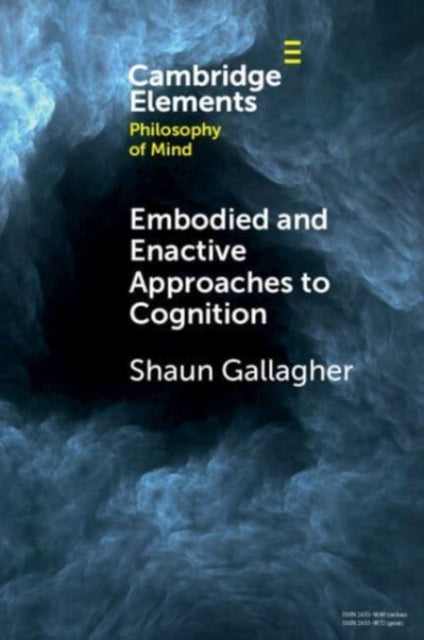
ShaunGallagher
Embodied and Enactive Approaches to Cognition
Embodied and Enactive Approaches to Cognition
💎 Earn 84 Points (£0.84) on this item.
YOU SAVE £1.01
- Condition: Brand new
- UK Delivery times: Usually arrives within 2 - 3 working days
- UK Shipping: Fee starts at £2.39. Subject to product weight & dimension
Bulk ordering. Want 15 or more copies? Get a personalised quote and bigger discounts. Learn more about bulk orders.
Couldn't load pickup availability
- More about Embodied and Enactive Approaches to Cognition
The element discusses contemporary theories of embodied cognition, including the 4Es, and explores their strengths and weaknesses in relation to the nature of the mind, the brain, and social cognition. It also provides a focus on enactive theory and its potential integrations with other embodied and extended theories.
Format: Paperback / softback
Length: 75 pages
Publication date: 03 August 2023
Publisher: Cambridge University Press
The study of embodied cognition explores contemporary theories that emphasize the role of the body in cognitive processes. These theories, often referred to as the "4Es" (embodied, embedded, extended, and enactive cognition), suggest that the mind is deeply intertwined with the physical world and that our experiences and thoughts are shaped by the interactions between our bodies and the environment.
One of the key concepts in embodied cognition is the idea that the mind is not a separate entity from the body, but rather an embodied entity that is constantly influenced and shaped by the body's movements, sensations, and interactions. This embodied perspective challenges the traditional view of the mind as a purely cognitive process that operates independently of the body.
Another important aspect of embodied cognition is the notion that the mind is embedded in the environment and that our perception, attention, and decision-making are influenced by the sensory information that we receive from the world around us. This embodied view suggests that our bodies are not just passive receivers of sensory information, but active agents that actively shape our experiences and perceptions.
Extended cognition, another key concept in embodied cognition, refers to the idea that the mind can extend beyond the body and interact with external objects and systems. This extended perspective suggests that the mind can use tools, language, and symbols to represent and manipulate the world around us and that these mental representations can have physical effects on the body.
Enactive cognition, the final key concept in embodied cognition, emphasizes the role of the body in generating and controlling behavior. This enactive perspective suggests that the mind is not just a passive observer of the world, but an active agent that actively shapes and influences the world through its movements and actions.
The study of embodied cognition has led to a range of diverse approaches to questions about the nature of the mind, the mind-body relationship, perceptual experience, mental representation, sense-making, the role of the environment, and social cognition. These approaches include embodied cognitive science, cognitive neuroscience, and cognitive psychology.
One of the strengths of embodied cognition is its ability to provide a more holistic understanding of human cognition. By integrating the study of the body and the environment, embodied cognition can help us to better understand how our thoughts, emotions, and behaviors are shaped by the physical world around us.
Another strength of embodied cognition is its ability to bridge the gap between the cognitive and the physical sciences. By integrating insights from cognitive neuroscience and cognitive psychology, embodied cognition can help us to better understand how the brain and the mind interact and how these interactions shape our cognitive processes.
However, embodied cognition also faces several challenges. One of the main challenges is the difficulty of measuring and quantifying the embodied aspects of cognition. Because the mind and the body are deeply intertwined, it can be difficult to isolate and measure the specific contributions of each to cognitive processes.
Another challenge is the difficulty of integrating embodied cognition with other theoretical perspectives, such as classic cognitivism and behaviorism. Some researchers argue that embodied cognition is too holistic and abstract to be fully integrated with these more reductionist approaches, while others argue that embodied cognition can provide a valuable complement to these approaches.
Despite these challenges, embodied cognition continues to be an active area of research and has the potential to revolutionize our understanding of human cognition. By integrating the study of the body and the environment, embodied cognition can help us to better understand how our thoughts, emotions, and behaviors are shaped by the physical world around us and how we can use this knowledge to improve our lives and well-being.
In conclusion, the study of embodied cognition explores contemporary theories that emphasize the role of the body in cognitive processes. These theories, often referred to as the "4Es" (embodied, embedded, extended, and enactive cognition), suggest that the mind is deeply intertwined with the physical world and that our experiences and thoughts are shaped by the interactions between our bodies and the environment. Embodied cognition has the potential to revolutionize our understanding of human cognition by providing a more holistic and integrated perspective on human thought and behavior. However, the study of embodied cognition also faces several challenges, and it is important to continue to develop and refine our understanding of this complex and fascinating field.
Weight: 148g
Dimension: 151 x 228 x 8 (mm)
ISBN-13: 9781009209809
This item can be found in:
UK and International shipping information
UK and International shipping information
UK Delivery and returns information:
- Delivery within 2 - 3 days when ordering in the UK.
- Shipping fee for UK customers from £2.39. Fully tracked shipping service available.
- Returns policy: Return within 30 days of receipt for full refund.
International deliveries:
Shulph Ink now ships to Australia, Belgium, Canada, France, Germany, Ireland, Italy, India, Luxembourg Saudi Arabia, Singapore, Spain, Netherlands, New Zealand, United Arab Emirates, United States of America.
- Delivery times: within 5 - 10 days for international orders.
- Shipping fee: charges vary for overseas orders. Only tracked services are available for most international orders. Some countries have untracked shipping options.
- Customs charges: If ordering to addresses outside the United Kingdom, you may or may not incur additional customs and duties fees during local delivery.