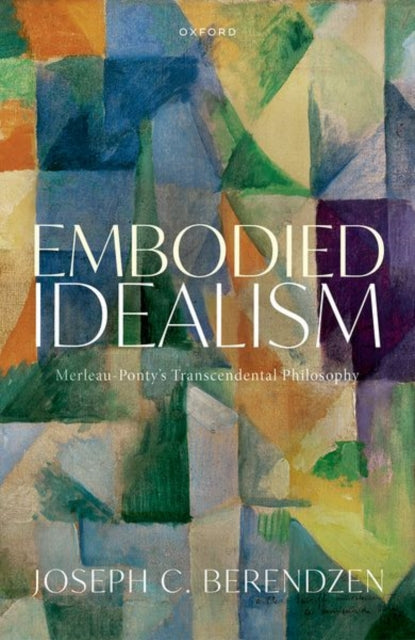
Joseph C.Berendzen
Embodied Idealism: Merleau-Ponty's Transcendental Philosophy
Embodied Idealism: Merleau-Ponty's Transcendental Philosophy
💎 Earn 424 Points (£4.24) on this item.
We can order this item for you. Delivery usually takes about 4 to 6 weeks.
This item is not held in our immediate stock. We will order it for you after checkout.
Estimated delivery: About 4 to 6 weeks
- Condition: Brand new
- UK Delivery times: Usually arrives within 2 - 3 working days
- UK Shipping: Fee starts at £3.89. Subject to product weight & dimension
Bulk ordering. Want 15 or more copies? Get a personalised quote and bigger discounts. Learn more about bulk orders.
Couldn't load pickup availability
- More about Embodied Idealism: Merleau-Ponty's Transcendental Philosophy
Embodied Idealism interprets Maurice Merleau-Ponty's early thought as transcendental idealism, which accommodates his criticisms of idealism while maintaining that our experience is inextricably structured by our minds and that reality is ontologically dependent on the mind. This interpretation emphasizes the importance of embodiment in understanding embodied consciousness and subjectivity and supports a novel form of idealism.
Format: Hardback
Length: 288 pages
Publication date: 22 June 2023
Publisher: Oxford University Press
Embodied Idealism presents a compelling interpretation of Maurice Merleau-Ponty's early thought, primarily evident in his works such as The Structure of Behavior and Phenomenology of Perception. This interpretation challenges the prevailing understanding of Merleau-Ponty's philosophy and presents alternative viewpoints that warrant consideration. While Merleau-Ponty's early works exhibit a critical stance towards idealism, it is important to note that his criticisms are directed towards specific aspects of idealist theories rather than representing a wholesale rejection of idealism.
Merleau-Ponty's early philosophy posits that our experience is intricately shaped by our minds, emphasizing the role of embodiment in shaping our perception and understanding of the world. This perspective aligns with the transcendental idealist notion that the mind plays a fundamental role in shaping reality. However, Merleau-Ponty's transcendental idealism differs from traditional intellectualist idealism associated with his teacher, Léon Brunschvicg. While Merleau-Ponty critiques certain aspects of intellectualist idealism, he does not reject idealism in its entirety. Instead, he proposes a unique form of idealism that is grounded in the body and its sensory experiences.
One of the key aspects of Merleau-Ponty's embodied idealism is his emphasis on the primacy of the body in shaping our consciousness and subjective experiences. He argues that the body is not merely an instrument for the mind but an active participant in the construction of meaning and understanding. Through the body, we gain access to the world and interact with others, and it is through our embodied experiences that we develop a sense of self and subjectivity. Merleau-Ponty's view of embodied consciousness and subjectivity supports a novel form of idealism that emphasizes the interconnection between the mind and the body and the role of the body in shaping our understanding of reality.
In contrast to traditional idealism, which often posits a mind-independent reality, Merleau-Ponty's embodied idealism recognizes the ontological dependence of reality on the mind. However, he also maintains that reality can be understood in a way that is not entirely mind-dependent. Merleau-Ponty suggests that the mind and the body are interdependent, with the body providing the foundation for the mind's activities and the mind shaping the body's experiences. This interdependence allows for a sense of reality that is both mind-independent and embodied.
Merleau-Ponty's transcendental idealism is characterized by its commitment to the body and its sensory experiences. He argues that the body is not merely a physical object but a complex system of sensations, movements, and relationships that shape our perception and understanding of the world. Through the body, we gain access to the world and interact with others, and it is through our embodied experiences that we develop a sense of self and subjectivity. Merleau-Ponty's embodied idealism supports a novel form of idealism that emphasizes the interconnection between the mind and the body and the role of the body in shaping our understanding of reality.
In conclusion, Embodied Idealism presents a compelling interpretation of Maurice Merleau-Ponty's early thought. While Merleau-Ponty's early works exhibit a critical stance towards idealism, his philosophy is grounded in the body and its sensory experiences. Through his emphasis on embodiment, Merleau-Ponty proposes a unique form of idealism that emphasizes the interconnection between the mind and the body and the role of the body in shaping our understanding of reality. While opposing interpretations may exist, Merleau-Ponty's transcendental idealism offers a rich and nuanced perspective on the nature of consciousness, subjectivity, and the relationship between the mind and the body.
Weight: 562g
Dimension: 240 x 158 x 20 (mm)
ISBN-13: 9780192874764
UK and International shipping information
UK and International shipping information
We deliver throughout the United Kingdom and to 128 countries and territories worldwide, including the United States, Australia, Canada, Germany, Spain and France.