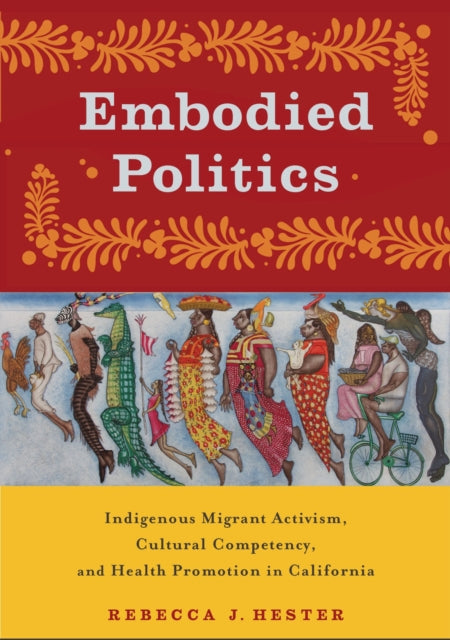
Rebecca J. Hester
Embodied Politics: Indigenous Migrant Activism, Cultural Competency, and Health Promotion in California
Embodied Politics: Indigenous Migrant Activism, Cultural Competency, and Health Promotion in California
💎 Earn 114 Points (£1.14) on this item.
YOU SAVE £3.19
- Condition: Brand new
- UK Delivery times: Usually arrives within 2 - 3 working days
- UK Shipping: Fee starts at £2.39. Subject to product weight & dimension
Bulk ordering. Want 15 or more copies? Get a personalised quote and bigger discounts. Learn more about bulk orders.
Couldn't load pickup availability
- More about Embodied Politics: Indigenous Migrant Activism, Cultural Competency, and Health Promotion in California
Embodied Politics explores the Indigenous Health Project's impact on indigenous migrant communities, highlighting conflicts, resistances, and counter-acts in promoting health behaviors and practices. It argues for a structurally competent approach to migrant health to address structural racism and neoliberalism undermining indigenous Oaxacans' health in Mexico and the US.
Format: Paperback / softback
Length: 208 pages
Publication date: 13 May 2022
Publisher: Rutgers University Press
Embodied Politics sheds light on the significant impact of public health promotion in indigenous migrant communities by exploring the Indigenous Health Project (IHP), a culturally and linguistically competent initiative that employs health workshops, health messages, and social programs to address the structural vulnerabilities of Oaxacan migrants in California. The book delves into the origins and operations of the IHP, highlighting the conflicts, resistances, and counteractions that arise as it seeks to influence the health behaviors and practices of Triqui and Mixteco migrants. Through its analysis, Embodied Politics advocates for a structurally competent approach to migrant health, revealing how efforts to promote indigenous health can inadvertently reinforce the same social and political economic forces, such as structural racism and neoliberalism, that are undermining the health of indigenous Oaxacans in Mexico and the United States.
The IHP was established in 1998 by a group of community-based organizations and health professionals who recognized the need to address the health disparities experienced by Oaxacan migrants in California. The project was designed to be culturally and linguistically competent, recognizing the unique cultural and linguistic backgrounds of the migrants and the importance of incorporating these factors into health interventions.
One of the key strategies of the IHP was to provide health workshops and health messages to migrants. These workshops covered a range of topics, including health promotion, disease prevention, and mental health. The workshops were conducted in both Spanish and English, and were designed to be interactive and engaging. The health messages were tailored to the specific needs of the migrants, and were designed to address the cultural and linguistic barriers that may prevent them from accessing health care.
In addition to health workshops and health messages, the IHP also implemented social programs to address the structural vulnerabilities of migrants. These programs included job training, housing assistance, and legal services. The IHP worked closely with local community organizations and government agencies to provide these services, and to ensure that they were accessible to migrants.
Despite the efforts of the IHP, there were several conflicts, resistances, and counteractions that emerged through its attempts to guide the health behaviors and practices of Triqui and Mixteco migrants. One of the main challenges was the cultural and linguistic barriers that migrants faced. Many migrants were not fluent in English, and were therefore unable to access health care. This led to a high rate of preventable diseases, such as diabetes, hypertension, and cancer.
To address this challenge, the IHP developed a series of language and cultural competency training programs for health care providers. These programs were designed to help health care providers communicate effectively with migrants, and to provide culturally appropriate care. However, these programs were not widely implemented, and many health care providers continued to struggle with providing care to migrants.
Another challenge was the lack of resources available to migrants. Many migrants were living in poverty, and were unable to afford health care. This led to a high rate of uninsured migrants, and to a lack of access to preventive care. The IHP worked to address this challenge by providing health insurance to migrants, and by providing financial assistance to local community organizations that provided health care services.
Despite these challenges, the IHP has had a significant impact on the health of Oaxacan migrants in California. The project has helped to reduce the rate of preventable diseases, and has improved the quality of life for many migrants. The IHP has also been recognized for its innovative approach to migrant health, and has been used as a model for other migrant health programs in the United States.
However, there are still many challenges that need to be addressed in order to improve the health of indigenous Oaxacans in Mexico and the United States. One of the main challenges is structural racism and neoliberalism. Structural racism refers to the systemic discrimination and marginalization of certain groups of people based on their race, ethnicity, and social class. Neoliberalism refers to the economic policies that have been implemented in recent years, which have led to the concentration of wealth and power in the hands of a few individuals.
These policies have had a negative impact on the health of indigenous Oaxacans. For example, the privatization of health care has led to a decrease in the quality of care, and has made it difficult for many indigenous Oaxacans to access health care. The privatization of education has also led to a decrease in the quality of education, and has made it difficult for many indigenous Oaxacans to access higher education.
In order to address these challenges, it is important to promote a structurally competent approach to migrant health. This approach should include the development of culturally and linguistically competent health interventions, the provision of resources to migrants, and the implementation of policies that promote social and economic justice.
One of the ways that this can be done is through the development of community-based health programs. Community-based health programs are designed to be responsive to the needs of the community, and are often run by community members. These programs can provide a range of health services, including health promotion, disease prevention, and mental health.
Community-based health programs can also be effective in addressing the structural vulnerabilities of migrants. For example, community-based health programs can provide job training and housing assistance to migrants, and can work to address the social and economic factors that contribute to poverty.
In addition to community-based health programs, it is also important to promote policies that promote social and economic justice. This can include the implementation of universal health care, the reduction of income inequality, and the protection of workers rights.
However, promoting a structurally competent approach to migrant health can be challenging. Many governments and organizations are resistant to change, and are often more interested in promoting economic growth than in promoting social and economic justice.
In conclusion, Embodied Politics sheds light on the significant impact of public health promotion in indigenous migrant communities by exploring the Indigenous Health Project (IHP). The book highlights the conflicts, resistances, and counteractions that emerge through the IHP s attempts to guide the health behaviors and practices of Triqui and Mixteco migrants. Through its analysis, Embodied Politics advocates for a structurally competent approach to migrant health, revealing how efforts to promote indigenous health can inadvertently reinforce the same social and political economic forces, such as structural racism and neoliberalism, that are undermining the health of indigenous Oaxacans in Mexico and the United States. To address these challenges, it is important to promote a structurally competent approach to migrant health, including the development of culturally and linguistically competent health interventions, the provision of resources to migrants, and the implementation of policies that promote social and economic justice.
Dimension: 229 x 152 x 15 (mm)
ISBN-13: 9780813589497
This item can be found in:
UK and International shipping information
UK and International shipping information
UK Delivery and returns information:
- Delivery within 2 - 3 days when ordering in the UK.
- Shipping fee for UK customers from £2.39. Fully tracked shipping service available.
- Returns policy: Return within 30 days of receipt for full refund.
International deliveries:
Shulph Ink now ships to Australia, Belgium, Canada, France, Germany, Ireland, Italy, India, Luxembourg Saudi Arabia, Singapore, Spain, Netherlands, New Zealand, United Arab Emirates, United States of America.
- Delivery times: within 5 - 10 days for international orders.
- Shipping fee: charges vary for overseas orders. Only tracked services are available for most international orders. Some countries have untracked shipping options.
- Customs charges: If ordering to addresses outside the United Kingdom, you may or may not incur additional customs and duties fees during local delivery.