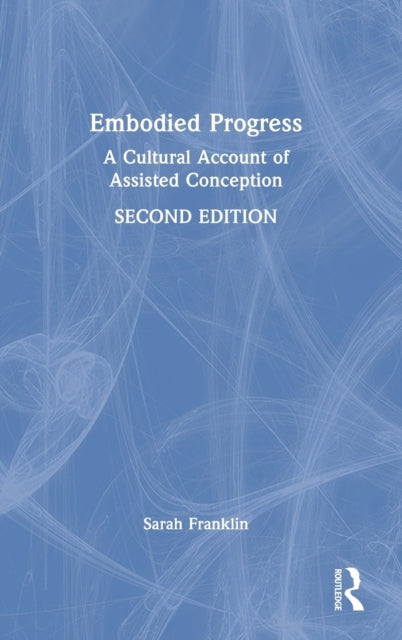
Sarah Franklin
Embodied Progress: A Cultural Account of Assisted Conception
Embodied Progress: A Cultural Account of Assisted Conception
💎 Earn 689 Points (£6.89) on this item.
We can order this item for you. Delivery usually takes about 4 to 6 weeks.
This item is not held in our immediate stock. We will order it for you after checkout.
Estimated delivery: About 4 to 6 weeks
YOU SAVE £8.18
- Condition: Brand new
- UK Delivery times: Usually arrives within 2 - 3 working days
- UK Shipping: Fee starts at £2.39. Subject to product weight & dimension
Bulk ordering. Want 15 or more copies? Get a personalised quote and bigger discounts. Learn more about bulk orders.
Couldn't load pickup availability
- More about Embodied Progress: A Cultural Account of Assisted Conception
Sarah Franklin's classic monograph on the development of in vitro fertilisation (IVF) has been updated with two new chapters that reflect on its relevance in the past two decades and provide a 'state-of-the-art review of the field today. The book explores the emergence of commercial IVF in the United Kingdom and its significance in relation to classic anthropological debates about kinship, gender, and the biological facts of parenthood. It documents the unique demands of the IVF technique and how it changes its users in ways they had not anticipated. Franklin argues that such experiences reveal a crucial feature of translational biomedical procedures more widely, that they are 'hope technologies that paradoxically generate new uncertainties and risks in the very space of their supposed resolution.
Format: Hardback
Length: 244 pages
Publication date: 12 October 2022
Publisher: Taylor & Francis Ltd
This new edition of Sarah Franklin's classic monograph on the development of in vitro fertilization (IVF) includes two entirely new chapters reflecting on the relevance of the book's findings in the context of the past two decades and providing a 'state-of-the-art review of the field today. Over the past 25 years, both the assisted conception industry and the academic field of reproductive studies have grown enormously. IVF, in particular, is belatedly becoming recognized as one of the most influential technologies of the twentieth and twenty-first centuries, with a far-reaching set of implications that have to date been underestimated, understudied, and under-reported. This pioneering text was the first to explore the emergence of commercial IVF in the United Kingdom, where the technique was originally developed. During the 1980s, the British Parliament devised a unique system of comprehensive national regulation of assisted reproduction amidst fractious public and media debate over IVF and embryo research. Franklin chronicles these developments and explores their significance in relation to classic anthropological debates about the meanings of kinship, gender, and the biological facts of parenthood. Drawing on extensive personal interviews with women and couples undergoing IVF, as well as ethnographic fieldwork in early IVF clinics, the book explores the unique demands of the IVF technique. In richly detailed chapters, it documents the 'topsy-turvy world of IVF, and how the experience of undergoing IVF changes its users in ways they had not anticipated. Franklin argues that such experiences reveal a crucial feature of translational biomedical procedures more widely – namely, that these are 'hope technologies that paradoxically generate new uncertainties and risks in the process of generating new possibilities for reproduction and family formation.
IVF is a complex and multifaceted technology that has had a profound impact on the lives of individuals and families around the world. In this essay, we will explore the history, development, and implications of IVF, including its impact on reproductive rights, access to healthcare, and the ethics of assisted reproduction.
The history of IVF can be traced back to the early 1970s, when researchers began to experiment with the fertilization of human eggs in vitro. The first successful IVF pregnancy was reported in 1978, and since then, the technology has undergone significant advancements and improvements. IVF is now a widely used and accepted form of assisted reproduction, with clinics and hospitals around the world offering it to couples who are unable to conceive naturally.
One of the key challenges of IVF is its cost, which can be prohibitive for many couples. The procedure involves a series of complex steps, including hormone therapy, egg retrieval, fertilization, and embryo transfer, and can cost thousands of dollars. This has led to concerns about access to IVF, particularly for low-income and marginalized communities.
Despite these challenges, IVF has had a significant impact on reproductive rights and access to healthcare. For example, IVF has enabled women who are unable to conceive naturally to have children, and has provided a means for same-sex couples to have children. IVF has also been used to help individuals with genetic disorders or infertility to have children who are free from these conditions.
However, IVF has also raised ethical concerns about the use of technology to manipulate human reproduction. Some critics argue that IVF is a form of genetic engineering, and that it raises questions about the nature of parenthood, the rights of children, and the potential for genetic discrimination.
In conclusion, IVF is a complex and multifaceted technology that has had a profound impact on the lives of individuals and families around the world. While it has provided a means for many couples to have children, it has also raised ethical concerns about the use of technology to manipulate human reproduction. As the technology continues to evolve and improve, it will be important to consider these issues and ensure that IVF is used in a way that is ethical, accessible, and responsible.
Weight: 639g
Dimension: 234 x 156 (mm)
ISBN-13: 9781032256696
Edition number: 2 ed
This item can be found in:
UK and International shipping information
UK and International shipping information
UK Delivery and returns information:
- Delivery within 2 - 3 days when ordering in the UK.
- Shipping fee for UK customers from £2.39. Fully tracked shipping service available.
- Returns policy: Return within 30 days of receipt for full refund.
International deliveries:
Shulph Ink now ships to Australia, Belgium, Canada, France, Germany, Ireland, Italy, India, Luxembourg Saudi Arabia, Singapore, Spain, Netherlands, New Zealand, United Arab Emirates, United States of America.
- Delivery times: within 5 - 10 days for international orders.
- Shipping fee: charges vary for overseas orders. Only tracked services are available for most international orders. Some countries have untracked shipping options.
- Customs charges: If ordering to addresses outside the United Kingdom, you may or may not incur additional customs and duties fees during local delivery.