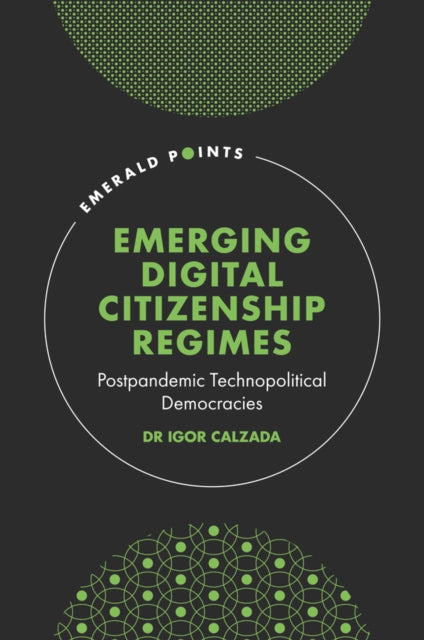
Dr IgorCalzada
Emerging Digital Citizenship Regimes: Postpandemic Technopolitical Democracies
Emerging Digital Citizenship Regimes: Postpandemic Technopolitical Democracies
💎 Earn 228 Points (£2.28) on this item.
YOU SAVE £2.31
- Condition: Brand new
- UK Delivery times: Usually arrives within 2 - 3 working days
- UK Shipping: Fee starts at £2.39. Subject to product weight & dimension
Bulk ordering. Want 15 or more copies? Get a personalised quote and bigger discounts. Learn more about bulk orders.
Couldn't load pickup availability
- More about Emerging Digital Citizenship Regimes: Postpandemic Technopolitical Democracies
The production and governance of urban space have experienced a rapid digitalization and datafication, creating new challenges for citizenship. Emerging Digital Citizenship Regimes: Postpandemic Technopolitical Democracies explores the roles played by digital citizenship in the context of changing geographies of the nation-state in Europe in the aftermath of the global pandemic and reframes the concept of digital citizenship amid the rescaling of nation-states in Europe by connecting it to the increasing digitalization of the urban environment.
Format: Hardback
Length: 208 pages
Publication date: 25 May 2022
Publisher: Emerald Publishing Limited
The production and governance of urban space have undergone a rapid digitalization and datafication in the context of COVID-19, presenting new challenges for citizenship. The urban realm is not only a setting where a new standard for digital development is established but also a realm from which rescaling nation-states are emerging pervasively.
Emerging Digital Citizenship Regimes: Postpandemic Technopolitical Democracies delves into the roles played by digital citizenship in the context of evolving geographies of the nation-state in Europe following the global pandemic. It also reimagines the concept of digital citizenship in the context of the rescaling of nation-states in Europe by linking it to the increasing digitalization of the urban environment as a consequence of the pandemic.
By theorizing the concept of citizenship in the digital age through the lens of the evolutionary character of its classical concept or by drawing upon narratives regarding the democratizing potential and risks of the Internet, Emerging Digital Citizenship Regimes explores the intricate interplay of social and political factors shaping offline and online civic practices and their interconnected relationship with the urban environment. It analyzes the way it is produced and governed in the COVID-19 new context.
The rapid digitalization and datafication of urban space have transformed the way we live, work, and interact with our surroundings. It has created new opportunities for innovation, economic growth, and social connectivity, but it has also brought about challenges and complexities.
One of the key challenges facing urban areas in the digital age is the need for effective governance. As cities become increasingly complex and interconnected, it becomes difficult for traditional government structures to manage and regulate the rapidly changing landscape. This has led to the emergence of new forms of governance, such as smart city initiatives, which aim to use technology and data to improve the efficiency and sustainability of urban services.
Another challenge is the issue of digital inequality. While the benefits of digital technology are widely distributed, there are significant gaps in access and usage among different groups of people, particularly those in low-income communities and marginalized populations. This can lead to social exclusion, economic inequality, and limited opportunities for participation in civic life.
To address these challenges, cities need to adopt a holistic approach to urban governance that incorporates digital technologies and data-driven decision-making. This requires collaboration between government agencies, private sector stakeholders, and community organizations to ensure that everyone has access to the resources and opportunities needed to thrive in the digital age.
In addition to governance, digitalization has also had a significant impact on the production of urban space. The rise digital technologies have enabled new forms of urban planning, design, and construction that are more efficient, sustainable, and resilient. For example, smart city initiatives use data and technology to optimize traffic flow, reduce waste, and improve energy efficiency in buildings.
However, the digitalization of urban space has also raised concerns about privacy, security, and the impact on human rights. As more and more data is collected and analyzed about urban residents, there are concerns about how this data is used and shared, and how it can be used to perpetuate social and economic inequality.
To address these concerns, cities need to adopt a transparent and accountable approach to data governance. This includes developing policies and regulations that protect the privacy and security of urban residents, as well as ensuring that data is used to promote social and economic equity and to improve the quality of life for all.
In conclusion, the production and governance of urban space have undergone a rapid digitalization and datafication in the context of COVID-19, presenting new challenges for citizenship. While the digital age has brought about many benefits, it has also highlighted the need for effective governance, digital inequality, and privacy and security concerns. By adopting a holistic approach to urban governance that incorporates digital technologies and data-driven decision-making, cities can create a more inclusive, sustainable, and resilient urban environment for all.
Weight: 430g
Dimension: 160 x 239 x 19 (mm)
ISBN-13: 9781803823324
This item can be found in:
UK and International shipping information
UK and International shipping information
UK Delivery and returns information:
- Delivery within 2 - 3 days when ordering in the UK.
- Shipping fee for UK customers from £2.39. Fully tracked shipping service available.
- Returns policy: Return within 30 days of receipt for full refund.
International deliveries:
Shulph Ink now ships to Australia, Belgium, Canada, France, Germany, Ireland, Italy, India, Luxembourg Saudi Arabia, Singapore, Spain, Netherlands, New Zealand, United Arab Emirates, United States of America.
- Delivery times: within 5 - 10 days for international orders.
- Shipping fee: charges vary for overseas orders. Only tracked services are available for most international orders. Some countries have untracked shipping options.
- Customs charges: If ordering to addresses outside the United Kingdom, you may or may not incur additional customs and duties fees during local delivery.