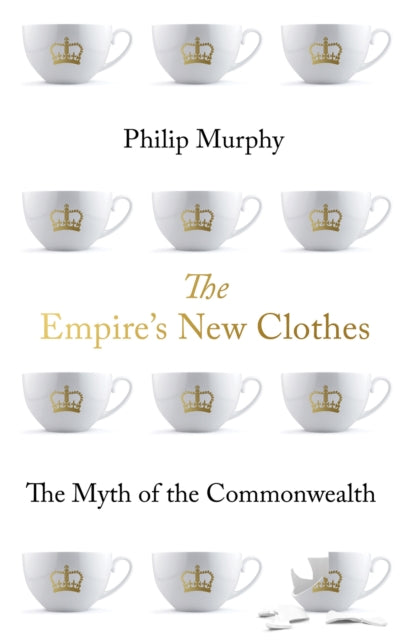
Philip Murphy
Empire's New Clothes: The Myth of the Commonwealth
Empire's New Clothes: The Myth of the Commonwealth
💎 Earn 61 Points (£0.61) on this item.
YOU SAVE £2.61
- Condition: Brand new
- UK Delivery times: Usually arrives within 2 - 3 working days
- UK Shipping: Fee starts at £2.39. Subject to product weight & dimension
Bulk ordering. Want 15 or more copies? Get a personalised quote and bigger discounts. Learn more about bulk orders.
Couldn't load pickup availability
- More about Empire's New Clothes: The Myth of the Commonwealth
The Commonwealth has been identified as an important body for future British trade and diplomacy, but few know what it actually does. How is it organized and what has held it together for so long? The author offers a personal perspective on this complex and poorly understood institution and asks if it can ever escape from the shadow of the British Empire to become an organization based on shared values.
\n Format: Paperback / softback
\n Length: 320 pages
\n Publication date: 01 July 2021
\n Publisher: C Hurst & Co Publishers Ltd
\n
The Commonwealth has emerged as a significant entity in the realm of future British trade and diplomacy, yet its functions and organizational structure remain largely unknown to many. This essay aims to delve into the intricacies of the Commonwealth, exploring its structure, historical significance, and the role of the monarch as Head of the Commonwealth.
The Commonwealth, a voluntary association of 53 member states, was established in 1931 with the aim of promoting cooperation and common interests among its members. It encompasses a diverse range of countries, including former British colonies, African nations, and Asian states. The organization operates on the principles of democracy, free trade, and mutual respect, and its members share a common history and cultural heritage.
One of the key features of the Commonwealth is its decentralized structure, which allows for a great deal of autonomy and flexibility among its members. Each member state has its own government and constitution, and the Commonwealth Secretariat, located in London, provides administrative and technical support to the organization. The Commonwealth also has various institutions and organizations, such as the Commonwealth Foundation, Commonwealth Business Council, and Commonwealth Youth Council, that work to promote development, education, and youth empowerment.
The role of the monarch as Head of the Commonwealth is a central aspect of the organization's identity. The current monarch, Queen Elizabeth II, has held the position since 1952, and her role is largely ceremonial. However, the monarch plays an important symbolic role in promoting the values and principles of the Commonwealth and in fostering inter-governmental cooperation.
Despite its many achievements, the Commonwealth has faced several challenges in recent years. One of the most significant is the growing influence of China and other emerging economies, which have challenged the traditional dominance of the United Kingdom and other Western countries. This has led to concerns about the Commonwealth's relevance and its ability to maintain its position as a global force.
Another challenge is the issue of democracy and human rights. While the Commonwealth values democracy and respect for human rights, there have been instances of member states violating these principles, particularly in Africa and Asia. This has led to calls for greater accountability and scrutiny of member states' actions.
Despite these challenges, there are reasons to be optimistic about the future of the Commonwealth. The organization has a strong commitment to promoting shared values and interests, and its diverse membership provides a platform for inter-governmental cooperation and dialogue. The Commonwealth also has a valuable role to play in promoting development, education, and youth empowerment, particularly in developing countries.
In conclusion, the Commonwealth is a complex and multifaceted organization that plays an important role in the realm
In the wake of Brexit, the Commonwealth has been identified as an important body for future British trade and diplomacy, but few know what it actually does. How is it organised and what has held it together for so long? How important is the monarchs role as Head of the Commonwealth? Most importantly, why has it had such a troubled recent past, and is it realistic to imagine that its fortunes might be reversed?
In The Empires New Clothes, Murphy strips away the gilded self-image of the Commonwealth to reveal an irrelevant institution afflicted by imperial amnesia. He offers a personal perspective on this complex and poorly understood institution, and asks if it can ever escape from the shadow of the British Empire to become an organisation based on shared values, rather than a shared history.
The Commonwealth, a voluntary association of 53 member states, was established in 1931 with the aim of promoting cooperation and common interests among its members. It encompasses a diverse range of countries, including former British colonies, African nations, and Asian states. The organization operates on the principles of democracy, free trade, and mutual respect, and its members share a common history and cultural heritage.
One of the key features of the Commonwealth is its decentralized structure, which allows for a great deal of autonomy and flexibility among its members. Each member state has its own government and constitution, and the Commonwealth Secretariat, located in London, provides administrative and technical support to the organization. The Commonwealth also has various institutions and organizations, such as the Commonwealth Foundation, Commonwealth Business Council, and Commonwealth Youth Council, that work to promote development, education, and youth empowerment.
The role of the monarch as Head of the Commonwealth is a central aspect of the organization's identity. The current monarch, Queen Elizabeth II, has held the position since 1952, and her role is largely ceremonial. However, the monarch plays an important symbolic role in promoting the values and principles of the Commonwealth and in fostering inter-governmental cooperation.
Despite its many achievements, the Commonwealth has faced several challenges in recent years. One of the most significant is the growing influence of China and other emerging economies, which have challenged the traditional dominance of the United Kingdom and other Western countries. This has led to concerns about the Commonwealth's relevance and its ability to maintain its position as a global force.
Another challenge is the issue of democracy and human rights. While the Commonwealth values democracy and respect for human rights, there have been instances of member states violating these principles, particularly in Africa and Asia. This has led to calls for greater accountability and scrutiny of member states' actions.
Despite these challenges, there are reasons to be optimistic about the future of the Commonwealth. The organization has a strong commitment to promoting shared values and interests, and its diverse membership provides a platform for inter-governmental cooperation and dialogue. The Commonwealth also has a valuable role to play in promoting development, education, and youth empowerment, particularly in developing countries.
In conclusion, the Commonwealth is a complex and multifaceted organization that plays an important role in the global landscape. While it faces challenges, it has a strong commitment to promoting shared values and interests and has a valuable role to play in promoting development, education, and youth empowerment. As the world continues to evolve, the Commonwealth will need to adapt and evolve to remain relevant and effective in the years to come.
\n Weight: 384g\n
Dimension: 133 x 197 x 31 (mm)\n
ISBN-13: 9781787384934\n \n
This item can be found in:
UK and International shipping information
UK and International shipping information
UK Delivery and returns information:
- Delivery within 2 - 3 days when ordering in the UK.
- Shipping fee for UK customers from £2.39. Fully tracked shipping service available.
- Returns policy: Return within 30 days of receipt for full refund.
International deliveries:
Shulph Ink now ships to Australia, Belgium, Canada, France, Germany, Ireland, Italy, India, Luxembourg Saudi Arabia, Singapore, Spain, Netherlands, New Zealand, United Arab Emirates, United States of America.
- Delivery times: within 5 - 10 days for international orders.
- Shipping fee: charges vary for overseas orders. Only tracked services are available for most international orders. Some countries have untracked shipping options.
- Customs charges: If ordering to addresses outside the United Kingdom, you may or may not incur additional customs and duties fees during local delivery.