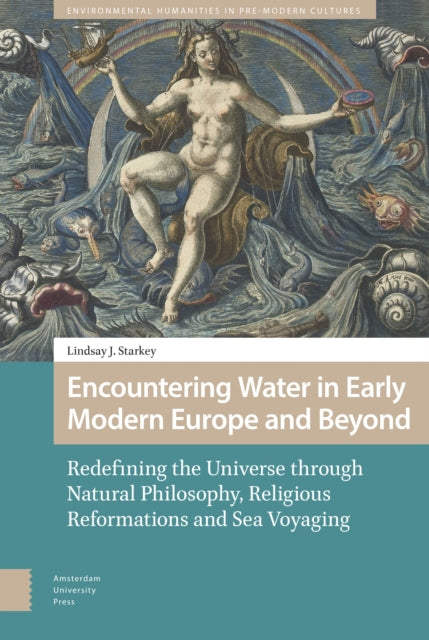
DR. Lindsay Starkey
Encountering Water in Early Modern Europe and Beyond: Redefining the Universe through Natural Philosophy, Religious Reformations, and Sea Voyaging
Encountering Water in Early Modern Europe and Beyond: Redefining the Universe through Natural Philosophy, Religious Reformations, and Sea Voyaging
💎 Earn 689 Points (£6.89) on this item.
We can order this item for you. Delivery usually takes about 4 to 6 weeks.
This item is not held in our immediate stock. We will order it for you after checkout.
Estimated delivery: About 4 to 6 weeks
YOU SAVE £8.18
- Condition: Brand new
- UK Delivery times: Usually arrives within 2 - 3 working days
- UK Shipping: Fee starts at £2.39. Subject to product weight & dimension
Bulk ordering. Want 15 or more copies? Get a personalised quote and bigger discounts. Learn more about bulk orders.
Couldn't load pickup availability
- More about Encountering Water in Early Modern Europe and Beyond: Redefining the Universe through Natural Philosophy, Religious Reformations, and Sea Voyaging
Lindsay Starkey's book explores why sixteenth-century Europeans were interested in waters failure to submerge the earth, combining biblical commentaries, natural philosophical, geographical, and cosmographical texts from these periods.
Sixteenth-century Europeans were interested in waters failure to submerge the earth due to sea voyages to the southern hemisphere and traditional methods of European scholarship and religious reformations, which led to a reinterpretation of water and earth's ontological and spatial relationships. This sheds light on how we can respond to our current water crisis before it is too late.
Format: Hardback
Length: 274 pages
Publication date: 10 September 2020
Publisher: Amsterdam University Press
Both the Christian Bible and Aristotles works suggest that water should entirely flood the earth. Though many ancient, medieval, and early modern Europeans relied on these works to understand and explore the relationships between water and earth, sixteenth-century Europeans particularly were especially concerned with why dry land existed. This book investigates why they were so interested in waters failure to submerge the earth when their predecessors had not been. Analyzing biblical commentaries as well as natural philosophical, geographical, and cosmographical texts from these periods, Lindsay Starkey shows that European sea voyages to the southern hemisphere combined with the traditional methods of European scholarship and religious reformations led sixteenth-century Europeans to reinterpret water and earths ontological and spatial relationships. The manner in which they did so also sheds light on how we can respond to our current water crisis before it is too late.
Water and Earth in the Christian Bible and Aristotles Works
Both the Christian Bible and Aristotles works suggest that water should entirely flood the earth. Though many ancient, medieval, and early modern Europeans relied on these works to understand and explore the relationships between water and earth, sixteenth-century Europeans particularly were especially concerned with why dry land existed. This book investigates why they were so interested in waters failure to submerge the earth when their predecessors had not been. Analyzing biblical commentaries as well as natural philosophical, geographical, and cosmographical texts from these periods, Lindsay Starkey shows that European sea voyages to the southern hemisphere combined with the traditional methods of European scholarship and religious reformations led sixteenth-century Europeans to reinterpret water and earths ontological and spatial relationships. The manner in which they did so also sheds light on how we can respond to our current water crisis before it is too late.
European Sea Voyages and the Reinterpretation of Water and Earth
European sea voyages to the southern hemisphere combined with the traditional methods of European scholarship and religious reformations led sixteenth-century Europeans to reinterpret water and earths ontological and spatial relationships. The manner in which they did so also sheds light on how we can respond to our current water crisis before it is too late. Starkey argues that European sea voyages to the southern hemisphere provided Europeans with a new perspective on the world and its natural resources. They saw the earth as a vast ocean, with water covering most of its surface. This perspective challenged the traditional belief that water was a finite resource and that dry land was a natural and necessary part of the world. Starkey also argues that European sea voyages to the southern hemisphere led to the development of new technologies and techniques for exploring and exploiting water resources. These technologies and techniques included the use of ships, the development of navigation systems, and the exploration of new trade routes. Starkey argues that these technologies and techniques helped to increase the amount of water that was available to Europeans and to improve the quality of their water. However, Starkey also argues that these technologies and techniques also had negative consequences. For example, they led to the overexploitation of water resources, which led to the depletion of water supplies and the degradation of water quality. Starkey also argues that European sea voyages to the southern hemisphere led to the development of new religious and philosophical beliefs. These beliefs included the belief in the existence of a divine creator and the belief in the importance of human beings in the world. Starkey argues that these beliefs helped to shape European society and to promote a sense of responsibility for the environment. However, Starkey also argues that these beliefs also had negative consequences. For example, they led to the exploitation of natural resources and the degradation of the environment. Starkey argues that we can respond to our current water crisis by taking a number of steps. These steps include reducing our consumption of water, improving the quality of our water, and protecting our water resources. Starkey also argues that we can respond to our current water crisis by promoting a sense of responsibility for the environment. This can be done by promoting sustainable development, reducing pollution, and protecting natural resources. Starkey also argues that we can respond to our current water crisis by working together with other countries and organizations. This can be done by developing international agreements and by providing financial assistance to developing countries. Starkey also argues that we can respond to our current water crisis by changing our attitudes and behaviors. This can be done by promoting a sense of empathy and compassion for others and by taking action to address the root causes of water scarcity. In conclusion, both the Christian Bible and Aristotles works suggest that water should entirely flood the earth. Though many ancient, medieval, and early modern Europeans relied on these works to understand and explore the relationships between water and earth, sixteenth-century Europeans particularly were especially concerned with why dry land existed. This book investigates why they were so interested in waters failure to submerge the earth when their predecessors had not been. Analyzing biblical commentaries as well as natural philosophical, geographical, and cosmographical texts from these periods, Lindsay Starkey shows that European sea voyages to the southern hemisphere combined with the traditional methods of European scholarship and religious reformations led sixteenth-century Europeans to reinterpret water and earths ontological and spatial relationships. The manner in which they did so also sheds light on how we can respond to our current water crisis before it is too late.
Weight: 582g
Dimension: 162 x 241 x 24 (mm)
ISBN-13: 9789462988736
Edition number: 0
This item can be found in:
UK and International shipping information
UK and International shipping information
UK Delivery and returns information:
- Delivery within 2 - 3 days when ordering in the UK.
- Shipping fee for UK customers from £2.39. Fully tracked shipping service available.
- Returns policy: Return within 30 days of receipt for full refund.
International deliveries:
Shulph Ink now ships to Australia, Belgium, Canada, France, Germany, Ireland, Italy, India, Luxembourg Saudi Arabia, Singapore, Spain, Netherlands, New Zealand, United Arab Emirates, United States of America.
- Delivery times: within 5 - 10 days for international orders.
- Shipping fee: charges vary for overseas orders. Only tracked services are available for most international orders. Some countries have untracked shipping options.
- Customs charges: If ordering to addresses outside the United Kingdom, you may or may not incur additional customs and duties fees during local delivery.