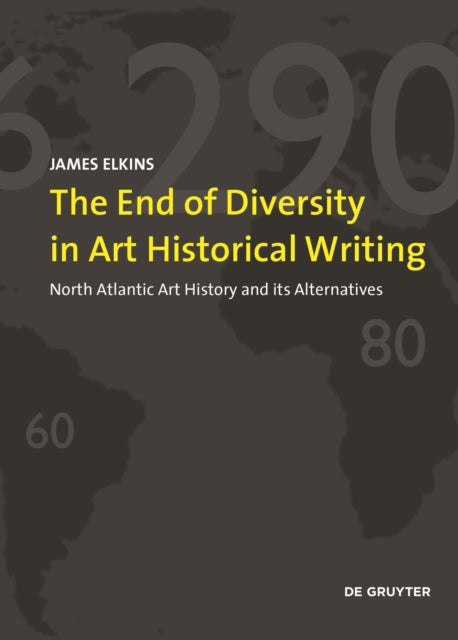
James Elkins
End of Diversity in Art Historical Writing: North Atlantic Art History and its Alternatives
End of Diversity in Art Historical Writing: North Atlantic Art History and its Alternatives
💎 Earn 136 Points (£1.36) on this item.
YOU SAVE £2.28
- Condition: Brand new
- UK Delivery times: Usually arrives within 2 - 3 working days
- UK Shipping: Fee starts at £2.39. Subject to product weight & dimension
Bulk ordering. Want 15 or more copies? Get a personalised quote and bigger discounts. Learn more about bulk orders.
Couldn't load pickup availability
- More about End of Diversity in Art Historical Writing: North Atlantic Art History and its Alternatives
The End of Diversity in Art Historical Writing is a comprehensive book on world art history, incorporating research from 7 countries and crowd-sourced comments. It covers Eurocentrism, center and margins, circulations and atlases of art, decolonial theory, incommensurate cultures, the October model, access to resources, multiple modernisms, and the emergence of English as the de facto lingua franca of art writing.
Format: Paperback / softback
Length: 221 pages
Publication date: 07 December 2020
Publisher: De Gruyter
The End of Diversity in Art Historical Writing is a groundbreaking and globally informed book on world art history, drawing on research in seven countries. It offers a comprehensive overview of the principal accounts of Eurocentrism, center and margins, circulations and atlases of art, decolonial theory, incommensurate cultures, the origins and dissemination of the October model, problems of access to resources, models of multiple modernisms, and the emergence of English as the de facto lingua franca of art writing.
The book has been crowd sourced, with chapters posted on the internet for comments and incorporated into the text. This approach has allowed the author to engage with a wide range of perspectives and ensure that the book reflects the latest research and thinking in the field.
The book covers a wide range of topics, including the history of art, the development of artistic styles, the role of art in society, and the impact of globalization on art. It challenges the notion of art as a universal language and explores the ways in which art has been shaped by different cultures and contexts.
One of the key themes of the book is the end of diversity in art historical writing. The author argues that the field has become increasingly dominated by Western perspectives and that this has led to a narrow and limited understanding of art. This has resulted in a lack of recognition of the contributions of non-Western artists and a perpetuation of stereotypes and biases.
To address this issue, the book proposes a number of solutions. One of these is the promotion of diversity in art historical writing. This can be done by encouraging more non-Western artists to publish their work, by providing funding for research on non-Western art, and by promoting the study of non-Western art in art schools and universities.
Another solution is the use of decolonial theory. Decolonial theory challenges the idea that Western culture is superior to other cultures and argues that all cultures have their own unique values and perspectives. This theory can be used to analyze art and to challenge the assumptions that have been made about it.
The book also explores the origins and dissemination of the October model. The October model was a theory of art history that was developed in the 1960s and 1970s by a group of French and American scholars. It argued that art history should be divided into three periods: the ancient, the medieval, and the modern. This model has been widely influential in the field, but it has also been criticized for its Eurocentrism and its neglect of non-Western art.
The book also addresses the problems of access to resources. Art is often expensive to purchase and to exhibit, and this can make it difficult for people from low-income backgrounds to access it. The book proposes a number of solutions to this problem, including the use of public art, the creation of art museums, and the provision of funding for art education.
In addition to these solutions, the book also explores the models of multiple modernisms. Multiple modernisms argue that art is not a single, unified movement, but rather a series of different movements that have emerged at different times and in different places. This theory can be used to analyze art and to challenge the assumptions that have been made about it.
The book also discusses the emergence of English as the de facto lingua franca of art writing. English has become the dominant language of art writing in the world, and this has led to a lack of recognition of the contributions of non-English-speaking artists. The book proposes a number of solutions to this problem, including the use of translation, the creation of art journals in non-English languages, and the promotion of the study of non-English art in art schools and universities.
In conclusion, The End of Diversity in Art Historical Writing is a groundbreaking and globally informed book on world art history. It offers a comprehensive overview of the principal accounts of Eurocentrism, center and margins, circulations and atlases of art, decolonial theory, incommensurate cultures, the origins and dissemination of the October model, problems of access to resources, models of multiple modernisms, and the emergence of English as the de facto lingua franca of art writing. By promoting diversity in art historical writing, using decolonial theory, exploring the origins and dissemination of the October model, addressing the problems of access to resources, and promoting the study of non-English art, the book aims to create a more inclusive and diverse field of art history.
Weight: 648g
Dimension: 174 x 240 x 18 (mm)
ISBN-13: 9783110681109
This item can be found in:
UK and International shipping information
UK and International shipping information
UK Delivery and returns information:
- Delivery within 2 - 3 days when ordering in the UK.
- Shipping fee for UK customers from £2.39. Fully tracked shipping service available.
- Returns policy: Return within 30 days of receipt for full refund.
International deliveries:
Shulph Ink now ships to Australia, Belgium, Canada, France, Germany, Ireland, Italy, India, Luxembourg Saudi Arabia, Singapore, Spain, Netherlands, New Zealand, United Arab Emirates, United States of America.
- Delivery times: within 5 - 10 days for international orders.
- Shipping fee: charges vary for overseas orders. Only tracked services are available for most international orders. Some countries have untracked shipping options.
- Customs charges: If ordering to addresses outside the United Kingdom, you may or may not incur additional customs and duties fees during local delivery.