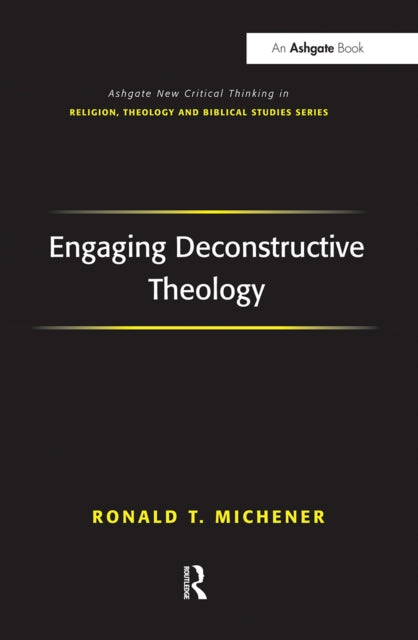
Ronald T. Michener
Engaging Deconstructive Theology
Engaging Deconstructive Theology
We can order this item for you. Delivery usually takes about 4 to 6 weeks.
This item is not held in our immediate stock. We will order it for you after checkout.
Estimated delivery: About 4 to 6 weeks
YOU SAVE £4.22
- Condition: Brand new
- UK Delivery times: Usually arrives within 2 - 3 working days
- UK Shipping: Fee starts at £3.89. Subject to product weight & dimension
Bulk ordering. Want 15 or more copies? Get a personalised quote and bigger discounts. Learn more about bulk orders.
Couldn't load pickup availability
- More about Engaging Deconstructive Theology
Engaging Deconstructive Theology offers an evangelical approach to theological dialogue with postmodern thinkers, drawing from Derrida, Foucault, Mark C. Taylor, Rorty, and Cupitt to develop an apologetic approach to the Christian faith that acknowledges diverse human sources.
Format: Paperback / softback
Length: 276 pages
Publication date: 30 June 2021
Publisher: Taylor & Francis Ltd
Engaging Deconstructive Theology presents an evangelical approach to engaging in theological dialogue with postmodern thinkers. The book explores a range of themes from influential figures such as Derrida, Foucault, Mark C. Taylor, Rorty, and Cupitt, fostering a open-minded evangelical perspective. Ron Michener, the author, draws upon insights from radical postmodern thought to develop an apologetic approach to the Christian faith that recognizes the diverse human sources that contribute to our understanding of faith, including experience, literature, and the imagination.
Deconstructive Theology is a fascinating and thought-provoking approach to theology that challenges traditional beliefs and assumptions. It originated in the late 20th century and was influenced by a range of philosophical and literary movements, including postmodernism, deconstructionism, and critical theory. One of the key ideas of deconstructive theology is that language and meaning are not fixed or universal, but are constantly evolving and contextualized. This means that the way we interpret religious texts, symbols, and practices can be influenced by our own cultural, historical, and social contexts.
Another important aspect of deconstructive theology is the idea that power and dominance are often constructed and maintained through language and discourse. This means that those in power can use language to manipulate and control those who are marginalized or oppressed. Deconstructive theology seeks to expose these power structures and challenge them, promoting a more equitable and just society.
One of the most influential figures in deconstructive theology is Jacques Derrida, who is known for his concept of "deconstruction." Deconstruction is a method of reading and interpreting texts that involves breaking them down into their constituent parts and analyzing their relationships and tensions. Derrida argued that traditional Western philosophy had been founded on a series of binary oppositions, such as good/evil, truth/false, and mind/body, which were ultimately false and oppressive. By deconstructing these oppositions, Derrida sought to create a more nuanced and complex understanding of the world.
Another key figure in deconstructive theology is Michel Foucault, who was interested in the power and control of knowledge and institutions. Foucault argued that knowledge is not neutral or objective, but is produced and distributed by those in power. He also explored the history of sexuality and the role of the body in shaping our understanding of ourselves and others. Foucault's work has had a significant impact on feminist theory, queer theory, and the study of power and oppression.
Mark C. Taylor is another influential figure in deconstructive theology. Taylor is a professor of religious studies at Duke University and is known for his work on the Bible and the Christian tradition. He argues that the Bible is not a literal or historical text, but is a collection of stories and metaphors that are meant to convey spiritual and moral truths. Taylor also explores the ways in which the Christian tradition has been used to justify violence and oppression, and seeks to reclaim the Bible as a source of liberation and hope.
Rorty is another key figure in deconstructive theology. Rorty is a philosopher who was influenced by postmodernism and critical theory. He argued that traditional philosophical questions, such as the existence of God, the nature of reality, and the meaning of life, are ultimately meaningless and irrelevant. Rorty instead proposed that we should focus on the practical and ethical implications of our beliefs and practices, rather than trying to answer abstract philosophical questions.
Cupitt is a theologian who is known for his work on the nature of God and the relationship between faith and reason. He argues that God is not a being or entity, but is a concept that is created and sustained by human imagination and discourse. Cupitt also explores the ways in which the Christian tradition has been used to justify violence and oppression, and seeks to create a more inclusive and democratic understanding of God.
Engaging Deconstructive Theology presents an evangelical approach to engaging in theological dialogue with postmodern thinkers. The book explores a range of themes from influential figures such as Derrida, Foucault, Mark C. Taylor, Rorty, and Cupitt, fostering a open-minded evangelical perspective. Ron Michener, the author, draws upon insights from radical postmodern thought to develop an apologetic approach to the Christian faith that recognizes the diverse human sources that contribute to our understanding of faith, including experience, literature, and the imagination.
One of the key strengths of Engaging Deconstructive Theology is its ability to engage with postmodern thinkers in a respectful and constructive manner. The book avoids the tendency of some evangelical approaches to postmodernism, which can be dismissive or condescending. Instead, Michener seeks to understand and appreciate the insights of postmodern thinkers while also challenging their assumptions and beliefs.
Another strength of the book is its ability to promote a more nuanced and complex understanding of the Christian faith. Deconstructive theology encourages readers to think critically about their own beliefs and practices, and to consider the ways in which they may be contributing to oppression and inequality. By recognizing the diverse human sources that contribute to our understanding of faith, deconstructive theology promotes a more inclusive and democratic understanding of God and the world.
However, it is important to note that deconstructive theology is not without its challenges. Some critics argue that it is too abstract and difficult to understand, and that it can lead to a loss of faith and a sense of hope. Others argue that it is too critical of traditional religious beliefs and practices, and that it can undermine the authority and legitimacy of the Christian faith.
In conclusion, Engaging Deconstructive Theology is a fascinating and thought-provoking approach to theology that challenges traditional beliefs and assumptions. It promotes a more nuanced and complex understanding of the Christian faith by recognizing the diverse human sources that contribute to our understanding of faith, including experience, literature, and the imagination. While it is not without its challenges, deconstructive theology is a valuable tool for those who are interested in engaging in theological dialogue with postmodern thinkers in a respectful and constructive manner.
Weight: 434g
Dimension: 157 x 233 x 21 (mm)
ISBN-13: 9781032099774
UK and International shipping information
UK and International shipping information
We deliver throughout the United Kingdom and to 128 countries and territories worldwide, including the United States, Australia, Canada, Germany, Spain and France.