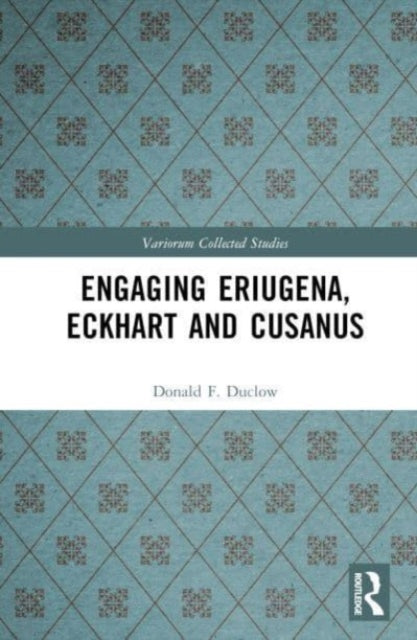
Donald F. Duclow
Engaging Eriugena, Eckhart and Cusanus
Engaging Eriugena, Eckhart and Cusanus
💎 Earn 811 Points (£8.11) on this item.
We can order this item for you. Delivery usually takes about 4 to 6 weeks.
This item is not held in our immediate stock. We will order it for you after checkout.
Estimated delivery: About 4 to 6 weeks
YOU SAVE £9.63
- Condition: Brand new
- UK Delivery times: Usually arrives within 2 - 3 working days
- UK Shipping: Fee starts at £3.89. Subject to product weight & dimension
Bulk ordering. Want 15 or more copies? Get a personalised quote and bigger discounts. Learn more about bulk orders.
Couldn't load pickup availability
- More about Engaging Eriugena, Eckhart and Cusanus
The book explores the relationship between Medieval Philosophy, Theology, Spirituality, and Cultural History, providing insights into the development of these disciplines and their impact on society.
The book is a valuable resource for students studying Medieval Philosophy, Theology, Spirituality, and their place within Cultural History.
Format: Hardback
Length: 176 pages
Publication date: 27 September 2023
Publisher: Taylor & Francis Ltd
The captivating book delves into the depths of Medieval Philosophy, Theology, Spirituality, and their profound significance within the rich tapestry of Cultural History. It offers a comprehensive exploration of these intellectual and spiritual realms, providing a wealth of insights and perspectives that will captivate students and scholars alike.
Medieval Philosophy:
The book explores the rich tapestry of Medieval Philosophy, delving into the profound thoughts and ideas of influential thinkers such as St. Thomas Aquinas, St. Augustine, and St. Bonaventure. It examines the core concepts of metaphysics, epistemology, ethics, and political philosophy, shedding light on the enduring questions that have shaped human understanding for centuries. Through meticulous analysis and engaging storytelling, the book offers a comprehensive understanding of the philosophical frameworks that underpinned the medieval world, providing valuable insights into the complexities of the human condition and the search for meaning.
Theology:
In its exploration of Theology, the book delves into the intricate relationship between faith and reason, exploring the doctrines, beliefs, and practices of the Christian Church during the Middle Ages. It examines the teachings of the Bible, the writings of the Church Fathers, and the philosophical and theological debates that emerged during this period. The book offers a comprehensive account of the development of Christian theology, its influence on society, and its role in shaping the cultural and intellectual landscape of the Middle Ages.
Spirituality:
The book also explores the profound dimensions of Spirituality in the Medieval world, examining the role of religion, prayer, and meditation in shaping individuals and communities. It explores the concept of the soul, the nature of God, and the search for spiritual fulfillment in a world plagued by uncertainty and suffering. The book offers a rich tapestry of spiritual practices and traditions, providing a deeper understanding of the human quest for transcendence and the interconnectedness of all things.
Cultural History:
The book situates Medieval Philosophy, Theology, Spirituality, and their place within the broader context of Cultural History, exploring the social, political, and economic factors that influenced their development and evolution. It examines the role of the Church, the monarchy, and the feudal system in shaping the intellectual and spiritual landscape of the Middle Ages, as well as the impact of cultural exchange and migration on these realms. The book offers a comprehensive understanding of the complex web of relationships that shaped the medieval world, providing valuable insights into the origins and development of modern society.
In conclusion, the book is a treasure trove of knowledge and insights, offering a comprehensive exploration of Medieval Philosophy, Theology, Spirituality, and their profound significance within Cultural History. It is a must-read for students and scholars alike, providing a rich and rewarding journey into the depths of human thought and spirituality.
Medieval Philosophy:
Medieval philosophy was a rich and complex period of intellectual inquiry that spanned several centuries in Europe. It was characterized by a deep reverence for classical Greek and Roman philosophy, as well as a commitment to Christian theology. During this time, philosophers such as St. Thomas Aquinas, St. Augustine, and St. Bonaventure developed sophisticated systems of thought that addressed a wide range of philosophical questions, including metaphysics, epistemology, ethics, and political philosophy.
One of the key themes of medieval philosophy was the relationship between faith and reason. Philosophers such as Aquinas argued that faith and reason were not mutually exclusive, but rather that they could be complementary to one another. He believed that faith provided a foundation for understanding the world, while reason provided a means of testing and evaluating that understanding. This approach to philosophy was known as the "via negativa," which means "by negating" or "by denying."
Another important theme of medieval philosophy was the concept of the soul. Philosophers such as Aquinas and St. Augustine believed that the soul was the essence of human beings, and that it was immortal and would continue to exist after death. They also believed that the soul was capable of experiencing pleasure and pain, and that it was the source of human moral behavior.
Medieval philosophy was also deeply influenced by Christian theology. Philosophers such as Aquinas and St. Augustine developed a systematic approach to understanding the Bible and the teachings of the Church. They believed that the Bible was the word of God and that it provided a guide for living a moral and ethical life.
In addition to these themes, medieval philosophy was also concerned with political philosophy. Philosophers such as Aquinas and St. Augustine argued that the state was necessary to promote the common good and to protect individuals from harm. They believed that the state should be guided by a just and virtuous government that was responsible for the well-being of its citizens.
Despite the many contributions of medieval philosophy, it was also criticized for its adherence to traditionalism and its lack of innovation. Some philosophers argued that the philosophy was too rigid and dogmatic, and that it failed to address the many new challenges that were emerging in the medieval world.
Theology:
Theology is the study of God, the divine, and the relationship between humans and God. It is a branch of philosophy that has been practiced for thousands of years and has played a central role in shaping the cultural and intellectual landscape of the world.
In the Middle Ages, theology was particularly important in shaping the religious beliefs and practices of the Christian Church. The Church was the dominant religious institution in Europe during this time, and its teachings and doctrines were widely accepted and followed by the majority of the population. Theologians such as St. Thomas Aquinas, St. Augustine, and St. Bonaventure developed sophisticated systems of thought that addressed a wide range of theological questions, including the nature of God, the existence of heaven and hell, the role of the Virgin Mary, and the sacraments.
One of the key themes of medieval theology was the concept of the Trinity. The Trinity is a doctrine that states that God is three persons in one: the Father, the Son, and the Holy Spirit. This doctrine was developed by St. Augustine in the fourth century AD and has been a central tenet of Christian theology ever since. The Trinity is a complex and controversial doctrine, but it is essential to understanding the nature of God and the relationship between humans and God.
Another important theme of medieval theology was the concept of salvation. Theologians such as St. Augustine and St. Bonaventure argued that salvation is achieved through the grace of God and the sacrifice of Jesus Christ. They believed that humans are sinners by nature and that they cannot save themselves through their own efforts. Salvation is a gift that is received through faith in Jesus Christ and the acceptance of his sacrifice.
Medieval theology was also influenced by the teachings of the Church Fathers, such as St. Basil the Great and St. Gregory the Great. These theologians developed a systematic approach to understanding the Bible and the teachings of the Church, and their work has been influential in shaping the development of Christian theology throughout the centuries.
In addition to these themes, medieval theology was also concerned with the role of the Church in society. Theologians such as St. Thomas Aquinas and St. Augustine argued that the Church should be a source of moral and ethical guidance for society, and that it should work to promote the common good and to protect individuals from harm. They believed that the Church should be involved in social justice and poverty alleviation, and that it should work to promote peace and harmony in the world.
Despite the many contributions of medieval theology, it was also criticized for its adherence to traditionalism and its lack of innovation. Some theologians argued that the theology was too rigid and dogmatic, and that it failed to address the many new challenges that were emerging in the medieval world.
Spirituality:
Spirituality is a broad and complex concept that encompasses a wide range of beliefs, practices, and experiences related to the search for meaning and purpose in life. It is a deeply personal and subjective experience that can be shaped by a variety of factors, including religious beliefs, cultural traditions, and personal experiences.
In the Middle Ages, spirituality was a central aspect of religious life and was closely tied to the teachings of the Christian Church. The Church was the dominant religious institution in Europe during this time, and its teachings and doctrines were widely accepted and followed by the majority of the population. Theologians such as St. Thomas Aquinas, St. Augustine, and St. Bonaventure developed sophisticated systems of thought that addressed a wide range of spiritual questions, including the nature of God, the existence of heaven and hell, the role of the Virgin Mary, and the sacraments.
One of the key themes of medieval spirituality was the concept of the soul. The soul was believed to be the essence of human beings, and it was believed to be immortal and to continue to exist after death. The soul was also believed to be capable of experiencing pleasure and pain, and it was the source of human moral behavior.
Another important theme of medieval spirituality was the concept of the afterlife. The afterlife was believed to be a place of eternal reward or punishment, depending on the actions of individuals during their earthly life. Theologians such as St. Augustine and St. Bonaventure developed elaborate systems of thought that addressed the nature of heaven and hell, the fate of the soul after death, and the role of the Church in preparing individuals for the afterlife.
Medieval spirituality was also influenced by the teachings of the Church Fathers, such as St. Basil the Great and St. Gregory the Great. These theologians developed a systematic approach to understanding the Bible and the teachings of the Church, and their work has been influential in shaping the development of Christian spirituality throughout the centuries.
In addition to these themes, medieval spirituality was also concerned with the role of the individual in society. Theologians such as St. Thomas Aquinas and St. Augustine argued that individuals should seek to live a moral and ethical life, and that they should strive to live in harmony with God and with one another. They believed that individuals should seek to cultivate their spiritual gifts and talents, and that they should use their resources to help others and to promote the common good.
Despite the many contributions of medieval spirituality, it was also criticized for its adherence to traditionalism and its lack of innovation. Some theologians argued that the spirituality was too rigid and dogmatic, and that it failed to address the many new challenges that were emerging in the medieval world.
Cultural History:
The Middle Ages was a period of significant cultural and intellectual transformation in Europe. It was a time of great change and innovation, as well as a time of great conflict and upheaval. The Middle Ages was a period of great cultural and intellectual transformation in Europe. It was a time of great change and innovation, as well as a time of great conflict and upheaval.
One of the most significant cultural changes of the Middle Ages was the development of the feudal system. The feudal system was a social and economic system that was based on the relationship between lords and vassals. Under the feudal system, lords granted land and other resources to vassals in exchange for loyalty and service. The vassals were then responsible for providing labor and other services to the lord, in return for protection and support.
The feudal system was a complex and hierarchical system that was deeply ingrained in European society. It was a time of great inequality and exploitation, as lords and vassals were often at odds with one another. However, the feudal system also provided a sense of stability and order in a time of great chaos and uncertainty.
Another significant cultural change of the Middle Ages was the development of the monastic order. The monastic order was a religious order that was dedicated to prayer, meditation, and the study of the Bible. The monastic order was a time of great spiritual and intellectual growth, as monks and nuns sought to deepen their understanding of God and the world around them.
The monastic order was also a significant contributor to the development of art and literature in the Middle Ages. Monks and nuns were often skilled artists and writers, and their works were widely admired and celebrated. The monastic order also played a significant role in the preservation of knowledge and culture during the Middle Ages, as many monasteries were centers of learning and scholarship.
In addition to these cultural changes, the Middle Ages was also a time of great scientific and technological innovation. The Middle Ages was a time of great scientific and technological innovation. The development of the printing press, for example, allowed for the widespread dissemination of knowledge and ideas, and the development of the telescope and microscope allowed for a deeper understanding of the natural world.
The Middle Ages was also a time of great religious conflict and upheaval. The Crusades, for example, were a series of religious wars that were fought between Christians and Muslims in the Middle East. The Crusades were a time of great violence and bloodshed, and they had a profound impact on the cultural and intellectual landscape of the Middle Ages.
In conclusion, the Middle Ages was a period of great cultural and intellectual transformation in Europe. It was a time of great change and innovation, as well as a time of great conflict and upheaval. The feudal system, the monastic order, the printing press, the telescope, and the microscope, as well as the Crusades, were all significant cultural and intellectual changes of the Middle Ages. These changes had a profound impact on the cultural and intellectual landscape of Europe, and they continue to be studied and celebrated today.
Weight: 512g
Dimension: 234 x 156 (mm)
ISBN-13: 9781032443904
UK and International shipping information
UK and International shipping information
We deliver throughout the United Kingdom and to 128 countries and territories worldwide, including the United States, Australia, Canada, Germany, Spain and France.