Shulph Ink
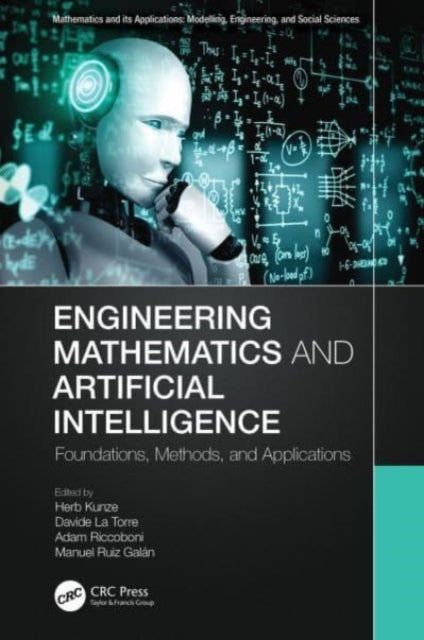
Engineering Mathematics and Artificial Intelligence: Foundations, Methods, and Applications
Engineering Mathematics and Artificial Intelligence: Foundations, Methods, and Applications
💎 Earn 887 Points (£8.87) on this item.
YOU SAVE £10.53
- Condition: Brand new
- UK Delivery times: Usually arrives within 2 - 3 working days
- UK Shipping: Fee starts at £2.39. Subject to product weight & dimension
Bulk ordering. Want 15 or more copies? Get a personalised quote and bigger discounts. Learn more about bulk orders.
Couldn't load pickup availability
- More about Engineering Mathematics and Artificial Intelligence: Foundations, Methods, and Applications
Machine Learning is a branch of Artificial Intelligence that uses advanced mathematics to improve algorithms, support mathematical modeling, simulate data, and classify algorithms. It combines mathematics, computer science, and statistics to enable machines to learn from data and make predictions. The future of Machine Learning will involve more integration with complex mathematical techniques.
Format: Hardback
Length: 513 pages
Publication date: 26 July 2023
Publisher: Taylor & Francis Ltd
Machine Learning (ML) is a rapidly evolving field that involves the use of advanced mathematics to enable computers to learn from data and make predictions or decisions without being explicitly programmed. It is a branch of Artificial Intelligence (AI) that focuses on developing algorithms that can learn from patterns and trends in data, allowing them to improve their performance over time.
One of the key aspects of Machine Learning is the use of mathematical models to represent and analyze data. These models can be used to identify patterns, relationships, and correlations in the data, which can then be used to make predictions or decisions. For example, a machine learning algorithm might be used to analyze customer data and predict which products they are likely to purchase in the future.
Mathematics plays a critical role in Machine Learning. It provides the framework for developing and analyzing mathematical models, as well as the tools for solving complex problems. Some of the advanced mathematics used in Machine Learning include linear algebra, probability theory, and statistics.
One of the ways in which mathematics can be used to improve existing algorithms is by using advanced mathematical techniques such as optimization, linear programming, and machine learning. These techniques can be used to optimize the parameters of an algorithm, improve its accuracy, and reduce its computational complexity. For example, optimization techniques can be used to optimize the hyperparameters of a neural network, which can improve its performance on a particular task.
Machine Learning can also support mathematical modeling. Mathematical models can be used to describe complex systems and processes, and Machine Learning algorithms can be used to infer the parameters of these models from data. For example, a mathematical model of the stock market can be used to predict stock prices in the future.
Another way in which Machine Learning can simulate data is by means of artificial neural networks. Artificial neural networks are a type of machine learning algorithm that is inspired by the structure of the human brain. They are capable of learning from data and making predictions or decisions based on that data. For example, an artificial neural network might be used to simulate the behavior of a weather system.
There are many cutting-edge Artificial Intelligence technologies that are based on Machine Learning. These technologies include natural language processing, image recognition, and speech recognition. Natural language processing involves the use of machine learning algorithms to understand and generate human language, while image recognition involves the use of machine learning algorithms to identify and classify images. Speech recognition involves the use of machine learning algorithms to understand and transcribe human speech.
One of the key challenges in Machine Learning is the classification of algorithms, optimization methods, and statistical techniques. Classification involves the use of machine learning algorithms to categorize data into different groups or categories, while optimization involves the use of machine learning algorithms to find the best solution to a problem. Statistical techniques involve the use of statistical methods to analyze data and make predictions or decisions.
In the future, Machine Learning is likely to integrate with complex mathematical techniques such as quantum computing and graph theory. Quantum computing is a type of computing that uses quantum bits, or qubits, to perform calculations. Graph theory is a type of mathematics that studies the structure and properties of graphs, which are a type of data structure that can be used to represent relationships between objects.
In conclusion, Machine Learning is a rapidly evolving field that involves the use of advanced mathematics to enable computers to learn from data and make predictions or decisions without being explicitly programmed. It is a branch of Artificial Intelligence that focuses on developing algorithms that can learn from patterns and trends in data, allowing them to improve their performance over time. Mathematics plays a critical role in Machine Learning, providing the framework for developing and analyzing mathematical models, as well as the tools for solving complex problems. By using advanced mathematical techniques such as optimization, linear programming, and machine learning, as well as supporting mathematical modeling, Machine Learning can improve existing algorithms and support mathematical modeling. Artificial neural networks and cutting-edge Artificial Intelligence technologies such as natural language processing, image recognition, and speech recognition are based on Machine Learning. The classification of algorithms, optimization methods, and statistical techniques is a key challenge in Machine Learning, and in the future, Machine Learning is likely to integrate with complex mathematical techniques such as quantum computing and graph theory.
Dimension: 234 x 156 (mm)
ISBN-13: 9781032255675
UK and International shipping information
UK and International shipping information
UK Delivery and returns information:
- Delivery within 2 - 3 days when ordering in the UK.
- Shipping fee for UK customers from £2.39. Fully tracked shipping service available.
- Returns policy: Return within 30 days of receipt for full refund.
International deliveries:
Shulph Ink now ships to Australia, Belgium, Canada, France, Germany, Ireland, Italy, India, Luxembourg Saudi Arabia, Singapore, Spain, Netherlands, New Zealand, United Arab Emirates, United States of America.
- Delivery times: within 5 - 10 days for international orders.
- Shipping fee: charges vary for overseas orders. Only tracked services are available for most international orders. Some countries have untracked shipping options.
- Customs charges: If ordering to addresses outside the United Kingdom, you may or may not incur additional customs and duties fees during local delivery.