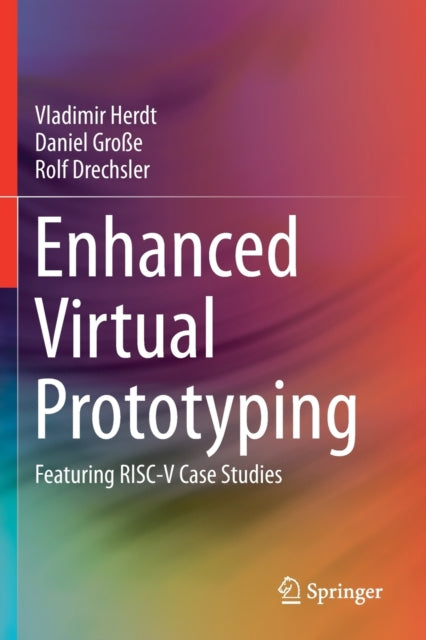
Vladimir Herdt,Daniel Grosse,Rolf Drechsler
Enhanced Virtual Prototyping: Featuring RISC-V Case Studies
Enhanced Virtual Prototyping: Featuring RISC-V Case Studies
💎 Earn 309 Points (£3.09) on this item.
We can order this item for you. Delivery usually takes about 4 to 6 weeks.
This item is not held in our immediate stock. We will order it for you after checkout.
Estimated delivery: About 4 to 6 weeks
YOU SAVE £13.05
- Condition: Brand new
- UK Delivery times: Usually arrives within 2 - 3 working days
- UK Shipping: Fee starts at £2.39. Subject to product weight & dimension
Bulk ordering. Want 15 or more copies? Get a personalised quote and bigger discounts. Learn more about bulk orders.
Couldn't load pickup availability
- More about Enhanced Virtual Prototyping: Featuring RISC-V Case Studies
This book provides techniques for enhancing the Virtual Prototype (VP)-based design flow, including automated formal verification, coverage-guided analysis, and testing techniques for SystemC-based VPs. It also covers VP modeling techniques for functional and non-functional aspects and discusses correspondence analyses between the Hardware- and VP-level. The book focuses on the modern RISC-V ISA, with case-studies covering modeling and verification aspects.
Format: Paperback / softback
Length: 247 pages
Publication date: 16 October 2021
Publisher: Springer Nature Switzerland AG
This comprehensive book offers a diverse range of techniques that significantly enhance all critical aspects of a modern Virtual Prototype (VP)-based design flow. The authors place great emphasis on automated formal verification methods, alongside advanced coverage-guided analysis and testing techniques tailored specifically for SystemC-based VPs and their associated Software (SW). The coverage extends to VP modeling techniques that encompass both functional and non-functional aspects, as well as discussing correspondence analyses between the Hardware- and VP-level to leverage information available at different abstraction levels. Each approach is thoroughly discussed and evaluated through extensive experimentation, using a series of case studies to showcase their effectiveness in improving the VP-based design flow. Furthermore, the book dedicates particular attention to the modern RISC-V ISA, presenting several case studies that cover both modeling and VP and SW verification aspects.
Introduction:
In the ever-evolving world of electronic design, the Virtual Prototype (VP) has emerged as a powerful tool for accelerating product development cycles. VP-based design flows enable designers to simulate and analyze electronic systems at a faster pace, reducing the need for physical prototypes and enabling early identification of design flaws. However, to fully leverage the potential of VP-based design, it is essential to employ a comprehensive set of techniques that enhance all key aspects of the design flow.
Automated Formal Verification Methods:
One of the key techniques emphasized in this book is the use of automated formal verification methods. Formal verification is a rigorous process that ensures the correctness of electronic designs by checking for errors and inconsistencies at the earliest stages of development. By automating this process, designers can save time and resources while ensuring that their designs meet stringent quality standards.
Advanced Coverage-Guided Analysis and Testing Techniques:
In addition to automated formal verification, the book also provides advanced coverage-guided analysis and testing techniques tailored for SystemC-based VPs and their associated Software (SW). Coverage-guided analysis involves analyzing the coverage information generated during simulation to identify areas of the design that are not fully exercised. This information can then be used to guide the selection of test cases and the optimization of test coverage.
VP Modeling Techniques:
VP modeling techniques play a crucial role in capturing the functional and non-functional aspects of electronic systems. The book discusses various VP modeling techniques, including state machines, data flow diagrams, and behavioral models, that can be used to effectively represent the behavior of electronic components and systems.
Correspondence Analyses:
Correspondence analyses are used to establish connections between the Hardware- and VP-level of abstraction. By analyzing the correspondence between these two levels, designers can utilize information available at different abstraction levels to improve the design and verification process.
Experimental Evaluation:
All approaches discussed in the book are thoroughly evaluated through extensive experimentation. The authors use a series of case studies to demonstrate the effectiveness of the techniques in enhancing the VP-based design flow. These case studies cover a wide range of applications, including digital logic design, mixed-signal design, and embedded systems.
Focus on Modern RISC-V ISA:
The book also puts a particular focus on the modern RISC-V ISA, with several case studies covering modeling as well as VP and SW verification aspects. The RISC-V ISA is a open-source instruction set architecture that is gaining popularity in the embedded systems industry. By covering the RISC-V ISA, the book provides designers with valuable insights and techniques that can be applied to developing systems based on this architecture.
Conclusion:
In conclusion, this comprehensive book offers a valuable set of techniques that enhance all key aspects of a modern Virtual Prototype-based design flow. By emphasizing automated formal verification methods, advanced coverage-guided analysis and testing techniques, VP modeling techniques, and correspondence analyses, the book provides designers with the tools they need to develop high-quality electronic systems more efficiently and effectively. Whether you are a seasoned designer or a newcomer to the field, this book is a must-read for anyone interested in improving their VP-based design skills.
Weight: 421g
Dimension: 235 x 155 (mm)
ISBN-13: 9783030548308
Edition number: 1st ed. 2021
This item can be found in:
UK and International shipping information
UK and International shipping information
UK Delivery and returns information:
- Delivery within 2 - 3 days when ordering in the UK.
- Shipping fee for UK customers from £2.39. Fully tracked shipping service available.
- Returns policy: Return within 30 days of receipt for full refund.
International deliveries:
Shulph Ink now ships to Australia, Belgium, Canada, France, Germany, Ireland, Italy, India, Luxembourg Saudi Arabia, Singapore, Spain, Netherlands, New Zealand, United Arab Emirates, United States of America.
- Delivery times: within 5 - 10 days for international orders.
- Shipping fee: charges vary for overseas orders. Only tracked services are available for most international orders. Some countries have untracked shipping options.
- Customs charges: If ordering to addresses outside the United Kingdom, you may or may not incur additional customs and duties fees during local delivery.