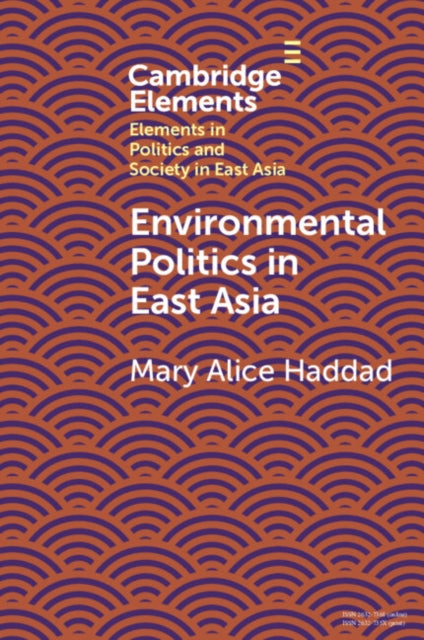
Mary AliceHaddad
Environmental Politics in East Asia
Environmental Politics in East Asia
💎 Earn 84 Points (£0.84) on this item.
We can order this item for you. Delivery usually takes about 4 to 6 weeks.
This item is not held in our immediate stock. We will order it for you after checkout.
Estimated delivery: About 4 to 6 weeks
YOU SAVE £1.01
- Condition: Brand new
- UK Delivery times: Usually arrives within 2 - 3 working days
- UK Shipping: Fee starts at £2.39. Subject to product weight & dimension
Bulk ordering. Want 15 or more copies? Get a personalised quote and bigger discounts. Learn more about bulk orders.
Couldn't load pickup availability
- More about Environmental Politics in East Asia
East Asia has made remarkable progress in pro-environmental policymaking, despite its pro-business orientation and ideological diversity. Governments in China, Japan, South Korea, and Taiwan have worked in collaboration with business and societal interests to craft policies in green technology, green finance, pollution management, and environmental justice. The region offers hope and caution for addressing the climate crisis.
Format: Paperback / softback
Length: 102 pages
Publication date: 21 December 2023
Publisher: Cambridge University Press
East Asia has undergone a remarkable transformation, moving from being perceived as an environmental hazard to the forefront of pro-environmental policymaking. This transformation has been both remarkable and surprising, considering the region's pro-business orientation and ideological diversity. Through a focused examination of three environmental policy areas exhibiting varying levels of success, this Element demonstrates how governments in China, Japan, South Korea, and Taiwan have been able to craft pro-environmental policies by collaborating with business and societal interests.
The evolution of East Asia's eco-developmental states has led to significant advancements in green technology and green finance. Countries in the region have invested heavily in renewable energy sources, implemented innovative green technologies, and developed sustainable financial systems. This has resulted in reduced greenhouse gas emissions, improved air quality, and increased environmental awareness among the public.
However, the outcomes in pollution management have been mixed. While some countries have made significant progress in reducing air and water pollution, others continue to face challenges in addressing environmental degradation. The region's industrialization and rapid economic growth have contributed to the accumulation of pollutants, leading to health issues and environmental damage.
Furthermore, East Asia has made negligible improvement in addressing environmental justice. The marginalized communities, who often bear the brunt of environmental harm, have limited access to resources, information, and political representation. This has resulted in a lack of accountability and responsibility for environmental issues, perpetuating social inequalities and environmental injustice.
As the planet faces the urgent challenge of addressing our collective climate crisis, East Asia offers both hope and caution for crafting pro-environmental policies in diverse political contexts. The region's experience demonstrates that collaboration between governments, businesses, and societal interests is crucial in achieving sustainable development goals. However, it also highlights the need for robust policies, regulations, and enforcement mechanisms to ensure that environmental protection is prioritized and that marginalized communities are included in decision-making processes.
East Asia's success in pro-environmental policymaking can be attributed to several factors. Firstly, the region's commitment to sustainable development has been driven by a recognition of the economic and environmental benefits of environmental protection. Governments in the region have implemented policies and initiatives to promote green growth, reduce carbon emissions, and protect natural resources.
Secondly, East Asia has benefited from the expertise and technological advancements of its developed countries. China, Japan, and South Korea have been pioneers in green technology and have invested heavily in research and development to address environmental challenges. This has facilitated the transfer of knowledge and technology to other countries in the region, enabling them to adopt sustainable practices and technologies.
Thirdly, East Asia has recognized the importance of public participation and engagement in environmental policymaking. Governments in the region have engaged with citizens, civil society organizations, and the private sector to develop and implement policies that are responsive to the needs and concerns of the public. This has helped to build trust and legitimacy in environmental policies and has facilitated the adoption of sustainable practices.
However, East Asia also faces challenges in its pro-environmental policymaking. One of the key challenges is the need to balance economic growth and environmental protection. The region's economies are rapidly expanding, and this has led to increased pressure on natural resources and increased greenhouse gas emissions. Governments need to find ways to promote economic growth while ensuring that environmental standards are not compromised.
Another challenge is the issue of climate change. East Asia is particularly vulnerable to the impacts of climate change, including sea-level rise, extreme weather events, and water scarcity. Governments need to take urgent action to reduce greenhouse gas emissions and adapt to the changing climate. This requires a coordinated effort between the public, private, and non-profit sectors, as well as international cooperation.
East Asia's pro-environmental policymaking has also faced challenges related to environmental governance. The region's diverse political systems and ideological diversity can make it difficult to develop and implement consistent and effective environmental policies. Different countries in the region have different priorities and interests, and this can lead to conflicts and disagreements over environmental issues.
To address these challenges, East Asia needs to continue to invest in green technology and green finance. Governments need to prioritize environmental protection in their economic policies and invest in research and development to develop innovative solutions to environmental challenges.
East Asia also needs to strengthen its environmental governance mechanisms. This includes developing effective policies and regulations, establishing transparent and accountable institutions, and promoting public participation and engagement in environmental decision-making.
Furthermore, East Asia needs to address the issue of environmental justice. Marginalized communities, who often bear the brunt of environmental harm, need to have access to resources, information, and political representation. Governments need to prioritize the needs and concerns of these communities and work towards achieving environmental equity.
In conclusion, East Asia has made remarkable progress in pro-environmental policymaking, moving from being perceived as an environmental hazard to the forefront of the global fight against climate change. The region's success can be attributed to a combination of factors, including a commitment to sustainable development, technological advancements, public participation, and effective environmental governance. However, East Asia also faces challenges in balancing economic growth and environmental protection, addressing climate change, and achieving environmental justice. By continuing to invest in green technology and green finance, strengthening environmental governance mechanisms, and prioritizing the needs and concerns of marginalized communities, East Asia can continue to lead the way in pro-environmental policymaking and contribute to the global effort to address climate change.
ISBN-13: 9781108965774
UK and International shipping information
UK and International shipping information
UK Delivery and returns information:
- Delivery within 2 - 3 days when ordering in the UK.
- Shipping fee for UK customers from £2.39. Fully tracked shipping service available.
- Returns policy: Return within 30 days of receipt for full refund.
International deliveries:
Shulph Ink now ships to Australia, Belgium, Canada, France, Germany, Ireland, Italy, India, Luxembourg Saudi Arabia, Singapore, Spain, Netherlands, New Zealand, United Arab Emirates, United States of America.
- Delivery times: within 5 - 10 days for international orders.
- Shipping fee: charges vary for overseas orders. Only tracked services are available for most international orders. Some countries have untracked shipping options.
- Customs charges: If ordering to addresses outside the United Kingdom, you may or may not incur additional customs and duties fees during local delivery.