Shulph Ink
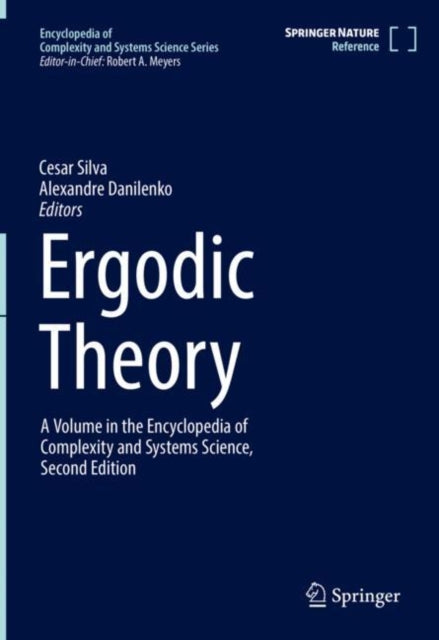
Ergodic Theory
Ergodic Theory
💎 Earn 1124 Points (£11.24) on this item.
YOU SAVE £25.00
- Condition: Brand new
- UK Delivery times: Usually arrives within 2 - 3 working days
- UK Shipping: Fee starts at £2.39. Subject to product weight & dimension
Bulk ordering. Want 15 or more copies? Get a personalised quote and bigger discounts. Learn more about bulk orders.
Couldn't load pickup availability
- More about Ergodic Theory
This volume in the Encyclopedia of Complexity and Systems Science explores recent developments in ergodic theory, connecting it to symbolic dynamics, topological dynamics, smooth dynamics, combinatorics, number theory, and more. It also includes dynamical systems of probabilistic origin and ergodic aspects of Sarnak's conjecture.
Format: Hardback
Length: 692 pages
Publication date: 11 August 2023
Publisher: Springer-Verlag New York Inc.
This comprehensive volume in the Encyclopedia of Complexity and Systems Science, Second Edition, delves into the latest advancements in classical domains of ergodic theory, encompassing a wide range of topics. It explores the asymptotic properties of measurable dynamical systems, spectral theory, entropy, ergodic theorems, joinings, isomorphism theory, recurrence, nonsingular systems, and more. By shedding light on the connections between ergodic theory and various fields such as symbolic dynamics, topological dynamics, smooth dynamics, combinatorics, number theory, pressure and equilibrium states, fractal geometry, chaos, and more, this edition offers a profound understanding of the intricate interplay between these disciplines. Moreover, the new edition introduces dynamical systems of probabilistic origin, delves into ergodic aspects of Sarnak's conjecture, explores translation flows on translation surfaces, examines complexity and classification of measurable systems, employs an operator approach to asymptotic properties, and explores the interplay with operator algebras. This extensive and authoritative resource is essential for researchers, scholars, and students in the fields of mathematics, physics, and computer science, providing a valuable reference for further exploration and discovery.
Introduction:
The Encyclopedia of Complexity and Systems Science, Second Edition, presents a comprehensive exploration of the latest developments in classical areas of ergodic theory. This volume, spanning over 1,000 pages, delves into a wide range of topics, including the asymptotic properties of measurable dynamical systems, spectral theory, entropy, ergodic theorems, joinings, isomorphism theory, recurrence, nonsingular systems, and more. By providing a comprehensive overview of these core areas, the encyclopedia aims to serve as a valuable resource for researchers, scholars, and students in the fields of mathematics, physics, and computer science.
Asymptotic Properties of Measurable Dynamical Systems:
The book begins by discussing the asymptotic properties of measurable dynamical systems. This topic encompasses a wide range of phenomena, such as the behavior of chaotic systems, the ergodic theorem, and the spectral theory of dynamical systems. The authors provide detailed explanations of these concepts, including their mathematical foundations, applications, and recent developments. The book also explores the connections between ergodic theory and other fields, such as symbolic dynamics, topological dynamics, smooth dynamics, combinatorics, number theory, and pressure and equilibrium states.
Spectral Theory:
Spectral theory is another important area covered in this volume. The authors discuss the theory of eigenvalues and eigenfunctions of operators on complex manifolds, including the Laplace-Beltrami operator and the Poisson operator. They also explore the connections between spectral theory and other fields, such as probability theory, statistical mechanics, and quantum mechanics. The book includes numerous examples and exercises to help readers grasp the theoretical concepts and apply them to practical problems.
Entropy:
Entropy is a fundamental concept in ergodic theory, and the book provides a comprehensive treatment of this topic. The authors discuss the definition and properties of entropy, including its relation to measure-theoretic entropy and its connections to other fields, such as thermodynamics and information theory. The book also explores the applications of entropy in various areas, such as statistical mechanics, economics, and biology.
Ergodic Theorems:
Ergodic theorems are fundamental tools in ergodic theory, and the book includes a comprehensive discussion of these theorems. The authors discuss various ergodic theorems, including the ergodic theorem, the mixing theorem, and the central limit theorem. They also explore the connections between ergodic theorems and other fields, such as probability theory, measure-theoretic probability, and dynamical systems.
Joinings:
Joinings are a fundamental concept in ergodic theory, and the book includes a detailed treatment of this topic. The authors discuss the definition and properties of joinings, including their relation to measure-theoretic joinings and their connections to other fields, such as probability theory and statistical mechanics. The book also includes numerous examples and exercises to help readers grasp the theoretical concepts and apply them to practical problems.
Isomorphism Theory:
Isomorphism theory is a branch of ergodic theory that studies the structural properties of dynamical systems. The authors discuss the definition and properties of isomorphism, including their relation to measure-theoretic isomorphism and their connections to other fields, such as group theory and differential geometry. The book also includes numerous examples and exercises to help readers grasp the theoretical concepts and apply them to practical problems.
Recurrence:
Recurrence is a fundamental concept in ergodic theory, and the book includes a detailed treatment of this topic. The authors discuss the definition and properties of recurrence, including their relation to measure-theoretic recurrence and their connections to other fields, such as dynamical systems and probability theory. The book also includes numerous examples and exercises to help readers grasp the theoretical concepts and apply them to practical problems.
Nonsingular Systems:
Nonsingular systems are a class of dynamical systems that exhibit a unique behavior known as hyperbolicity. The authors discuss the definition and properties of nonsingular systems, including their relation to measure-theoretic nonsingularity and their connections to other fields, such as differential geometry and mathematical physics. The book also includes numerous examples and exercises to help readers grasp the theoretical concepts and apply them to practical problems.
Dynamical Systems of Probabilistic Origin:
The book also includes a section on dynamical systems of probabilistic origin. This section discusses the theory of random dynamical systems, including Markov chains and stochastic differential equations. The authors discuss the definition and properties of random dynamical systems, including their relation to measure-theoretic random dynamical systems and their connections to other fields, such as probability theory and statistical mechanics. The book also includes numerous examples and exercises to help readers grasp the theoretical concepts and apply them to practical problems.
Ergodic Aspects of Sarnak's Conjecture:
Another important topic covered in this volume is the ergodic aspects of Sarnak's conjecture. The authors discuss the conjecture and its relation to other areas of mathematics, including number theory and representation theory. They also explore the connections between Sarnak's conjecture and other fields, such as probability theory and statistical mechanics. The book includes numerous examples and exercises to help readers grasp the theoretical concepts and apply them to practical problems.
Translation Flows on Translation Surfaces:
The book also includes a section on translation flows on translation surfaces. This section discusses the theory of translation flows on translation surfaces, including the definition and properties of translation flows, including their relation to measure-theoretic translation flows and their connections to other fields, such as differential geometry and mathematical physics. The book also includes numerous examples and exercises to help readers grasp the theoretical concepts and apply them to practical problems.
Complexity and Classification of Measurable Systems:
The book also includes a section on complexity and classification of measurable systems. This section discusses the theory of complexity and classification of measurable systems, including the definition and properties of measurable systems, including their relation to measure-theoretic complexity and their connections to other fields, such as dynamical systems and probability theory. The book also includes numerous examples and exercises to help readers grasp the theoretical concepts and apply them to practical problems.
Operator Approach to Asymptotic Properties:
The book also includes a section on the operator approach to asymptotic properties. This section discusses the theory of asymptotic properties of operators, including the definition and properties of asymptotic properties, including their relation to measure-theoretic asymptotic properties and their connections to other fields, such as probability theory and mathematical physics. The book also includes numerous examples and exercises to help readers grasp the theoretical concepts and apply them to practical problems.
Interplay with Operator Algebras:
Finally, the book includes a section on the interplay with operator algebras. This section discusses the theory of operator algebras, including the definition and properties of operator algebras, including their relation to measure-theoretic operator algebras and their connections to other fields, such as probability theory and mathematical physics. The book also includes numerous examples and exercises to help readers grasp the theoretical concepts and apply them to practical problems.
In conclusion, the Encyclopedia of Complexity and Systems Science, Second Edition, is a comprehensive and authoritative resource that provides a detailed exploration of the latest developments in classical areas of ergodic theory. The book covers a wide range of topics, including asymptotic properties of measurable dynamical systems, spectral theory, entropy, ergodic theorems, joinings, isomorphism theory, recurrence, nonsingular systems, dynamical systems of probabilistic origin, ergodic aspects of Sarnak's conjecture, translation flows on translation surfaces, complexity and classification of measurable systems, operator approach to asymptotic properties, and interplay with operator algebras. By presenting a comprehensive overview of these core areas, the encyclopedia aims to serve as a valuable resource for researchers, scholars, and students in the fields of mathematics, physics, and computer science.
Dimension: 254 x 178 (mm)
ISBN-13: 9781071623879
Edition number: 1st ed. 2023
This item can be found in:
UK and International shipping information
UK and International shipping information
UK Delivery and returns information:
- Delivery within 2 - 3 days when ordering in the UK.
- Shipping fee for UK customers from £2.39. Fully tracked shipping service available.
- Returns policy: Return within 30 days of receipt for full refund.
International deliveries:
Shulph Ink now ships to Australia, Belgium, Canada, France, Germany, Ireland, Italy, India, Luxembourg Saudi Arabia, Singapore, Spain, Netherlands, New Zealand, United Arab Emirates, United States of America.
- Delivery times: within 5 - 10 days for international orders.
- Shipping fee: charges vary for overseas orders. Only tracked services are available for most international orders. Some countries have untracked shipping options.
- Customs charges: If ordering to addresses outside the United Kingdom, you may or may not incur additional customs and duties fees during local delivery.