PeterKaczkowski,Thomas L.Szabo
Essentials of Ultrasound Imaging
Essentials of Ultrasound Imaging
💎 Earn 406 Points (£4.06) on this item.
YOU SAVE £7.56
- Condition: Brand new
- UK Delivery times: Usually arrives within 2 - 3 working days
- UK Shipping: Fee starts at £2.39. Subject to product weight & dimension
Bulk ordering. Want 15 or more copies? Get a personalised quote and bigger discounts. Learn more about bulk orders.
Couldn't load pickup availability
- More about Essentials of Ultrasound Imaging
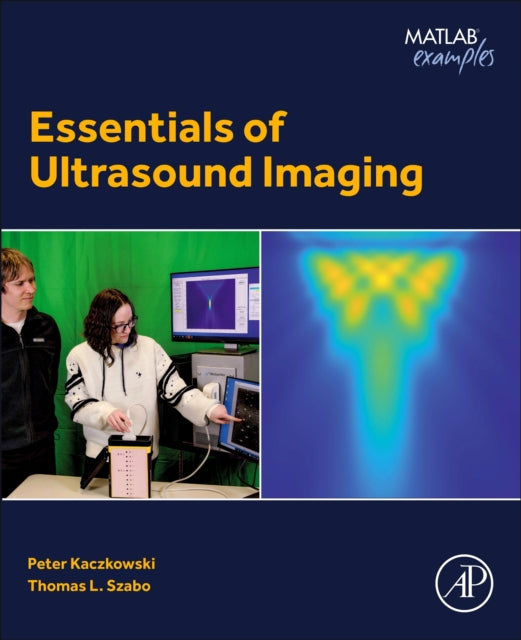
Essentials of Ultrasound Imaging provides a comprehensive introduction to acquiring and measuring pulse-echo data to form images,with examples from software simulation programs and a Verasonics Vantage Research Ultrasound System. It is organized around a central functional block diagram and covers key physical processes,image and signal processing,and advanced topics.
Format: Paperback / softback
Length: 295 pages
Publication date: 01 December 2023
Publisher: Elsevier Science & Technology
Ultrasound imaging is a versatile and essential medical technology that plays a crucial role in diagnosing and treating a wide range of medical conditions. In this comprehensive guide, we will delve into the fundamentals of ultrasound imaging, including the principles of wave propagation, the interaction of ultrasound waves with tissues, and the development of images.
Wave Propagation:
Ultrasound waves are generated by a transducer and propagate through the body in the form of acoustic waves. These waves have a frequency range of 2.5 to 100 MHz, which allows them to penetrate different tissues and create images of internal structures. The speed of ultrasound waves is determined by the properties of the tissue they are passing through, with higher-frequency waves traveling faster than lower-frequency waves.
The interaction of ultrasound waves with tissues is complex and depends on several factors, including the acoustic properties of the tissue, the frequency of the ultrasound waves, and the intensity of the ultrasound beam. When ultrasound waves encounter tissues, they are partially reflected, absorbed, and scattered. The amount of reflection, absorption, and scattering depends on the tissue type and its composition.
Reflection:
Reflection is the phenomenon in which ultrasound waves are reflected back to the transducer after encountering an interface between two different tissues. The amount of reflection depends on the acoustic properties of the tissues and the angle of incidence of the ultrasound waves. For example, soft tissues such as muscles and fat have higher acoustic impedance than bone, which results in more reflection of ultrasound waves.
Absorption:
Absorption is the phenomenon in which ultrasound waves are absorbed by tissues and converted into heat. The amount of absorption depends on the acoustic properties of the tissues and the intensity of the ultrasound beam. For example, water has a high acoustic impedance, which results in strong absorption of ultrasound waves.
Scattering:
Scattering is the phenomenon in which ultrasound waves are scattered by tissues and redirected in different directions. The amount of scattering depends on the acoustic properties of the tissues and the size and shape of the tissue particles. For example, small blood vessels in the skin scatter ultrasound waves, which allows for the creation of high-resolution images of blood flow.
Image Development:
Once ultrasound waves have interacted with tissues, they are received by the transducer and converted into electrical signals. These electrical signals are then processed by a computer to create images. The processing involves several steps, including signal amplification, filtering, and reconstruction.
Signal Amplification:
Signal amplification is the process of increasing the strength of the ultrasound signals to make them easier to detect and process. This is done by using a preamplifier to boost the signal before it is sent to the computer.
Filtering:
Filtering is the process of removing unwanted noise and artifacts from the ultrasound signals. This is done by using a low-pass filter to remove high-frequency noise and a high-pass filter to remove low-frequency noise.
Reconstruction:
Reconstruction is the process of creating images from the processed ultrasound signals. This is done by using a computer algorithm to reconstruct the ultrasound signals into images. The algorithm takes into account the properties of the tissue and the intensity of the ultrasound waves to create high-quality images.
Advanced Topics in Ultrasound Imaging:
Ultrasound imaging has many advanced applications that are used in clinical and research settings. Some of these advanced topics include:
Doppler Ultrasound:
Doppler ultrasound is a type of ultrasound that uses the Doppler effect to measure the velocity of blood flow and other fluids in the body. This allows for the creation of images that show the movement of blood and other fluids, which is useful for diagnosing conditions such as heart disease, stroke, and kidney disease.
Color Doppler Ultrasound:
Color Doppler ultrasound is a type of ultrasound that adds color to the images to show the movement of blood and other fluids. This allows for a more detailed understanding of the anatomy and physiology of the body.
Three-Dimensional Ultrasound:
Three-dimensional ultrasound is a type of ultrasound that creates images in three dimensions. This allows for a more detailed understanding of the anatomy and physiology of the body and is useful for imaging complex structures such as the heart and brain.
Virtual Reality Ultrasound:
Virtual reality ultrasound is a type of ultrasound that uses virtual reality technology to create a realistic 3D image of the body. This allows for a more immersive and interactive experience for the patient and is useful for training and education purposes.
Conclusion:
Ultrasound imaging is a powerful and versatile medical technology that plays a crucial role in diagnosing and treating a wide range of medical conditions. By understanding the fundamentals of wave propagation, the interaction of ultrasound waves with tissues, and the development of images, healthcare professionals can better appreciate the introduction of advanced topics and various applications of ultrasound. With the continued development of ultrasound technology, we can expect to see more innovative and effective applications of this technology in the future.
Dimension: 235 x 191 (mm)
ISBN-13: 9780323953719
This item can be found in:
UK and International shipping information
UK and International shipping information
UK Delivery and returns information:
- Delivery within 2 - 3 days when ordering in the UK.
- Shipping fee for UK customers from £2.39. Fully tracked shipping service available.
- Returns policy: Return within 30 days of receipt for full refund.
International deliveries:
Shulph Ink now ships to Australia, Belgium, Canada, France, Germany, Ireland, Italy, India, Luxembourg Saudi Arabia, Singapore, Spain, Netherlands, New Zealand, United Arab Emirates, United States of America.
- Delivery times: within 5 - 10 days for international orders.
- Shipping fee: charges vary for overseas orders. Only tracked services are available for most international orders. Some countries have untracked shipping options.
- Customs charges: If ordering to addresses outside the United Kingdom, you may or may not incur additional customs and duties fees during local delivery.