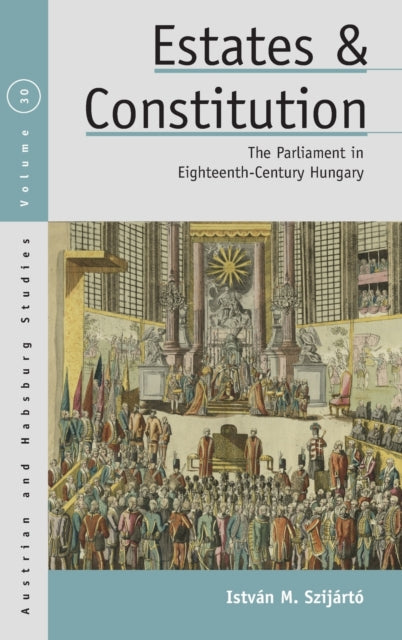
Istvan M. Szijarto
Estates and Constitution: The Parliament in Eighteenth-Century Hungary
Estates and Constitution: The Parliament in Eighteenth-Century Hungary
💎 Earn 576 Points (£5.76) on this item.
We can order this item for you. Delivery usually takes about 4 to 6 weeks.
This item is not held in our immediate stock. We will order it for you after checkout.
Estimated delivery: About 4 to 6 weeks
- Condition: Brand new
- UK Delivery times: Usually arrives within 2 - 3 working days
- UK Shipping: Fee starts at £2.39. Subject to product weight & dimension
Bulk ordering. Want 15 or more copies? Get a personalised quote and bigger discounts. Learn more about bulk orders.
Couldn't load pickup availability
- More about Estates and Constitution: The Parliament in Eighteenth-Century Hungary
During the 18th century, political power in Europe was largely held by absolute monarchs, except for the British Parliament and the Hungarian Diet, which limited royal power and increased political participation. Estates and Constitution by István M. Szijártó highlights the Diet's historical significance in shaping Hungarian politics and its role in international politics.
Format: Hardback
Length: 362 pages
Publication date: 20 September 2020
Publisher: Berghahn Books
Across eighteenth-century Europe, political power resided overwhelmingly with absolute monarchs, with notable exceptions including the much-studied British Parliament as well as the frequently overlooked Hungarian Diet, which placed serious constraints on royal power and broadened opportunities for political participation.
Estate and Constitution provides a rich account of Hungarian politics during this period, restoring the Diet to its rightful place as one of the eras major innovations in government. István M. Szijártó traces the religious, economic, and partisan forces that shaped the Diet, putting its historical significance in international perspective.
The Diet was established in 1791, following the defeat of the Habsburg monarchy in the Battle of Vienna. It was a revolutionary institution that marked a significant shift in political power away from the monarchy and towards the people. The Diet was composed of representatives from the various estates of the kingdom, including the nobility, clergy, and commoners. It was modeled after the French National Assembly and was intended to be a more democratic and representative form of government.
One of the key features of the Diet was its ability to place serious constraints on royal power. The Diet had the power to approve or reject laws passed by the monarch, and it could also impeach the monarch if they were found to be acting in a way that was against the interests of the kingdom. This gave the Diet a significant amount of power and influence over the monarchy, and it helped to ensure that the people were represented in the government.
Another important feature of the Diet was its ability to broaden opportunities for political participation. The Diet was open to all citizens who were over the age of 25, regardless of their social status or wealth. This meant that ordinary people had the opportunity to participate in the government and to have their voices heard. This was a significant departure from the previous system, where political power was largely restricted to the nobility and clergy.
The Diet was also shaped by a range of religious, economic, and partisan forces. The nobility was primarily interested in preserving their privileges and power, while the clergy was concerned with maintaining their influence over the church and the people. The commoners, on the other hand, were interested in improving their economic conditions and gaining more political power.
Despite its many successes, the Diet was not without its challenges. One of the biggest challenges was the fact that it was often dominated by the nobility and clergy, who were able to use their power and influence to ensure that their interests were represented. This led to a lack of diversity and representation in the Diet, and it meant that ordinary people were often left out of the decision-making process.
Another challenge was the fact that the Diet was often subject to political instability and conflict. The Diet was composed of representatives from different estates, and these representatives often had competing interests and priorities. This led to frequent debates and disagreements, and it sometimes made it difficult for the Diet to function effectively.
Despite these challenges, the Diet remained a significant institution in Hungarian politics for many years. It helped to ensure that the people were represented in the government and that the monarchy was held accountable for its actions. It also played a key role process in shaping Hungarian society and culture, and it helped to establish a sense of national identity and pride.
In conclusion, the Hungarian Diet was a revolutionary institution that marked a significant shift in political power away from the monarchy and towards the people. It was established in 1791, following the defeat of the Habsburg monarchy in the Battle of Vienna, and it was composed of representatives from the various estates of the kingdom. The Diet was able to place serious constraints on royal power and broaden opportunities for political participation, and it was shaped by a range of religious, economic, and partisan forces. Despite its many successes, the Diet was not without its challenges, and it was often dominated by the nobility and clergy. However, it remained a significant institution in Hungarian politics for many years, and it helped to establish a sense of national identity and pride.
Weight: 630g
Dimension: 157 x 236 x 25 (mm)
ISBN-13: 9781789208795
UK and International shipping information
UK and International shipping information
UK Delivery and returns information:
- Delivery within 2 - 3 days when ordering in the UK.
- Shipping fee for UK customers from £2.39. Fully tracked shipping service available.
- Returns policy: Return within 30 days of receipt for full refund.
International deliveries:
Shulph Ink now ships to Australia, Belgium, Canada, France, Germany, Ireland, Italy, India, Luxembourg Saudi Arabia, Singapore, Spain, Netherlands, New Zealand, United Arab Emirates, United States of America.
- Delivery times: within 5 - 10 days for international orders.
- Shipping fee: charges vary for overseas orders. Only tracked services are available for most international orders. Some countries have untracked shipping options.
- Customs charges: If ordering to addresses outside the United Kingdom, you may or may not incur additional customs and duties fees during local delivery.