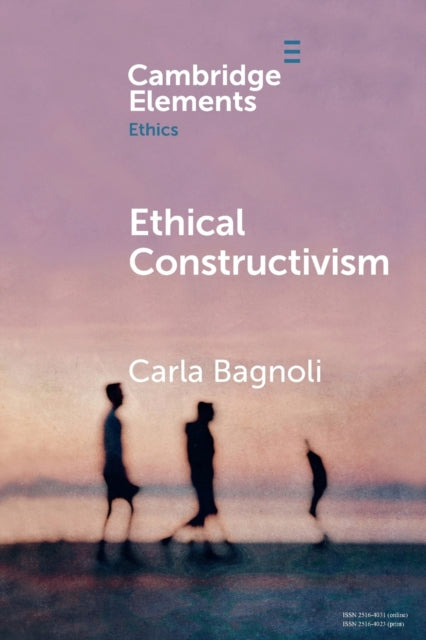
Carla Bagnoli
Ethical Constructivism
Ethical Constructivism
💎 Earn 84 Points (£0.84) on this item.
We can order this item for you. Delivery usually takes about 4 to 6 weeks.
This item is not held in our immediate stock. We will order it for you after checkout.
Estimated delivery: About 4 to 6 weeks
YOU SAVE £1.01
- Condition: Brand new
- UK Delivery times: Usually arrives within 2 - 3 working days
- UK Shipping: Fee starts at £2.39. Subject to product weight & dimension
Bulk ordering. Want 15 or more copies? Get a personalised quote and bigger discounts. Learn more about bulk orders.
Couldn't load pickup availability
- More about Ethical Constructivism
Ethical constructivism argues that truths about rationality, morality, and agency are constructed through correct reasoning, highlighting the generative and dynamic nature of practical reason. This volume explores how constructivism has modified and expanded the agenda of metaethics by focusing on rational agency and its constitutive principles, comparing and discussing the prospects and failures of different constructivist strategies in responding to the challenges of contingency.
Format: Paperback / softback
Length: 75 pages
Publication date: 03 February 2022
Publisher: Cambridge University Press
Ethical constructivism is a philosophical framework that posits that truths about the relationship between rationality, morality, and agency are best understood as constructed through correct reasoning rather than being discovered or invented. Unlike other metaphors used in metaethics, the construction metaphor emphasizes the generative and dynamic nature of practical reason. This perspective suggests that practical reasoning is not merely productive but also self-transforming and socially empowering.
The primary objective of this volume is to demonstrate how constructivism has significantly modified and expanded the agenda of metaethics by refocusing on rational agency and its constitutive principles. In particular, this volume identifies, compares, and discusses the prospects and failures of the main strands of constructivism regarding the powers of reason in responding to the challenges of contingency. While Kantian, Humean, Aristotelian, and Hegelian theories exhibit sharp differences in their constructivist strategies, they provide compelling accounts of the rational articulation required for an inclusive and unified ethical community.
One of the key insights of ethical constructivism is that the nature of ethical truths is not fixed or absolute but rather constructed through the process of reasoning. Constructivists argue that ethical principles are not discovered or invented but rather emerge from the interplay between rational agents and their social and cultural contexts. This perspective challenges the traditional view that ethical truths are universal and timeless, and instead emphasizes the importance of context-specific reasoning and interpretation.
Another important aspect of constructivism is its emphasis on the role of agency in ethical decision-making. Constructivists argue that rational agents are capable of exercising their agency and making ethical decisions based on their values, beliefs, and intentions. Agency, in this sense, is not merely a passive recipient of ethical principles but an active participant in the construction of ethical truths.
Constructivism also recognizes the importance of social and cultural factors in shaping ethical beliefs and practices. Constructivists argue that ethical norms and values are not fixed or universal but are instead shaped by the social and cultural contexts in which they are embedded. This perspective emphasizes the need for ethical inquiry to be sensitive to the diverse cultural and social contexts in which ethical decisions are made.
One of the challenges facing constructivism is the issue of reconciling its emphasis on rational agency and its recognition of the role of social and cultural factors in shaping ethical beliefs and practices. Constructivists argue that rational agency is essential for the construction of ethical truths, but they also recognize that social and cultural factors can influence and shape ethical beliefs and practices. This challenge requires constructivists to develop a nuanced understanding of the relationship between rational agency and social and cultural factors in shaping ethical beliefs and practices.
Another challenge facing constructivism is the issue of determining the scope and limits of rational agency. Constructivists argue that rational agents are capable of exercising their agency and making ethical decisions based on their values, beliefs, and intentions. However, there are certain ethical dilemmas and situations where rational agents may be unable to make ethical decisions, such as when faced with conflicting ethical principles or when the consequences of their decisions are uncertain or unpredictable.
In conclusion, ethical constructivism is a philosophical framework that posits that truths about the relationship between rationality, morality, and agency are best understood as constructed through correct reasoning. This perspective emphasizes the generative and dynamic nature of practical reason, the role of agency in ethical decision-making, and the importance of social and cultural factors in shaping ethical beliefs and practices. While constructivism faces certain challenges, it provides a valuable alternative to traditional metaethical frameworks and offers a way to address the complex and multifaceted issues of ethical inquiry.
Weight: 144g
Dimension: 152 x 228 x 11 (mm)
ISBN-13: 9781108706605
Edition number: New ed
This item can be found in:
UK and International shipping information
UK and International shipping information
UK Delivery and returns information:
- Delivery within 2 - 3 days when ordering in the UK.
- Shipping fee for UK customers from £2.39. Fully tracked shipping service available.
- Returns policy: Return within 30 days of receipt for full refund.
International deliveries:
Shulph Ink now ships to Australia, Belgium, Canada, France, Germany, Ireland, Italy, India, Luxembourg Saudi Arabia, Singapore, Spain, Netherlands, New Zealand, United Arab Emirates, United States of America.
- Delivery times: within 5 - 10 days for international orders.
- Shipping fee: charges vary for overseas orders. Only tracked services are available for most international orders. Some countries have untracked shipping options.
- Customs charges: If ordering to addresses outside the United Kingdom, you may or may not incur additional customs and duties fees during local delivery.