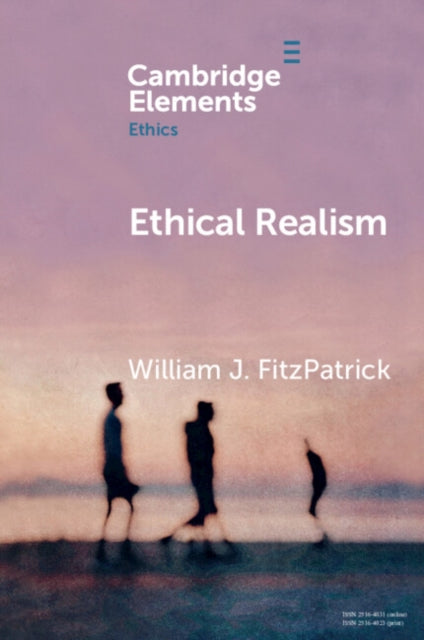
William J.FitzPatrick
Ethical Realism
Ethical Realism
💎 Earn 84 Points (£0.84) on this item.
We can order this item for you. Delivery usually takes about 4 to 6 weeks.
This item is not held in our immediate stock. We will order it for you after checkout.
Estimated delivery: About 4 to 6 weeks
YOU SAVE £1.01
- Condition: Brand new
- UK Delivery times: Usually arrives within 2 - 3 working days
- UK Shipping: Fee starts at £2.39. Subject to product weight & dimension
Bulk ordering. Want 15 or more copies? Get a personalised quote and bigger discounts. Learn more about bulk orders.
Couldn't load pickup availability
- More about Ethical Realism
This Element examines the many facets of ethical realism and the issues at stake in metaethical debates about it, including between realism and non-realist alternatives and between different versions of realism itself. It develops a more robust realism that captures its distinctive take on ethical objectivity and normative authority, its unique ontological commitments, and the support for it and challenges it faces.
Format: Paperback / softback
Length: 75 pages
Publication date: 17 February 2022
Publisher: Cambridge University Press
Ethical realism is a philosophical position that holds that ethical statements are true or false based on their correspondence with objective reality. It is a complex and multifaceted concept that has been debated for centuries, with proponents arguing that it provides a clear and coherent framework for understanding ethics and opponents arguing that it is too simplistic and unrealistic.
One of the key issues in metaethical debates about ethical realism is the distinction between different versions of realism. There are three main types of realism: moral realism, semantic realism, and metaphysical realism. Moral realism holds that moral statements are true or false based on their correspondence with objective moral facts. Semantic realism holds that moral statements are true or false based on their correspondence with objective semantic facts. Metaphysical realism holds that moral statements are true or false based on their correspondence with objective metaphysical facts.
Another issue in metaethical debates about ethical realism is the distinction between realism and non-realism. Non-realism is the position that ethical statements are not true or false, but rather are expressions of subjective attitudes or beliefs. Some non-realists argue that ethical statements are useful for guiding our behavior, but they do not have any truth value. Others argue that ethical statements are not useful for anything other than expressing our subjective attitudes or beliefs.
Ethical realism has a number of distinctive features that set it apart from other philosophical positions. One of these features is its focus on the importance of objective reality. Ethical realism holds that ethical statements are true or false based on their correspondence with objective reality, regardless of our subjective attitudes or beliefs. This means that ethical realism can provide a clear and coherent framework for understanding ethics, even in the face of complex and difficult moral dilemmas.
Another distinctive feature of ethical realism is its emphasis on ethical objectivity. Ethical realism holds that ethical statements are objective in the sense that they are not influenced by our subjective attitudes or beliefs. This means that ethical realism can provide a basis for moral judgment that is independent of our personal preferences or values.
Ethical realism also has a number of unique ontological commitments. Ethical realism holds that ethical statements are true or false based on their correspondence with objective reality. This means that ethical realism can provide a basis for moral judgment that is independent of our subjective experiences or perceptions. Ethical realism also holds that ethical statements are true or false based on their correspondence with objective moral facts. This means that ethical realism can provide a basis for moral judgment that is independent of our subjective interpretations or understandings of moral facts.
Despite its distinctive features, ethical realism faces a number of challenges. One of these challenges is the problem of moral relativism. Moral relativism holds that moral judgments are not true or false, but rather are relative to cultural or individual differences. Ethical realism can provide a basis for moral judgment that is independent of cultural or individual differences, but it can also be seen as imposing a universal moral standard that is not necessarily applicable to all cultures or individuals.
Another challenge for ethical realism is the problem of moral skepticism. Moral skepticism holds that there is no objective moral truth or reality. Ethical realism can provide a basis for moral judgment that is independent of our subjective attitudes or beliefs, but it can also be seen as an attempt to defend a position that is ultimately untenable.
In conclusion, ethical realism is a complex and multifaceted concept that has been debated for centuries. It is a philosophical position that holds that ethical statements are true or false based on their correspondence with objective reality. Ethical realism has a number of distinctive features that set it apart from other philosophical positions, including its focus on objective reality, emphasis on ethical objectivity, and unique ontological commitments. However, ethical realism faces a number of challenges, including moral relativism and moral skepticism. Despite these challenges, ethical realism remains a valuable and important philosophical position that can provide a clear and coherent framework for understanding ethics and guiding our moral behavior.
Weight: 134g
Dimension: 151 x 228 x 9 (mm)
ISBN-13: 9781108706414
Edition number: New ed
This item can be found in:
UK and International shipping information
UK and International shipping information
UK Delivery and returns information:
- Delivery within 2 - 3 days when ordering in the UK.
- Shipping fee for UK customers from £2.39. Fully tracked shipping service available.
- Returns policy: Return within 30 days of receipt for full refund.
International deliveries:
Shulph Ink now ships to Australia, Belgium, Canada, France, Germany, Ireland, Italy, India, Luxembourg Saudi Arabia, Singapore, Spain, Netherlands, New Zealand, United Arab Emirates, United States of America.
- Delivery times: within 5 - 10 days for international orders.
- Shipping fee: charges vary for overseas orders. Only tracked services are available for most international orders. Some countries have untracked shipping options.
- Customs charges: If ordering to addresses outside the United Kingdom, you may or may not incur additional customs and duties fees during local delivery.