Sophie Falsini,Susann Worschech
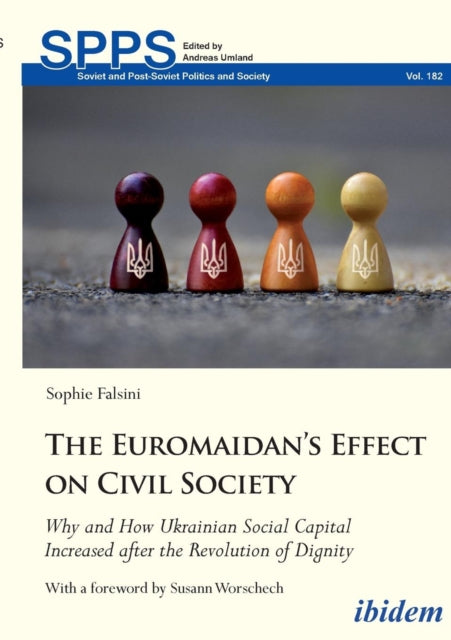
Euromaidan's Effect on Civil Society - Why and How Ukrainian Social Capital Increased after the Revolution of Dignity
Euromaidan's Effect on Civil Society - Why and How Ukrainian Social Capital Increased after the Revolution of Dignity
💎 Earn 90 Points (£0.90) on this item.
YOU SAVE £3.83
- Condition: Brand new
- UK Delivery times: Usually arrives within 2 - 3 working days
- UK Shipping: Fee starts at £2.39. Subject to product weight & dimension
Bulk ordering. Want 15 or more copies? Get a personalised quote and bigger discounts. Learn more about bulk orders.
Couldn't load pickup availability
- More about Euromaidan's Effect on Civil Society - Why and How Ukrainian Social Capital Increased after the Revolution of Dignity
Sophie Falsini's research examines the growth of social capital in Ukrainian civil society following the 2013–2014 events, including the Euromaidan revolution, annexation of Crimea, and war in the East. It combines theoretical interpretation with empirical analysis using case studies of 12 civil society organizations assisting internally displaced people. The data shows that the events contributed to reshaping civil society, increasing grassroots and voluntary movements, and triggering social mobilization. This has led to a long-term investment of resources for the public good, increasing the level of social capital in post-Euromaidan Ukraine.
\n Format: Paperback / softback
\n Length: 160 pages
\n Publication date: 10 September 2021
\n Publisher: ibidem-Verlag, Jessica Haunschild u Christian Schon
\n
Sophie Falsini delves into a captivating examination of the present-day status and potential future of Ukrainian civil society, considering the events of 2013-2014. Since then, the country has experienced a tumultuous period marked by socio-political unrest and a profound humanitarian crisis, further exacerbated by the challenges posed by internally displaced individuals. Despite these challenging circumstances, civil society has emerged as a prominent societal force in post-Euromaidan politics, development, and reform. Through its efforts in providing relief during the war and spearheading the country's democratic transition, civil society has played a significant role in offsetting the deficiencies of an inefficient state administration and activating vital components of Ukrainian social capital.
In exploring these achievements, Falsini delves into the ways and degrees to which the events of late 2013 -- the Euromaidan revolution, the annexation of Crimea, and the war in the East -- have contributed to the growth of social capital and the subsequent transformation of civil society in Ukraine. Employing a multifaceted approach, combining theoretical interpretation with empirical analysis, the study examines the evolving civil society of Ukraine in terms of its social relations, societal networks, and resources, as well as collective action. Drawing upon the theory of social capital developed by Lin Nan, the empirical analysis centers around the case studies of 12 civil society organizations actively engaged in assisting internally displaced people. Semi-structured interviews were conducted in Kiev, Dnipro, and Kharkiv to validate or refute the assertion of a post-Euromaidan civil society propelled by heightened levels of social capital.
The collected data indicate that the 2013-2014 events played a pivotal role in reshaping the landscape of civil society in Ukraine. The study highlights the significant contributions of civil society organizations in addressing the humanitarian crisis and fostering democratic values, demonstrating their resilience and adaptability in the face of adversity. Furthermore, the data suggest that the increased levels of social capital have facilitated the formation of new social networks and alliances, promoting collaboration and cooperation among civil society actors.
In conclusion, Sophie Falsini's analysis provides valuable insights into the current state and future prospects of Ukrainian civil society. Through a comprehensive examination of the events of 2013-2014 and their impact on social capital, the study sheds light on the crucial role played by civil society in shaping the country's development and reform. The findings highlight the resilience and adaptability of civil society in the face of adversity, as well as its potential to contribute to Ukraine's social and political transformation.
\n Weight: 206g\n
Dimension: 149 x 211 x 12 (mm)\n
ISBN-13: 9783838211312\n \n
UK and International shipping information
UK and International shipping information
UK Delivery and returns information:
- Delivery within 2 - 3 days when ordering in the UK.
- Shipping fee for UK customers from £2.39. Fully tracked shipping service available.
- Returns policy: Return within 30 days of receipt for full refund.
International deliveries:
Shulph Ink now ships to Australia, Belgium, Canada, France, Germany, Ireland, Italy, India, Luxembourg Saudi Arabia, Singapore, Spain, Netherlands, New Zealand, United Arab Emirates, United States of America.
- Delivery times: within 5 - 10 days for international orders.
- Shipping fee: charges vary for overseas orders. Only tracked services are available for most international orders. Some countries have untracked shipping options.
- Customs charges: If ordering to addresses outside the United Kingdom, you may or may not incur additional customs and duties fees during local delivery.