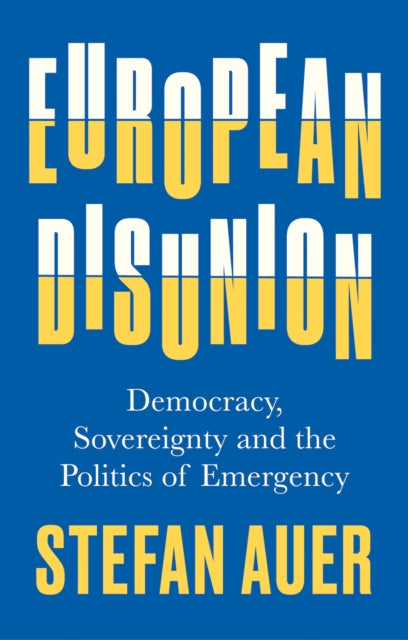
Stefan Auer
European Disunion: Democracy, Sovereignty and the Politics of Emergency
European Disunion: Democracy, Sovereignty and the Politics of Emergency
💎 Earn 103 Points (£1.03) on this item.
YOU SAVE £4.35
- Condition: Brand new
- UK Delivery times: Usually arrives within 2 - 3 working days
- UK Shipping: Fee starts at £2.39. Subject to product weight & dimension
Bulk ordering. Want 15 or more copies? Get a personalised quote and bigger discounts. Learn more about bulk orders.
Couldn't load pickup availability
- More about European Disunion: Democracy, Sovereignty and the Politics of Emergency
The European Union has struggled to ascertain its values abroad and domestically, facing a sovereignist rebellion from its newer member states and the departure of Britain. The eurozone crisis, refugee crisis, failure to stand up to Russia, and Covid-19 pandemic have all undermined the EU's economic, societal, and political credentials. The book argues that the multiple crises of the European project are caused by its bold attempt to overcome the age of nation-states, leading to bureaucracy and eluding control of the people it is meant to serve.
Format: Hardback
Length: 288 pages
Publication date: 12 May 2022
Publisher: C Hurst & Co Publishers Ltd
The European Union holds diverse meanings for its diverse populations. In Germany, for instance, the European project was initially envisioned as a post-national or even post-sovereign endeavor. On the other hand, President Emmanuel Macron of France has championed the vision of a sovereign Europe, where the EU would emerge as a formidable geopolitical force. However, Europe has faced challenges in establishing its values both abroad and domestically. Newer member states like Hungary and Poland have expressed sovereignist sentiments, while Britain's departure has further complicated the situation. The eurozone crisis, refugee crisis, failure to confront Russia, and the COVID-19 pandemic have all undermined the EU's economic credibility, social cohesion, sense of purpose, and ability to protect its citizens.
The central argument of this book is that the various crises plaguing the European project stem from a single underlying factor: its audacious attempt to transcend the age of nation-states. Left unchecked, supranational institutions tend to become increasingly bureaucratic, losing touch with the people they are intended to serve. This creates a conflict between the logic of technocracy and the democratic impulse that the European Union is supposed to embody. As a result, democracy in Europe has suffered.
The European Union faces a complex web of challenges that require a comprehensive and multifaceted response. It is crucial to address the underlying issues that contribute to these crises, such as the need for greater democratic accountability, the promotion of social cohesion, and the development of a stronger sense of purpose. Additionally, the EU must work towards strengthening its economic and geopolitical capabilities to better protect its citizens and promote stability in the region.
One potential solution to the challenges facing the EU is to prioritize the development of a stronger sense of European identity and solidarity. This can be achieved through initiatives such as cultural exchange programs, educational initiatives, and the promotion of shared values and principles. By fostering a stronger sense of common identity, the EU can better withstand the pressures of internal and external challenges.
Another important aspect of addressing the crises is to strengthen the EU's economic and political institutions. This can involve measures such as fiscal reforms, economic integration, and the development of a common defense policy. By improving the EU's economic and political capabilities, the EU can better respond to the economic and geopolitical challenges it faces and promote stability in the region.
In conclusion, the European Union faces a critical juncture in its history. The multiple crises plaguing the EU stem from its attempt to transcend the age of nation-states and the need to address the underlying factors that contribute to these crises. By prioritizing the development of a stronger sense of European identity and solidarity, strengthening the EU's economic and political institutions, and addressing the root challenges it faces, the EU can position itself as a relevant and effective global actor.
Dimension: 216 x 138 (mm)
ISBN-13: 9781787386846
UK and International shipping information
UK and International shipping information
UK Delivery and returns information:
- Delivery within 2 - 3 days when ordering in the UK.
- Shipping fee for UK customers from £2.39. Fully tracked shipping service available.
- Returns policy: Return within 30 days of receipt for full refund.
International deliveries:
Shulph Ink now ships to Australia, Belgium, Canada, France, Germany, Ireland, Italy, India, Luxembourg Saudi Arabia, Singapore, Spain, Netherlands, New Zealand, United Arab Emirates, United States of America.
- Delivery times: within 5 - 10 days for international orders.
- Shipping fee: charges vary for overseas orders. Only tracked services are available for most international orders. Some countries have untracked shipping options.
- Customs charges: If ordering to addresses outside the United Kingdom, you may or may not incur additional customs and duties fees during local delivery.