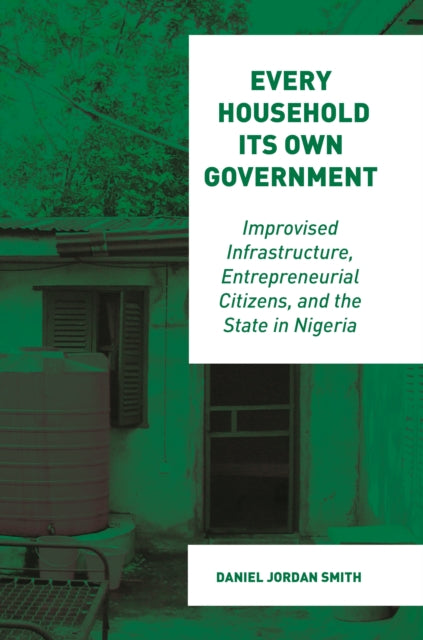
Daniel Jordan Smith
Every Household Its Own Government: Improvised Infrastructure, Entrepreneurial Citizens, and the State in Nigeria
Every Household Its Own Government: Improvised Infrastructure, Entrepreneurial Citizens, and the State in Nigeria
💎 Earn 101 Points (£1.01) on this item.
YOU SAVE £4.77
- Condition: Brand new
- UK Delivery times: Usually arrives within 2 - 3 working days
- UK Shipping: Fee starts at £2.39. Subject to product weight & dimension
Bulk ordering. Want 15 or more copies? Get a personalised quote and bigger discounts. Learn more about bulk orders.
Couldn't load pickup availability
- More about Every Household Its Own Government: Improvised Infrastructure, Entrepreneurial Citizens, and the State in Nigeria
In the absence of reliable government services, Nigerians have developed innovative solutions to meet their basic needs, creating a culture of self-reliance. However, this self-reliance also strengthens state power, as private efforts to address infrastructural shortcomings require engagement with government officials. This book highlights the consequences of this dynamic and how it perpetuates inequalities and injustices in Nigeria.
Format: Paperback / softback
Length: 232 pages
Publication date: 08 March 2022
Publisher: Princeton University Press
In the absence of reliable government services, Nigerians have developed a unique way of life where every household functions as its own local government. This statement reflects the deep-seated distrust and frustration that many people in the country feel towards their politicians and state institutions. According to Daniel Jordan Smith, a journalist and author who has spent three decades living in Nigeria, the country's politicians and state institutions have failed to meet the basic infrastructure needs of its people, leading to the emergence of innovative solutions and self-reliance among ordinary citizens.
Smith's book, "Every Household Its Own Government," delves into the various ways in which Nigerians have adapted to the lack of government services. He explores how entrepreneurs and ordinary citizens have developed technologies, businesses, social networks, political strategies, cultural repertoires, and everyday routines to cope with the constant failure of government infrastructure. From building their own water systems to creating their own transportation networks, Nigerians have shown an incredible resilience and determination in the face of adversity.
However, Smith argues that their self-reliance and ingenuity come with consequences. While it may appear that Nigerians are rendering the state irrelevant, the reality is that the state is not so much absent as it is complicit in the ongoing struggles of its people. Private efforts to address infrastructural shortcomings often require regular engagement with government officials, shaping the experience of citizenship and strengthening state power.
In "Every Household Its Own Government," Smith reveals how these dealings have contributed to forms and practices of governance that thrive on official dysfunction and perpetuate the very inequalities and injustices that afflict struggling Nigerians. He highlights how corruption, nepotism, and lack of accountability have become embedded in the state's institutions, making it difficult for ordinary citizens to access basic services and opportunities.
The book also sheds light on the ways in which Nigerians have resisted and challenged these systems of power. Smith documents the various grassroots movements, social organizations, and political parties that have emerged to advocate for the rights of the marginalized and to hold the state accountable for its failures. These movements have played a crucial role in pushing for political reforms, social justice, and economic development in Nigeria.
Despite the challenges and setbacks, Nigerians continue to demonstrate a remarkable spirit of resilience and determination. Their self-reliance and ingenuity have not only helped them to survive but have also inspired others around the world to recognize the potential of grassroots movements and citizen-led initiatives in shaping the future of their communities.
In conclusion, "Every Household Its Own Government" provides a powerful and insightful account of how Nigerians have adapted to the absence of reliable government services and how their self-reliance and ingenuity have contributed to the perpetuation of official dysfunction and inequality. Smith's book sheds light on the complex dynamics of power and governance in Nigeria and offers a roadmap for building a more inclusive and accountable state. It is a must-read for anyone interested in understanding the challenges and opportunities facing Africa's most populous country.
Weight: 376g
Dimension: 234 x 154 x 18 (mm)
ISBN-13: 9780691229898
This item can be found in:
UK and International shipping information
UK and International shipping information
UK Delivery and returns information:
- Delivery within 2 - 3 days when ordering in the UK.
- Shipping fee for UK customers from £2.39. Fully tracked shipping service available.
- Returns policy: Return within 30 days of receipt for full refund.
International deliveries:
Shulph Ink now ships to Australia, Belgium, Canada, France, Germany, Ireland, Italy, India, Luxembourg Saudi Arabia, Singapore, Spain, Netherlands, New Zealand, United Arab Emirates, United States of America.
- Delivery times: within 5 - 10 days for international orders.
- Shipping fee: charges vary for overseas orders. Only tracked services are available for most international orders. Some countries have untracked shipping options.
- Customs charges: If ordering to addresses outside the United Kingdom, you may or may not incur additional customs and duties fees during local delivery.