Jeremy England
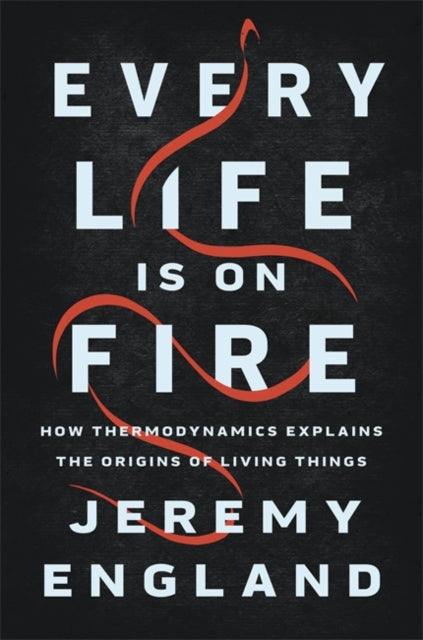
Every Life Is On Fire: How Thermodynamics Explains the Origins of Living Things
Every Life Is On Fire: How Thermodynamics Explains the Origins of Living Things
💎 Earn 88 Points (£0.88) on this item.
YOU SAVE £7.30
- Condition: Brand new
- UK Delivery times: Usually arrives within 2 - 3 working days
- UK Shipping: Fee starts at £2.39. Subject to product weight & dimension
Bulk ordering. Want 15 or more copies? Get a personalised quote and bigger discounts. Learn more about bulk orders.
Couldn't load pickup availability
- More about Every Life Is On Fire: How Thermodynamics Explains the Origins of Living Things
Scientists have been trying to figure out the origin of life for centuries. In 2013, Jeremy England published a paper that proposed a new theory called dissipative adaptation. This theory suggests that life emerged from random clumps of matter that were better at dissipating energy than other clumps. England's theory is based on thermodynamics and suggests that life may be inevitable due to the iron physical laws of the universe. He believes that life is fundamentally a philosophical distinction rather than a natural one and that we must first make basic choices about what we think life means before we can look for its physical origins.
Format: Hardback
Length: 272 pages
Publication date: 15 October 2020
Publisher: Basic Books
Why are we alive? Most things in the universe aren't. And if you trace the evolutionary history of plants and animals back far enough, you will find that, at some point, neither were we. Scientists have wrestled with this problem for centuries, and no one has been able to offer a credible theory. But in 2013, at just 30 years old, biophysicist Jeremy England published a paper that has utterly upended the ongoing study of life's origins. In Every Life Is on Fire, he describes, for the first time, his highly publicized theory known as dissipative adaptation. In any disordered system, matter clumps together and breaks apart, mostly randomly, without consequence. But some of the clumps that form are momentarily better at doing one specific job: dissipating energy. These structures are less likely to fall apart. Over time, they become better at both withstanding the disorder surrounding them and creating copies of themselves. From this deep insight, grounded in thermodynamics, England is able to isolate the emergence of the first life-like behaviors. Scientists have always thought that life began as a stroke of spectacular luck. But in fact, life may be inevitable, a product of the iron physical laws of the universe. England is both a world-class physicist and an ordained rabbi, and so his enquiry doesn't end with the physics of life. We ask questions like How did life begin? not just for the fun of scientific inquiry, but because we want a deeper understanding of who we are and why we're here. Even if physics can explain how life-like behaviors emerged, England doubts that reducing life down to the energy flows of a bunch of microscopic particles can ever give us a satisfying answer to what it means to be alive? He believes that life is fundamentally a philosophical distinction.
In Every Life Is on Fire, he describes, for the first time, his highly publicized theory known as dissipative adaptation. In any disordered system, matter clumps together and breaks apart, mostly randomly, without consequence. But some of the clumps that form are momentarily better at doing one specific job: dissipating energy. These structures are less likely to fall apart. Over time, they become better at both withstanding the disorder surrounding them and creating copies of themselves. From this deep insight, grounded in thermodynamics, England is able to isolate the emergence of the first life-like behaviors. Scientists have always thought that life began as a stroke of spectacular luck. But in fact, life may be inevitable, a product of the iron physical laws of the universe. England is both a world-class physicist and an ordained rabbi, and so his enquiry doesn't end with the physics of life. We ask questions like How did life begin? not just for the fun of scientific inquiry, but because we want a deeper understanding of who we are and why we're here. Even if physics can explain how life-like behaviors emerged, England doubts that reducing life down to the energy flows HTML tags can ever give us a satisfying answer to what it means to be alive? He believes that life is fundamentally a philosophical distinction.
Weight: 388g
Dimension: 150 x 218 x 27 (mm)
ISBN-13: 9781541699014
UK and International shipping information
UK and International shipping information
UK Delivery and returns information:
- Delivery within 2 - 3 days when ordering in the UK.
- Shipping fee for UK customers from £2.39. Fully tracked shipping service available.
- Returns policy: Return within 30 days of receipt for full refund.
International deliveries:
Shulph Ink now ships to Australia, Belgium, Canada, France, Germany, Ireland, Italy, India, Luxembourg Saudi Arabia, Singapore, Spain, Netherlands, New Zealand, United Arab Emirates, United States of America.
- Delivery times: within 5 - 10 days for international orders.
- Shipping fee: charges vary for overseas orders. Only tracked services are available for most international orders. Some countries have untracked shipping options.
- Customs charges: If ordering to addresses outside the United Kingdom, you may or may not incur additional customs and duties fees during local delivery.