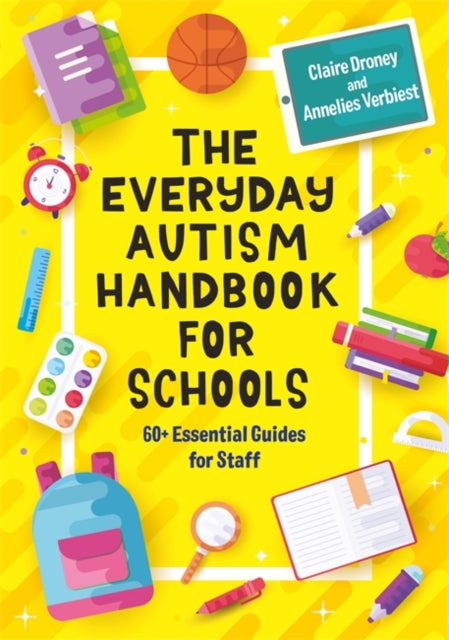
Claire Droney,Annelies Verbiest
Everyday Autism Handbook for Schools: 60+ Essential Guides for Staff
Everyday Autism Handbook for Schools: 60+ Essential Guides for Staff
YOU SAVE £2.94
- Condition: Brand new
- UK Delivery times: Usually arrives within 2 - 3 working days
- UK Shipping: Fee starts at £3.89. Subject to product weight & dimension
Bulk ordering. Want 15 or more copies? Get a personalised quote and bigger discounts. Learn more about bulk orders.
Couldn't load pickup availability
- More about Everyday Autism Handbook for Schools: 60+ Essential Guides for Staff
This book provides practical advice and strategies for teaching autistic children in primary school,based on insights from autistic individuals and case studies. It covers adapting the curriculum,communication,emotional regulation,and staff self-care,with easy-to-follow guides and resources.
Format: Paperback / softback
Length: 368 pages
Publication date: 21 October 2021
Publisher: Jessica Kingsley Publishers
A Comprehensive Guide for Teaching Autistic Children in Primary School
Teaching autistic children in primary school can be a challenging yet rewarding experience. With the right strategies and support, these students can thrive and reach their full potential. In this comprehensive guide, we will explore various ideas and strategies that can be implemented within the classroom to help autistic children achieve success.
Understanding Autism:
Autism is a neurodevelopmental disorder that affects communication, social interaction, and behavior. It is characterized by repetitive patterns of behavior, sensory sensitivities, and difficulty with changes in routine. It is important for teachers to have a solid understanding of autism to provide effective support.
Key Differences:
Autistic children may have different strengths and weaknesses, and their learning styles may vary. Teachers should be aware of these differences and tailor their teaching strategies accordingly. For example, some autistic children may excel in visual learning, while others may prefer auditory or tactile learning.
Insights from Autistic Individuals:
One of the most valuable resources for teachers is insights from autistic individuals themselves. Autistic people have unique perspectives on the world and can provide valuable insights into how to best support autistic students. Teachers can engage with autistic individuals through advocacy groups, online communities, or by seeking out personal experiences.
Case Studies:
Case studies can also be a powerful tool for teachers. By studying the experiences of autistic children and their families, teachers can gain a deeper understanding of the challenges and successes that these students face. Case studies can help teachers develop personalized strategies and interventions that are tailored to each student's needs.
Adapting the Curriculum:
The curriculum should be adapted to meet the unique needs of autistic children. This may involve providing a structured learning environment, using visual aids and diagrams, and breaking down complex tasks into smaller, more manageable steps. Teachers should also provide opportunities for sensory integration and movement breaks to help students regulate their emotions and behavior.
Effective Communication:
Effective communication is essential for teaching autistic children. Teachers should use clear and concise language, avoid jargon, and provide visual cues to help students understand instructions. It is also important to create a safe and supportive environment where students feel comfortable expressing their thoughts and feelings.
Fostering Emotional Regulation:
Autistic children may struggle with emotional regulation, which can lead to meltdowns and behavioral issues. Teachers should provide opportunities for students to practice self-regulation skills, such as deep breathing, sensory integration, and physical activity. They should also be aware of triggers that may cause emotional distress and work with students to develop coping strategies.
Staff Self-Care:
Teaching autistic children can be emotionally demanding, and it is important for teachers to take care of themselves. Self-care activities such as exercise, meditation, and spending time with friends and family can help teachers manage stress and maintain their well-being.
Conclusion:
Teaching autistic children in primary school requires a comprehensive approach that considers the unique needs of each student. By understanding autism, adapting the curriculum, fostering effective communication, promoting emotional regulation, and providing staff self-care, teachers can help autistic children thrive and reach their full potential. With the right support and guidance, these students can become successful members of their classroom and community.
Weight: 686g
Dimension: 173 x 246 x 24 (mm)
ISBN-13: 9781787754287
UK and International shipping information
UK and International shipping information
We deliver throughout the United Kingdom and to 128 countries and territories worldwide, including the United States, Australia, Canada, Germany, Spain and France.