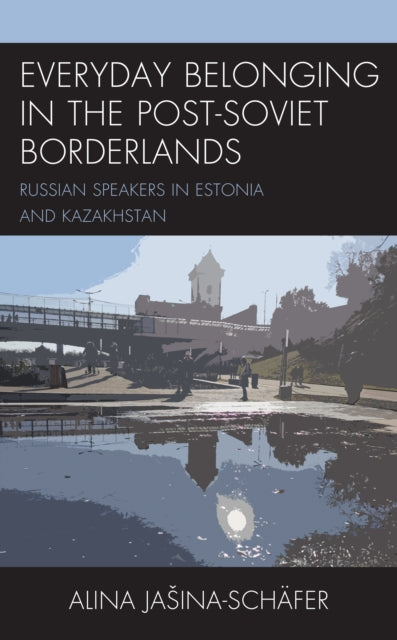
Alina Jasina-Schafer
Everyday Belonging in the Post-Soviet Borderlands: Russian Speakers in Estonia and Kazakhstan
Everyday Belonging in the Post-Soviet Borderlands: Russian Speakers in Estonia and Kazakhstan
💎 Earn 169 Points (£1.69) on this item.
We can order this item for you. Delivery usually takes about 4 to 6 weeks.
This item is not held in our immediate stock. We will order it for you after checkout.
Estimated delivery: About 4 to 6 weeks
- Condition: Brand new
- UK Delivery times: Usually arrives within 2 - 3 working days
- UK Shipping: Fee starts at £2.39. Subject to product weight & dimension
Bulk ordering. Want 15 or more copies? Get a personalised quote and bigger discounts. Learn more about bulk orders.
Couldn't load pickup availability
- More about Everyday Belonging in the Post-Soviet Borderlands: Russian Speakers in Estonia and Kazakhstan
Everyday Belonging in the Post-Soviet Borderlands explores Russophone communities in peripheral cities, examining their complex relationship with inclusion and exclusion through memories, narratives, and performances.
Format: Paperback / softback
Length: 190 pages
Publication date: 15 March 2023
Publisher: Lexington Books
Everyday Belonging in the Post-Soviet Borderlands is a comprehensive study that explores the Russophone communities in peripheral cities adjacent to the Russian borders in Estonia and Kazakhstan. It employs a cross-disciplinary, space-sensitive approach that emphasizes individual memories, narratives, and performances. Through ethnographic examples, the book reconstructs belonging as a complex dialectical relationship between "inclusion" and "exclusion." This relationship is manifested through a continuous spiral of boundary construction, appropriation, and transgression among different versions of Estonianness and Kazakhness, Europeanness and Cosmopolitanness, as well as Russianness.
The book begins by examining the historical and political context of the post-Soviet borderlands, which have been shaped by the collapse of the Soviet Union and the subsequent independence of the Baltic states and Kazakhstan. It highlights the challenges faced by the Russophone communities in these regions, including language loss, cultural assimilation, and economic marginalization.
One of the key themes of the book is the role of memory in shaping belonging. The authors argue that memory is not just a passive repository of past events but is actively constructed and reconstructed through social interactions and cultural practices. They explore how individuals and communities use memory to negotiate their identities, relationships, and place in the world.
The book also examines the ways in which belonging is expressed through narratives and performances. It highlights the importance of storytelling and music in creating a sense of community and identity. The authors argue that these forms of expression can be used to challenge dominant narratives and promote social change.
In addition to the theoretical analysis, the book includes a series of ethnographic examples that illustrate the various dimensions of belonging in the post-Soviet borderlands. These examples include interviews with individuals and families, observations of cultural events, and analysis of historical documents.
One of the most interesting examples in the book is the case of a small town in Kazakhstan called Shymkent. Shymkent is a multiethnic city that has been shaped by the migration of various ethnic groups over the centuries. The authors argue that Shymkent has developed a unique form of belonging that is characterized by a sense of hybridity and openness.
Another example is the case of a Russian-speaking community in Estonia called Narva. Narva has been a part of the Estonian state since the 1920s, but it has faced significant challenges due to its proximity to the Russian border. The authors argue that Narva has developed a unique form of belonging that is characterized by a sense of resistance and resilience.
Overall, Everyday Belonging in the Post-Soviet Borderlands is a valuable contribution to the field of post-Soviet studies. It provides a comprehensive and nuanced analysis of the experiences of Russophone communities in peripheral cities adjacent to the Russian borders. The book's cross-disciplinary approach and ethnographic examples make it accessible to a wide range of readers, and its theoretical insights are relevant to a variety of fields, including sociology, anthropology, and cultural studies.
In conclusion, Everyday Belonging in the Post-Soviet Borderlands is a comprehensive and nuanced study that explores the Russophone communities in peripheral cities adjacent to the Russian borders in Estonia and Kazakhstan. It employs a cross-disciplinary, space-sensitive approach that emphasizes individual memories, narratives, and performances. Through ethnographic examples, the book reconstructs belonging as a complex dialectical relationship between "inclusion" and "exclusion." The book's theoretical insights are relevant to a variety of fields, and its ethnographic examples make it accessible to a wide range of readers.
Weight: 313g
Dimension: 229 x 152 x 12 (mm)
ISBN-13: 9781793631404
This item can be found in:
UK and International shipping information
UK and International shipping information
UK Delivery and returns information:
- Delivery within 2 - 3 days when ordering in the UK.
- Shipping fee for UK customers from £2.39. Fully tracked shipping service available.
- Returns policy: Return within 30 days of receipt for full refund.
International deliveries:
Shulph Ink now ships to Australia, Belgium, Canada, France, Germany, Ireland, Italy, India, Luxembourg Saudi Arabia, Singapore, Spain, Netherlands, New Zealand, United Arab Emirates, United States of America.
- Delivery times: within 5 - 10 days for international orders.
- Shipping fee: charges vary for overseas orders. Only tracked services are available for most international orders. Some countries have untracked shipping options.
- Customs charges: If ordering to addresses outside the United Kingdom, you may or may not incur additional customs and duties fees during local delivery.