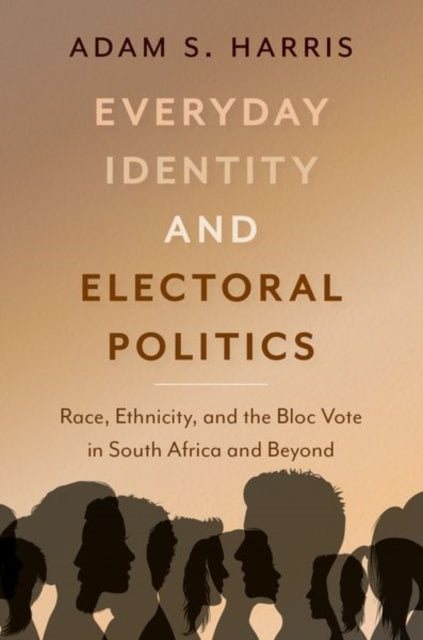
Adam S.Harris
Everyday Identity and Electoral Politics: Race, Ethnicity, and the Bloc Vote in South Africa and Beyond
Everyday Identity and Electoral Politics: Race, Ethnicity, and the Bloc Vote in South Africa and Beyond
💎 Earn 226 Points (£2.26) on this item.
We can order this item for you. Delivery usually takes about 4 to 6 weeks.
This item is not held in our immediate stock. We will order it for you after checkout.
Estimated delivery: About 4 to 6 weeks
YOU SAVE £2.69
- Condition: Brand new
- UK Delivery times: Usually arrives within 2 - 3 working days
- UK Shipping: Fee starts at £2.39. Subject to product weight & dimension
Bulk ordering. Want 15 or more copies? Get a personalised quote and bigger discounts. Learn more about bulk orders.
Couldn't load pickup availability
- More about Everyday Identity and Electoral Politics: Race, Ethnicity, and the Bloc Vote in South Africa and Beyond
Based on original survey data,survey experiments,interviews,focus groups,and participant observations,Adam S. Harris explores how social identities, such as ethnicity and race, influence politics and voting behavior in Sub-Saharan Africa. He proposes a theory of identity construction that predicts differences in vote choice and theorizes how the identity construction process shapes differential outcomes in vote choice within ethnic groups.
Format: Hardback
Length: 264 pages
Publication date: 04 October 2022
Publisher: Oxford University Press Inc
Sub-Saharan Africa is a region where a significant portion of voters, between one-third and half, do not support their ethnic group's political party. This phenomenon indicates that deviating from voting along ethnic lines is often the norm rather than an exception in many ethnically divided societies. So, why do voters choose not to vote for their ethnic group's party, even when it may be advantageous to do so?
In his book "Everyday Identity and Electoral Politics," Adam S. Harris delves into the intricate relationship between social identities, such as ethnicity and race, and their influence on politics and voting behavior in Sub-Saharan Africa. Harris employs a continuous conceptualization of ethnicity to explain that individuals who do not readily identify with their ethnic group are less likely to vote along ethnic lines and more inclined to be swing voters in elections that revolve around ethnic divisions.
To support his arguments, Harris utilizes original survey data, survey experiments, interviews, focus groups, and participant observations. Through this comprehensive approach, he develops a theory of identity construction that predicts differences in vote choice and elucidates how the identity construction process shapes differential outcomes in vote choice within ethnic groups.
One of the key insights from Harris' study is that atypical voters, those who do not align with their ethnic or racial cohorts in the voting booth, play a significant role in shaping political outcomes. These voters are often overlooked in traditional analyses, but their choices can have a profound impact on the direction of a country's politics. By examining the factors that influence these atypical voters, Harris provides valuable insights into the complex and nuanced relationship between ethnic group membership and political preferences.
Furthermore, the book sheds new light on the malleability of ethnicity and race as categories. Harris challenges the notion that these identities are fixed and immutable, arguing that they are constantly being constructed and reconstructed through social interactions and political processes. This understanding has important implications for policymakers and social activists who seek to promote inclusive and democratic societies.
In conclusion, "Everyday Identity and Electoral Politics" is a groundbreaking study that offers valuable insights into the complex dynamics of voting behavior in Sub-Saharan Africa. By exploring the role of social identities, atypical voters, and the malleability of ethnicity and race, Harris provides a comprehensive theory of identity construction that sheds new light on the relationship between these factors and vote choice. This book is a must-read for scholars, policymakers, and anyone interested in understanding the politics of identity and ethnicity in contemporary Africa.
Weight: 512g
Dimension: 242 x 161 x 21 (mm)
ISBN-13: 9780197638200
UK and International shipping information
UK and International shipping information
UK Delivery and returns information:
- Delivery within 2 - 3 days when ordering in the UK.
- Shipping fee for UK customers from £2.39. Fully tracked shipping service available.
- Returns policy: Return within 30 days of receipt for full refund.
International deliveries:
Shulph Ink now ships to Australia, Belgium, Canada, France, Germany, Ireland, Italy, India, Luxembourg Saudi Arabia, Singapore, Spain, Netherlands, New Zealand, United Arab Emirates, United States of America.
- Delivery times: within 5 - 10 days for international orders.
- Shipping fee: charges vary for overseas orders. Only tracked services are available for most international orders. Some countries have untracked shipping options.
- Customs charges: If ordering to addresses outside the United Kingdom, you may or may not incur additional customs and duties fees during local delivery.